[ View menu ]

August 20, 2013

Soda, pop, and coke

Filed in Books ,Gossip ,Ideas ,Research News
Subscribe to Decision Science News by Email (one email per week, easy unsubscribe)

REGIONAL AMERICAN ENGLISH

spcsite

When Decision Science News was in college, we used to volunteer at the Dictionary of American Regional English. We learned things like if you ask folks in the US:

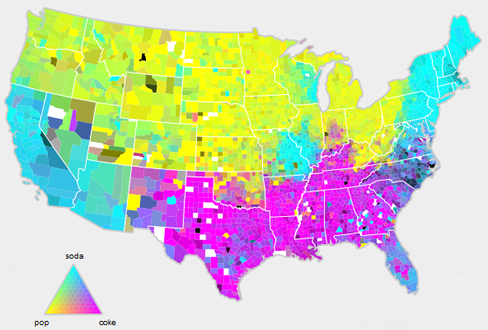
What generic word do you use to describe carbonated soft drinks? (Note that these could be of any brand or type, Coca-Cola, Pepsi, 7-Up, etc. We are concerned with the overall word, not a specific brand.) If you have changed the word you use at some point in your life, please enter the term you first used when you learned English.

… you get data that look like the above. People in the Midwest tend to say “pop”, people in the South tend to say “Coke” (even when they are not referring to a Coke ™), and everybody else tends to say “soda”. That image is from http://www.popvssoda.com. Fine.

Back when Decision Science News as a first year assistant professor at London Business School, we presented this chart to make a point about geographic differences. An American student said “That’s wrong. I’ve been all over and that’s just not true”. This made for an awkward teaching experience.

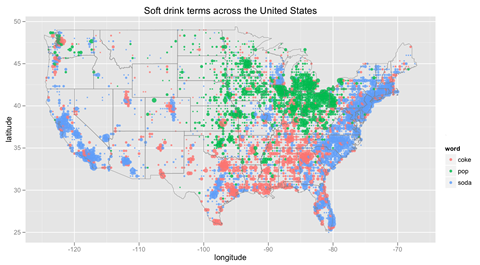
Years pass, Twitter is invented, and data scientist Edwin Chen decides to analyze Twitter tweets for soft drink terms. The result:

spc.sm

Same deal.

ADDENDUM

Linguist Bert Vaux (a friend of a friend) shared some valuable notes

“The best coke database is indeed Alan McConchie’s…The last time I checked, about 7-8 years ago, Alan already had more than 400,000 data points for coke/pop/soda.

The next best database for that and 121 other variables is my old Harvard survey from 2002-3, for which I collected data from about 50,000 Americans. I’ve mapped those and some of my other surveys using the Google maps engine here:

http://www.tekstlab.uio.no/cambridge_survey

You two have probably also come across Josh Katz’s recent mappings of my old Harvard data:

http://www4.ncsu.edu/~jakatz2/project-dialect.html

August 12, 2013

Good intentions don’t justify lying about risk

Filed in Books ,Ideas
Subscribe to Decision Science News by Email (one email per week, easy unsubscribe)

DO NOT LIE ABOUT RISK: PRESENT PROBABILITIES TRUTHFULLY OR NOT AT ALL

bag

On July 7th 2005, four bags containing bombs were left on London public transport. They exploded, killing 52 people. Bombs in two bags at the Boston Marathon this year killed three.

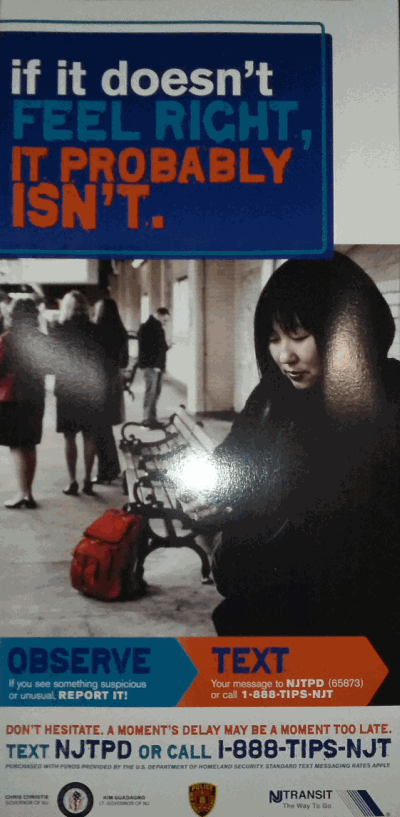
We can imagine the policy-maker’s thinking when they came up with this campaign. “If we had reports of all the suspicious bags, we’d be able to stop some of these bombs from going off. But when people see a left bag, they probably think it’s nothing, and so they don’t report it. So, let’s just lie. That way, they’ll be so scared that they’ll report every bag. We’ll stop some bombs. And that justifies the lying. Here how about this?”:

If it doesn’t feel right, it probably isn’t.

This reminds of of conversations we have had about mortgages. To prevent another meltdown, some policy-makers suggest exaggerating risks of foreclosure to scare people into choosing less expensive houses.

At Decision Science News, we are all for getting people to report suspicious packages, to choose safer mortgages, to exercise and eat well to safeguard their health, but we are dead set against mis-reporting probabilites to scare people into action.

Don’t say something will probably happen when it won’t.

Let’s look at London, in an example from Michael Blastland and David Spiegelhalter’s book The Norm Chronicles: Stories and Numbers About Danger

Since the London attacks, some 250,000 bags have been left on London Transport.

None have turned out to be bombs.

If we define a “present era” as eight years before and after 7/7, the probability of a left bag on London Transport being a bomb is something like 4 in 500,000 or 1 in 125,000. If we consider all the bags left in all the large metropolises of Europe and North America over a decade, we’re talking about microscopic chances.

No trying to be fresh here, but despite what the very well-intentioned New Jersey officials are saying above, which implies a greater than 50% probability of foul play, it’s more the case that:

If it doesn’t feel right, there’s a 0.000008 chance it isn’t.

Again, we’re all for reporting every suspicious bag. Perhaps 7/7 and Boston events could have been prevented. And we’re not saying that “Suspicious bags: Almost certainly safe” is how the poster should read. We’re just saying that there are many ways to bring about desirable behaviors that don’t involve fibbing. For example: Make it easier to report suspicious bags, provide an email address, appeal to reason, remind people of how awful it is when bombs to go off, emphasize how many things could have been prevented if everyone reported everything, and so on.

And we’re not against scaring people. Emotions drive decisions, and getting people to think about possible consequences can improve long-run decision making. But you can present truthful, graphic depictions of outcomes without lying about the probabilities of these outcomes. It’s the product of the probability and the outcome that counts.

To this, you might say “Oh, Decision Science News, don’t you realize that people are irrational, biased, myopic, self-serving, probability-neglecting innumerates who won’t do the right thing unless you make up stories to scare them?”. To this we say “No. First, assembling an ever-expanding list of so-called biases is not science. Science is proposing and testing models of the larger system that predicts when these effects appear, disappear, and invert. Second, the Santa Claus approach of lying to bring about good behavior is not only dishonest but self-defeating. People will quickly learn not to trust you and will ignore all your posters and warnings.”

Improved risk literacy will help people lead happier, healthier and safer lives. But for people to become risk literate, they need accurate risk estimates, not phony probabilities that cry wolf.

August 10, 2013

ACR 2013, October 3-6, Chicago, IL

Filed in Conferences
Subscribe to Decision Science News by Email (one email per week, easy unsubscribe)

ASSOCIATION FOR CONSUMER RESEARCH 2013 CONFERENCE

acr2013


What: ACR 2013 conference
Where: Hilton Palmer House Hotel, Chicago, IL (map)
When: October 3-6, 2013
Conference Co-chairs:

  • Simona Botti, London Business School
  • Aparna Labroo, University of Toronto

Registration

ACR 2013: Making a Difference

The theme of this conference is “Making a Difference,” which was inspired by the energy of Chicago, by its ability to change, adapt, and remain cutting edge in creative domains such as architecture, food, arts, and music. We hope that this conference will be an opportunity for consumer researchers from all over the world to discuss ways in which our ideas can make a difference to established theory and practice, as well as advance our understanding of consumers in the lab and in the field.

But Chicago is also a fun city. We want this conference to be a forum in which exciting thoughts, viewpoints, and findings are shared among people who have in common the same passion for rigorous, challenging, and cool consumer research.

Special Events (free with registration)
“Mediation, Contrasts, and LISREL” Workshop
“Design Your Studies with Qualtrics” Workshop
“How to Make a Good Consumer Research Video” Workshop
“New Reviewer Training Session” Workshop
“Advanced Reviewer Training Session” Workshop

Special Events (paid)
Saturday Night Party at House of Blues
Sunday Architectural Boat Tour
Sunday guided tour of the Art Institute of Chicago

August 3, 2013

BDRM 2014 July 17-19 at London Business School

Filed in Conferences
Subscribe to Decision Science News by Email (one email per week, easy unsubscribe)

BEHAVIORAL DECISION RESEARCH IN MANAGEMENT 2014

lbs

BDRM 2014 Website

Our LBS colleagues and Yuval write:

The Behavioral Decision Research in Management (BDRM) Conference will be held on July 17-19, 2014 at London Business School. Please watch your email for more information about the conference and the submission deadline after the summer. In the meantime, save the date and spread the word!

Also announcing “The Greater Good” pre-conference in partnership with the Journal of Marketing Research, which will focus on behavioral decision research that can contribute to understanding and fixing pressing social needs. The pre-conference will take place at London Business School on July 17, 2014. For questions about the pre-conference, contact Deborah Small (deborahs@wharton.upenn.edu) or Cynthia Cryder (cryder@wustl.edu).

Have a nice summer and hope to see you next year in London.

Simona Botti (Term Associate Professor of Marketing, London Business School)
David Faro (Associate Professor of Marketing, London Business School)
Yuval Rottenstreich (Professor of Management, Rady School of Management, U.C. San Diego)

Visit the BDRM 2014 Conference Website.

July 26, 2013

Dubai offers a gram of gold for every kilo of weight lost

Filed in Ideas
Subscribe to Decision Science News by Email (one email per week, easy unsubscribe)

AU YEAH: GOLDEN NUDGE

au

One of our colleagues at London Business School was speaking to a doctor from Dubai about the growing obesity problem in the UAE. The doctor felt his patients had a hard time noticing they were gaining weight because their long, loose-fitting traditional garments don’t give much feedback when weight is gained. No tightening waistline to clue you in.

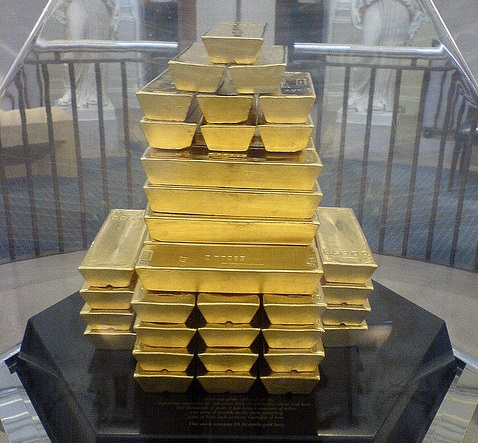
Whatever the cause, there seems to be a weight problem in Dubai and now the government has come up with a clever incentive: lose a kilogram of weight, get a gram of gold.

That’s about 20 bucks a pound (at current rates, for you American readers (13 quid for you Brits)), but what we like best about this nudge is that they’re not giving people 20 bucks. They’re giving gold, which is likely generating much more buzz.

Photo credit: http://www.flickr.com/photos/teflon/147695972/

July 15, 2013

U. S. Behavioral Insights Team

Filed in Ideas ,Jobs ,Research News
Subscribe to Decision Science News by Email (one email per week, easy unsubscribe)

A BEHAVIORAL INSIGHTS TEAM FOR THE STATES

whstp

We’ve posted before about the UK’s Behavioural Insights Team. Some recent good news is that a similar team has been approved for the United States government. What’s more: they’re hiring! The team is led by the impressive Maya U. Shankar, Senior Policy Advisor , who is a Ph.D. psychologist and Rhodes Scholar. We just chatted with Maya and feel that this team is poised to do great things.

With out further ado, the call:

Research to Results:
Strengthening Federal Capacity for Behavioral Insights

Overview:

A growing body of evidence suggests that insights from the social and behavioral sciences can be used to help design public policies that work better, cost less, and help people to achieve their goals. The practice of using behavioral insights to inform policy has seen success overseas. In 2010, UK Prime Minister David Cameron commissioned the Behavioural Insights Team (BIT, https://www.gov.uk/government/organisations/behavioural-insights-team), which through a process of rapid, iterative experimentation (“Test, Learn, Adapt”), has successfully identified and tested interventions that will further advance priorities of the British government, while saving the government at least £1 billion within the next five years (see previous Annual Reports 2010-11 and 2011-12). The federal government is currently creating a new team that will help build federal capacity to experiment with these approaches, and to scale behavioral interventions that have been rigorously evaluated, using, where possible, randomized controlled trials. The team will be staffed by 4-5 experts in behavioral science and experimental design and evaluation. It is likely that selected individuals will serve on a temporary detail under the Intergovernmental Personnel Act before returning to their home organization, which can be a university, non-profit, or state and local government. Our preference is for individuals who are willing to serve full time but we will also consider people who are only in a position to serve part-time. Moreover, several agencies are looking to recruit expert academics to sit directly within their agencies and to help inspire, design, and execute on specific policy projects, and so it is possible to serve in this capacity as well.

If you are aware of individuals with strong analytic skills, experience designing, testing, and evaluating rigorous randomized control trials, and a strong research background in fields such as social psychology, cognitive psychology, or behavioral economics, please encourage them send a CV and contact information to mshankar2@ostp.eop.gov, which will be sent to the relevant parties for consideration.

Job Responsibilities for Central Team:

* Build Capacity: Work with a broad range of federal agencies to identify new program areas that could benefit from the application of behavioral insights. Help to design, implement, and test the relevant interventions using rigorous experimental methods.

* Enhance Capacity: Provide conceptual and technical support to agencies with specific behavioral insights efforts already underway.

* Convene: Lead a multi-agency “community of practice” to identify and share promising practices and common challenges.

* Create and Provide Resources: Generate tutorials and other “how to” documents to help accelerate these efforts within agencies. Manage online library of relevant documents and media.

* Help inspire new ideas: Work with external partners to identify research findings that can inform policy and practice.

We are already working with over a dozen federal departments and agencies on newly-designed behavioral insights projects, including the Department of Labor, Department of Health and Human Services, Department of Education, Veterans Administration, Department of Treasury, Social Security Administration, Department of Housing and Urban Development, and the United States Department of Agriculture.

Below are some examples of U.S. and international policy initiatives that have benefited from the implementation of behavioral insights:

* Increasing college enrollment and retention: Providing streamlined personal assistance on the FAFSA form (e.g., pre-populating forms using tax return data and following up with a personal call) to low or moderate income individuals resulted in a 29% greater likelihood of their attending college for two consecutive years.

* Getting people back to work: Asking unemployed individuals to create a concrete plan for immediate implementation regarding how, when, and where they would pursue reemployment efforts led to a 15-20% decrease in their likelihood of claiming unemployment benefits just 13 weeks later.

* Improving academic performance: Students taught to view their intelligence as a “muscle” that can grow with hard work and perseverance (as compared to a “fixed trait”, such as eye-color) experienced academic boosts of a letter grade, with the largest effects often seen for low-performing students, students of color, or females in STEM-related courses.

* Increasing retirement savings: The Save More Tomorrow program 1) invites employees to pledge now to increase their savings rate later, since self-control is easier to exert for future events; 2) links planned increases in the savings rate to pay raises, in order to diminish loss aversion; and 3) leverages the power of inertia by keeping members enrolled until they reach a preset limit or elect to opt. Adoption of these auto-escalation plans has boosted annual savings by an estimated $7.4 billion.

* Increasing adoption of energy efficient measures: Offering an attic-clearance service (at full cost) to people led to a five-fold increase in their subsequent adoption of attic-insulation. Interestingly, providing additional government subsidies on attic insulation services had no such effect.

* Increasing tax compliance: Sending letters to late taxpayers that indicated a social norm –i.e., that “9 out of 10 people in Britain paid their taxes on time” – resulted in a 15 percentage point increase in response rates over a three-month period, rolling out to £30 million of extra annual revenue.

July 10, 2013

Numbers worth knowing: 142857

Filed in Encyclopedia ,Ideas
Subscribe to Decision Science News by Email (one email per week, easy unsubscribe)

ONE CRAZY NUMBER

enne

We at DSN thought it would be worth memorizing some reciprocals because we have a system for remembering numbers and because it might come in handy. So, we started writing out 1/x

1/2 = .5
1/3 = .3
1/4 = .25
1/5 = .2
1/6 = .16
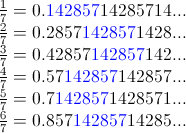
1/7 = .142857
1/8 = .125
1/9 = .1
1/10 = .1

Everything seems plain, predictable, ordinary, but what’s that going on at 1/7? .142857 repeating. That’s weird. Everywhere else it’s the first or second digit right of the decimal that repeats, but then at 1/7 you get 6 unique numbers that repeat as a weird group.

Are the multiples of this number weird? They’re even weirder.

1/7 = .142857
2/7 = .285714
3/7 = .428571
4/7 = .571428
5/7 = .714285
6/7 = .857142
See what’s going on there? They’re all just rotations of the same digits, 142857. Just pop digits off the left and stick them on the right to get any of the above.

Or as this blog shows it:

14

If we keep going, we run across
22/7 = 3.142857, which is of course, very nearly (within .0013 of) pi. Weird.

100/7 = 14.2857142857, which is handy b/c it comes up a lot.

Now, we were hooked. A bit of search engine magic showed us that 142857 is kind of famous. It has its own Wikipedia page.

And it has other kooky propreties:
142+857=999 and
.142+.857 = 1

What’s more, 142857 is a Harshad number, which means it is divisible by the sum of its digits:
142857/(1+4+2+8+5+7) = 5291

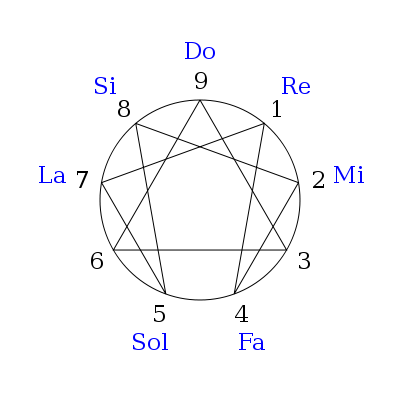
What’s surely not the last oddity, if you write the numbers 1 … 9 around a circle, put a triangle connecting 3, 6, and 9 and then connect 1, 4, 2, 8, 5 and 7, you get the New-Agey enneagram pictured above.

Photo credit: Wikipedia.

July 2, 2013

Which airline should you be loyal to?

Filed in Ideas ,R
Subscribe to Decision Science News by Email (one email per week, easy unsubscribe)

LOYALTY PROGRAM CHOICE BASED ON DEPARTURE COUNT

flights.alldest.sm.frompdf

If you read Decision Science News, you’re probably a professor or grad student or researcher or policy type who flies around a lot to conferences, symposia, workshops, tutorials, summer schools, and all-hands meetings. You travel the globe to give talks and work with co-authors. All this flying around is hard on you, but, you find it gets easier on you when you have status on the airlines you use through their frequent flier programs. Status allows you to choose your seat easily (which helps if you are tall), board early (which makes it easier to carry on luggage, which saves time), upgrade to business class (which helps you get work done), etc. You have found that being loyal to one airline pays off in terms of status.

But which airline should you choose to be loyal to? A simple rule would be to choose the airline that has the most departures from your home airport.

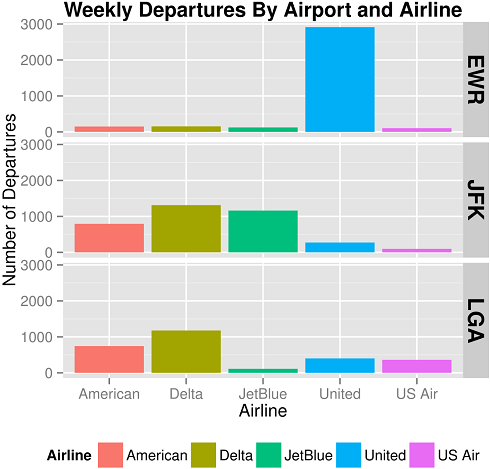
We figured this out for where we’re based: New York City. We scraped all the flights departing from NYC’s three airports (LGA=LaGuardia, JFK=John F Kennedy, EWR=Newark) for an entire week and looked at which airlines had the most departures. This was disappointing because a huge number of the flights listed were by regional airlines you never heard of like “ExpressJet” and “Chautauqua Airlines”(*). Codeshares. So, we scraped the web to figure out who these little airlines were actually flying for, the Deltas, Americans and Uniteds of the world.

The result is above. In short:

  • If you live in NJ, go with United
  • If you’re a LaGuardia/JFK flyer, go with Delta

This surprised us. We thought American had the most out of the New York airports. Once again, a little data analysis provides big insight.

What do you do if you discover you want to switch loyalties? We’ve heard (but not tried it) that you can get status on one airline with proof of status on another airline. We hear you need to fly a certain amount in 6 months or they revoke it.

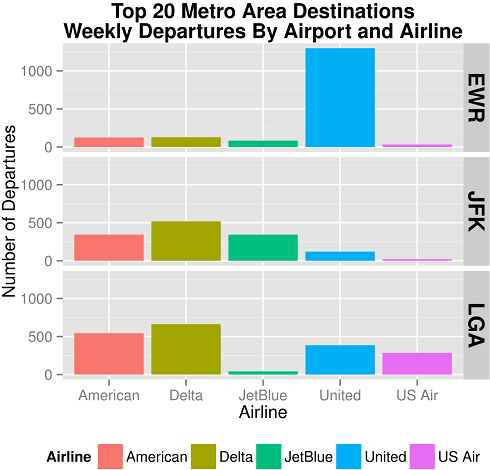
Now, suppose you don’t care about all destinations, but just places you are likely to fly. Well, we don’t know much about you in particular, DSN reader, but we might assume you tend to go where the people are. So, we redid the analysis restricting to the following airports, which fall within the major metropolitan areas of the US and Canada:

New York, NY
Newark, NJ
Los Angeles, CA
Long Beach, CA
Chicago, IL
Washington, DC
San Francisco, CA
Oakland, CA
San Jose, CA
Boston, MA
Philadelphia, PA
Dallas, TX
Miami, FL
Houston, TX
Atlanta, GA
Detroit, MI
Seattle, WA
Phoenix, AZ
Minneapolis, MN
Cleveland, OH
Denver, CO
San Diego, CA
Portland, OR
Orlando, FL
Saint Louis, MO
Tampa, FL
Pittsburgh, PA
Toronto, ON
Montreal, QC
Vancouver, BC

And here is that result:

flights.topmetro.sm.frompdf

Much the same.

As a side note, this was a lot of work after the kid went to bed. And it still isn’t perfect. Flight data are messy. Tools used (an incomplete list):

(*) Here are the raw results before merging the codeshare flights with the big airlines. EWR, JFK and LGA combined, only airlines with more than 200 departures per week:

AIRLINE            DEPARTURES / WEEK
United             1872
JetBlue Airways    1398
Delta Air Lines    1351
Atlantic Southeast 1234
American           842
ShuttleAmerica     711
American Eagle     662
Chautauqua         436
US Airways         421
Express Airlines   370
Southwest          266
Commutair          253
Republic Airlines  249
Compass Airlines   207

June 25, 2013

Heuristics for dodging Swiss customs

Filed in Articles ,Research News
Subscribe to Decision Science News by Email (one email per week, easy unsubscribe)

CUES CUSTOMS OFFICERS USE

cues

When leaving an international airport, you usually see many people walking straight through customs, but occasionally see a passenger whose suitcases are being searched by customs officers. How do the customs officers decide which people to stop? It must be a case of cue-based inference. This leads to two natural questions. What are the cues? How are they used?

By interviewing the chief customs officer at a major international airport, Thorsten Pachur and Gianmarco Marinello found out what the common cues are in a paper called Expert intuitions: How to model the decision strategies of airport customs officers?:

  • flight origin
  • gender
  • nationality
  • age
  • amount of luggage
  • eye contact with officer
  • clothing
  • speed of gait

Which cue values point in which direction? For smuggling drugs, the relationships go like this (positive values are more indicative of a drug smuggler).

tab1

Customs officers have beliefs about the predictiveness of these cues. The bar graph at the top shows how diagnostic officers felt each cue to be (on a scale where 1=not diagnostic and 100=highly diagnostic). As you can see experts and novices have different opinions about the validities of cues (e.g., experts know that eye contact tells you nothing, which is good news for me since I rarely make it, like, ever).

Now, you’re a customs officer. Here’s your task:

task

On analyzing many such decisions made by actual customs officers, Pachur and Marinello can predict which strategy people are using to decide:

  • WADD – Weighted additive (combine everything after giving each cue a weight)
  • EQW – Equal weight (combine everything but give every cue equal weight)
  • TTB – Take The Best (use Gigerenzer and Goldstein’s 1996 Take-The-Best heuristic)
  • Guess – Guess

As in many such studies, those who have done the task a lot (experts) drop into a lexicographic TTB strategy:


ttb

CITATION
Pachur, T., & Marinello, G. (2013). Expert intuitions: How to model the decision strategies of airport customs officers?. Acta Psychologica, 144, 97-103. doi:10.1016/j.actpsy.2013.05.003

ABSTRACT

How does expertise impact the selection of decision strategies? We asked airport customs officers and a novice control group to decide which passengers (describedon several cue dimensions) they would submit to a search. Additionally, participants estimated the validities of the different cues. Then we modeled the decisions using compensatory strategies, which integrate many cues, and a noncompensatory heuristic, which relies on one-reason decision making. The majority of the customs officers were best described by the noncompensatory heuristic, whereas the majority of the novices were best described by a compensatory strategy. We also found that the experts’ subjective cue validity estimates showed a higher dispersion across the cues and that differences in cue dispersion partially mediated differences in strategy use between experts and novices. Our results suggest that experts often rely on one-reason decision making and that expert–novice differences in strategy selection may reflect a response to the internal representation of the environment.

June 21, 2013

Subway riders’ quirks

Filed in Ideas ,Research News
Subscribe to Decision Science News by Email (one email per week, easy unsubscribe)

A TRAIN OF DECISIONS

sw

The New York Times reports on a report, written by the MTA, about the decisions of subway riders:

Now, the daily seating calculations of subway riders have been recorded for academic use, as part of an observational study conducted by researchers of the Metropolitan Transportation Authority. A draft of their report, published on the Web site of the Transportation Research Board, drew on data collected over three weeks in late winter 2012.

It’s full of gems, such as:

“Customers do change seats as seats become available due to passengers disembarking,” the report said, in language riders would be unlikely to use: “but seat-change maneuvers incur utility costs (movement effort, and risk of desired seat becoming occupied midmaneuver).”

When a subway car has more passengers than seats, the study found that an average of 10 percent or more of the seats were not taken. And even when a subway car is less than half-filled, the authors found that a small percentage of riders would inevitably choose to stand.

Riders prefer seats near a door, the authors said, and demonstrate “disdain for bench spots between two other seats.”

H/T @heratylaw
Photo credit:http://www.flickr.com/photos/chrisschoenbohm/8548316881