[ View menu ]

June 14, 2013

2013 guide to the American Marketing Association job market interviews for aspiring professors

Filed in Gossip ,Jobs
Subscribe to Decision Science News by Email (one email per week, easy unsubscribe)

EVERYTHING YOU EVER WANTED TO KNOW ABOUT THE AMA INTERVIEWS (2013 edition)

PhD students in Marketing, Psychology, and Economics should send their “packets” out by the fourth of July in the hopes of lining up interviews at the annual AMA Summer Educator’s Conference. Each year DSN reprints this sort of “what to expect while you’re applying” guide, first published here by Dan Goldstein in 2005. This year, Dave Hardisty and Abby Sussman have co-authored this guide with Dan to bring it up to date 2013. “I” will refer to Dan in what follows.

SHARE YOUR OWN AMA TIPS
I am more than happy to publish AMA tips, updated information, or just AMA horror stories as part of this post. You can reach me at dan at dangoldstein dot com and let me know if you want to be anonymous or nonymous.

WHY AM I WRITING THIS?
I have seen the Marketing job market turn happy grad students into quivering masses of fear. I want to share experiences and provide a bit of advice to make the whole process less mysterious.

WHY SHOULD ANYONE LISTEN TO ME?
Dan went on the AMA job market in the mid 2000s. Dave and Abby, who thoroughly revised this guide, went on in 2012. As a professor, Dan’s conducted a bunch of AMA interviews and been a part of dozens of hiring decisions. Together, we’ve been on the candidate end many AMA interviews, and experienced numerous campus visits, face-to-face interviews, offers, and rejections.

HOW TO GET INTO THE AMA JOB MARKET
First, at least a couple months before the conference, find where it will be. It’s called the American Marketing Association Summer Educator’s Conference. Strange name, we know. Insiders just call it “The AMA”. Get yourself a room in the conference hotel, preferably on the floor where the express elevator meets the local elevator for the upper floors. You’ll be hanging out on this floor waiting to change elevators anyway, so you might as well start there. Next, create a list of schools at which you would like a job. You can find the top 100 schools ranked by journal publications at: http://jindal.utdallas.edu/the-utd-top-100-business-school-research-rankings . Next, apply to each one you’d go to. In the past, this involved physically mailing application packets, but these days nearly everything is electronic. Some schools have online application portals, and others will take applications by email. How do you find out which one? Hopefully, the school you are applying to will have posted a job at ELMAR (see http://ama-academics.communityzero.com/elmar; and subscribe to their mailing list) or elsewhere, which will specify how to submit your application. Other times, you’ll need to get in touch with a department administrator to find out how to apply. It’s a good idea to apply to schools you like even if they say they aren’t hiring. Sometimes things change suddenly (a tenured faculty member unexpectedly moves to another school), and the only thing you risk is your time.

On this topic, one recent market participant wrote us saying: “Sometimes during an AMA interview the people you are interviewing with might tell you up front that they are not planning to hire someone in CB (consumer behavior) and that they are just interviewing you because they wanted to hear about your work (or, more generally, to get to know the star candidates on the market). This happened to me with at least one school, and it almost makes you NOT want to try seriously (i.e., to use that interview as a “break” from the more consequential interviews). However, I would strongly advise candidates to take all their interviews seriously, even with schools that claim not to be hiring CB candidates. First of all, the interview is an opportunity for schools to learn about candidates’ research and therefore an additional opportunity to invest in one’s reputation. But, more importantly, sometimes they end up changing their minds and giving you a fly-out anyway, despite what they initially said about not hiring CB candidates (this happened to me).”

http://www.marketingphdjobs.com/ has general information about the Marketing job market, including a job board showing who is advertising jobs. This site also has information about the times when jobs are announced. Different schools require different materials for the application, involving some combination of: cover letter, CV, teaching statement (and/or teaching evaluations), research statement, letters of recommendation (roughly three), your “job talk” paper, and one or two additional publications.

It’s useful to have your advisor (or if that’s not feasible, his/her assistant) send an e-mail with your materials directly to their colleagues at each of your top choice schools. Ideally you would have your letter writers e-mail their recommendations directly to your advisor so the information is aggregated. This will not take the place of applying through a school’s official online system, but will bring attention to your application before it arrives. This is also useful for schools that are slow to set up their official application, or who are uncertain about whether they’ll be hiring. Some candidates will send hard copies of these packets to all of the schools, although this practice seems to be dwindling.

Note that the CV for AMA takes a special format, including an extended abstract of your “job talk” paper, so you should find an example to model your CV after. It’s helpful if your letters of recommendation come from faculty in marketing. You need to demonstrate your commitment to the field of marketing, so it’s also ideal to have publications in marketing journals, or at least something under review at a marketing journal.

It’s invaluable to have an “application buddy” who is also on the job market. You can share notes about who is hiring, how to apply at each place, etc. It also just makes the whole process more fun, to have a friend along for the ride.

With the advent of electronic submissions, the “marginal cost” of additional submissions is extremely low, and schools are facing a flood of applications. Last year, the median number of applications sent by each candidate was 60, and this will probably increase next year. Each school can only interview a limited number of candidates at AMA (perhaps 20 or 30), so they need to be selective: they are not necessarily looking for the best candidates, but rather the best candidates that would accept an offer from their school (over and above offers from other schools). For this reason, “lower tier” schools will often not give interviews to “upper tier” candidates, because they believe that there is little chance the upper tier candidate would actually accept an offer from them. Therefore, you need to find a way to communicate why you are interested in that school in particular. The best way is if you have a contact at that school (or your advisor has a contact). You should let them know that their school is a high priority for you, and why. Another strategy is to get the word out that you are targeting a particular region (such as the west coast or midwest) or type of school (big city vs rural location, small vs large school, etc). Thus, even though your real priority is probably to get a job *anywhere*, it’s good to specialize a bit to give yourself a competitive advantage. Likewise, once you get an AMA interview or a fly-out, it’s good to have a host of reasons prepared to explain why you are excited about that school in particular. Keep in mind that information about your preferences that you tell to one school may get back to other schools as well. For that reason, it’s best to come up with unique reasons why you like each school that do not detract from your ability to credibly like others.

If you are submitting by email, it’s a good idea to follow up and confirm that they have all your application materials. Sometimes email applications get lost (this happened to a friend of ours at his top-choice school), and once the AMA interviews are scheduled, it may be too late.

As for deadlines: the rough deadline is July 4th, but there is a lot of variability. A few schools have earlier deadlines and will have scheduled all their interviews by the 4th, whereas other schools will be behind schedule and won’t even post a job opening until after the 4th. Within reason (beginning mid-June), there’s an advantage to submitting materials sooner rather than later. Ethan Pew adds “July 4 is still largely the target for sending out packets, however schools seem to be moving to more of a just-in-time process. [In 2011], 53 positions were announced between July 4 and AMA. There were also 24 positions announced the last week in June — and presumably those schools didn’t expect packets by July 4. In total, those 77 positions accounted for 40% of the jobs announced prior to AMA last year.”

THEN WHAT?
Wait to get calls or emails from schools wishing to set up AMA interviews with you. These calls may come in as late as one week before the conference. Often they come when you are sitting outside having a drink with friends. Some schools will not invite you for totally unknown reasons. You may get interviews from the top 10 schools and rejected from the 30th-ranked one. Don’t sweat it. Again, this is the land of total and absolute unpredictability that you’re entering into. Also, know that just because you get an interview doesn’t mean they have a job. Sometimes schools don’t know until the last minute if they’ll have funding for a post. Still, you’ll want to meet with them anyway. Other times, schools are quite certain they have two positions, but then later university politics shift and they turn out to have none.

When the schools call to set up an AMA interview, you will have some flexibility in scheduling. Should you put your top schools at the beginning of the weekend, the end, or somewhere in the middle? Common advice is to put your less preferred schools on the beginning of the first day, because this gives you a chance to practice before the “important” ones. Then you can put your top choice schools early (say 10am, not 8) on the second day of the conference, so you’ve had some time to practice, but you and the interviewers can still be fresh and energized. While it’s nice to schedule strategically, it’s very difficult since you have no idea which schools you’ll ultimately be hearing from, and calls come in over time. Don’t worry if it’s not possible to schedule everything perfectly- there’s no real magic to this. For example, the beginning of the weekend is also when interviewers will be freshest, and a primacy effect could help you: in fact, we know a candidate that put his top school first, and eventually got a job offer from them.

After the AMA, you’ll hopefully get “fly-outs,” that is, offers to come and visit the campus and give a talk. This means you’ve made the top five or so. Offers for fly-outs generally come within a week or two of AMA. Actual job offers start in late October, and the market has generally cleared by Thanksgiving. There’s a second job market that happens after all the schools realize they’ve made offers to the same person. Some schools over-correct for this and don’t make offers to amazing people who would have come. We need some kind of market mechanism to work out this part of the system.

THE “IT’S ALL ABOUT FRIENDSHIP” RULE
Keep in mind that you will leave this process with 1 or 0 jobs. Therefore, when talking to a person, the most likely thing is that he or she will not be your colleague in the future. You should then think of each opportunity as a chance to make a friend. You’ll need friends to collaborate, to get tenure, get grants, and to go on the market again if you’re not happy with what you get. It’s a good idea to send thank-you emails after AMA, to maintain contact, show your interest in the school, and express your appreciation. After all, the AMA interviewers have sacrificed their weekend to talk to you.

HOW DO YOU FIND OUT IN WHICH ROOM TO INTERVIEW?
The schools will send you e-mails either a few days in advance, or the night before telling you which room to go to. Many profs ask the hotel to make their room number public, but for some reason many hotel operators will still not give you the room number.

HOW TO TREAT YOURSELF WHILE THERE
My sponsor gave me the advice of not going out at night and getting room service for breakfast and dinner. This worked for me. Also, the ridiculously high price of a room-service breakfast made me feel like I was sparing no expense, which I found strangely motivating. However, as this guide has gotten more popular, many people are ordering room service breakfast, and there were reports at last year’s AMA that the hotel was overwhelmed with orders and breakfasts were delivered quite late as a result.

HOW DO THE ACTUAL AMA INTERVIEWS GO?
At the pre-arranged time you will knock on their hotel room door. You will be let into a suite (p=.4) or a normal hotel room (p=.5, but see below). In the latter case, there will be professors with long and illustrious titles—people you once imagined as dignified—sitting on beds in their socks. The other people in the room may not look at you when you walk in because they will be looking for a precious few seconds at your CV. For at least some people in the room, this may be the first time they have concentrated on your CV. Yikes is right. Put the important stuff early in your CV so nobody can miss it. You can expect anywhere between one and nine faculty members to show up usually it will be between three to five. Some of them may take cell phone calls in the middle of your interview. Don’t take It personally.

THE SEAT OF HONOR
There will be one armchair in the room. Someone will motion towards the armchair, smile, and say, “You get the seat of honor!” This will happen at every school, at every interview, for three days. I promise.

THE TIME COURSE
Allow extra time to get to your interview: all the candidates are traveling from one room to another at the same time, and the elevators can get pretty backed up. When you arrive, there will be two minutes of pleasant chit-chat. They will propose that you talk first and they talk next. There will be a little table next to the chair on which you will put your flip book of slides. You will present for 30 minutes, taking their questions as they come. Usually 20 minutes of scripted material will take you through the full time since you’ll be interrupted the whole way through. But you should be prepared to talk for up to 35-40 minutes for quiet groups, or sessions where only one faculty member shows up. They will be very nice. When done, they will ask you if you have anything to ask them. You of course do not. You hate this question. You make something up. Don’t worry, they too have a spiel, and all you need to do is find a way to get them started on it. By the time they are done, it’s time for you to leave. The whole experience will feel like it went rather well.

PREDICTING IF YOU WILL GET A FLY-OUT
It’s impossible to tell from how it seems to have gone whether they will give you a fly-out or not. Again, this is the land of staggering and high-impact uncertainty. They might not invite you because you were too bad (and they don’t want you), or because you were too good (and they think they don’t stand a chance of getting you and they don’t want to waste a precious fly-out on you). The latter fact means that “playing hard to get” is a bad idea. Interviewers will be friendly because everyone wants you to like their school, regardless of whether or not they will invite you for a fly-out.

DO INTERVIEWS DEVIATE FROM THAT MODEL?
Yes.
Sometimes instead of a hotel room, they will have a private meeting room (p=.075). Sometimes they will have a private meeting room with fruit, coffee, and bottled water (p=.025). Sometimes, they will fall asleep while you are speaking (p=.05). Sometimes they will be rude to you (p=.025). Sometimes a key person will miss an early interview due to a hangover (p=.025). Sometimes, if it’s the end of the day, they will offer you alcohol (p=.18, conditional on it being the end of the day).

HOW YOU THINK THE PROCESS WORKS
The committee has read your CV and cover letter and looked at your pubs. They know your topic and can instantly appreciate that what you are doing is important. They know the value of each journal you have published in and each prize you’ve won. They know your advisor and the strengths she or he instills into each student. They ignore what they’re supposed to ignore and assume everything they’re supposed to assume. They’ll attach a very small weight to the interview and fly you out based on your record, which is the right thing to do according to a mountain of research on interviews.

HOW THE PROCESS REALLY WORKS
The interviewers will have looked at your CV for about one minute a couple months ago, and for a few seconds as you walked in the room. They will never have read your entire cover letter, and they will have forgotten most of what they did read. They could care less about your advisor and will get quite annoyed that you didn’t cite their advisor. They’ll pay attention to everything they’re supposed to ignore and assume nothing except what you repeat five times. Flouting 50 years of research in judgment and decision-making, they’ll attach a small weight to your CV and fly you out based on the interview and their gut feeling.

IF ENGLISH IS NOT YOUR MOTHER TONGUE
Your ability to speak English well won’t get you a good job, but your inability to do so will eliminate you from consideration at every top school. Understand that business schools put a premium on teaching. If the interviewers don’t think you can communicate in the classroom, they’re probably not going to take a chance on you. If you are just starting out and your spoken English is shaky, my advice is to work on it as hard as you are working on anything else. Hire a dialect coach (expensive) or an english-speaking actor or improviser (cheaper) to work with you on your English pronunciation. In the Internet age, it’s quite easy to download samples of English conversational speech, for instance from podcasts, for free. It’s also very easy to get a cheap headset and a free audio recorder (like Audacity) with which to practice.

TWO WAYS TO GIVE YOUR SPIEL
1) The plow. You start at the first slide and go through them until the last slide. Stop when interrupted and get back on track.
2) The volley. Keep the slides closed and just talk with the people about your topic. Get them to converse with you, to ask you questions, to ask for clarifications. When you need to show them something, open up the presentation and show them just that slide.
I did the plow the first year and the volley the second year. I got four times more fly-outs the second year. Econometricians are working hard to determine if there was causality. I would not attempt the volley unless you are generally considered to be good with words.
A middle ground is to have a shorter presentation prepared, with many backup slides that you can turn to in response to audience interest or specific questions. This helps the audience understand that you’ve thought about the project deeply, that your responsive to their specific interests and feedback, and that there’s more to support your argument than the prearranged script, but it’s easier for some to execute than a straight volley.
What do you use to show your slides? Many candidates print out slides and put them into a presentation binder, such as one of these: http://tinyurl.com/c46ob64 . Insert two copies of each slide into the binder so you can see a copy from the back, and the audience can see another from the front. Hand-outs are also a good idea, as a supplement to your slides. Bring lots of hand-outs, because it’s common to let them keep one copy. Keep in mind that AMA slides are not the same as a typical PowerPoint presentation. People should be able to read your slides from the back of the room. I recommend no smaller than size 40 font, and larger is better.

Lately, people have talked about showing slides on an iPad, but I don’t know anyone that has actually done this.

HOW TO ACT
Make no mistake, you are an actor auditioning for a part. There will be no energy in the room when you arrive. You have to be like Santa Claus bringing in a large sack of energy. The interviewers will be tired. They’ve been listening to people in a stuffy hotel room from dawn till dusk for days. If you do an average job, you lose: You have to be two standard deviations above the mean to get a fly-out. So audition for the part, and make yourself stand out. If you want to learn how actors audition, read Audition by Michael Shurtleff.

SOCIAL SKILLS MATTER
From the candidate’s point of view, everything is about the CV and the correctness of the mathematical proofs in the job market paper. However, for better or for worse, extra-academic qualities matter. Here are two examples. 1) The Social Lubricant factor. Departments get visitors all the time: guest speakers, visiting professors, job candidates, etc. Some departments are a bunch of folks who stare at their shoes when introduced to a new person. These departments have a real problem: they have nobody on board who can make visitors feel at ease, and sooner or later word starts to spread about how socially awkward the people at University X are. To fix such problems, departments sometimes hire socially-skilled types who know how to make people comfortable in conversation, and who know how to ask good questions during talks. Also, interviewers assume that people who can talk a good game will be star teachers. 2) The Soft Sell factor. Many people succeed in academia not because they are often right, but also because they are masters of making other people feel like they aren’t wrong. Defensiveness or determination to embarrass when responding to critique is an effective way to blow an interview.

HAVE A QUIRK
One of the biggest risks facing you is that you will be forgotten. Make sure the interviewers know something unusual about you. My quirk is that I worked internationally as an actor and theater director for over a decade; I even had a bit part in a Conan O’Brien sketch on TV. It has nothing to do my research, but people always bring up this odd little fact when I do campus visits. Some bits of trivia are just more memorable than others.

DON’T GIVE UP
Never think it’s hopeless. Just because you’re not two SDs above the mean at the school of your dreams, it does not mean you’re not the dream candidate of another perfectly good school.
Many candidates don’t realize the following: The students are competing for schools but the schools are also competing for students. If you strike out, you can just try again next year. I know a person in Psychology who got 70 rejections in one year. I know a person in Marketing who was told he didn’t place in the top 60 candidates at the 20th ranked school. The subsequent year, both people got hired by top 5 departments. One of them is ridiculously famous and considered among the smartest people in Marketing!

RUMORS
Gossip can mess with your chances. Gossip that you are doing well can hurt you because schools will be afraid to invite you if they think you won’t come. Gossip that you are doing poorly can hurt you because schools that like you will be afraid to invite you if they think no one else does. Sometimes people will ask a prof at your school if you would come to their school, and the prof will then ask you. To heck with that. Just say that if they want to talk to you, they should talk with you directly.

The danger of rumors can be summed up by the following story. At ACR in 2003, I was having a beer with someone who confessed, “you know, my friend X at school Y told me that they want to hire you, but they’re afraid your wife won’t move to Z”. I was single.

June 8, 2013

Kurzban: Are All Dictator Game Results Artifacts?

Filed in Research News
Subscribe to Decision Science News by Email (one email per week, easy unsubscribe)
DARN THAT IS INTERESTING

wm

Rob Kurzban has an interesting write up of this article on the dictator game here.

ABSTRACT

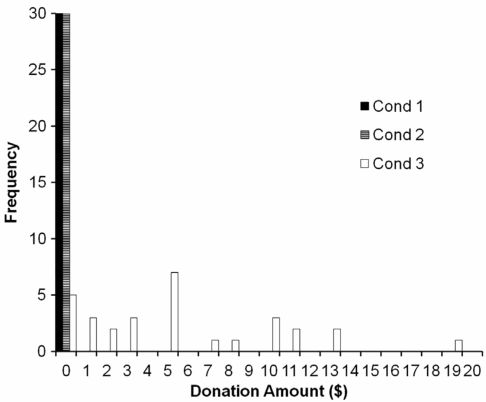
Economic experiments are increasingly being used in a number of research areas and are a major source of data guiding the debate surrounding the nature of human prosociality. The degree to which experiment behavior accurately reflects external behavior, however, has long been debated. A number of recent studies have revealed just how remarkably sensitive participants are to cues of a lack of anonymity. Similarly, others have suggested that the very structure of the experimental context induces participants to choose prosocial options. In order to truly create anonymous conditions and to eliminate the effects of experimental contexts, participants must not be aware of their participation. Here, I present the results of a natural-field Dictator Game in which participants are presented with a believable endowment and provided an opportunity to divide the endowment with a stranger without knowing that they are taking part in an experiment. No participants gave any portion of the endowment to the stranger. Baseline frequencies of prosocial behaviors exhibited under experimental contexts might therefore be substantially inflated compared to those exhibited under natural contexts.

REFERENCE
Winking, J. and Mizer, N. (in press). Natural-field dictator game shows no altruistic giving. Evolution and Human Behavior.

June 1, 2013

The heuristics debate in book form

Filed in Books
Subscribe to Decision Science News by Email (one email per week, easy unsubscribe)

A WHOLE BOOK ABOUT IT

hd

If you’ve ever wondered about The Heuristics Debate, this is the book for you.

If you have no interest in heuristics, you’ll probably be happier with another book. How about one of these?

Wait, sorry, those were all about heuristics too. If you are not into heuristics, maybe you’d like this book instead:

ot

May 22, 2013

Creativity inside the box

Filed in Books
Subscribe to Decision Science News by Email (one email per week, easy unsubscribe)
SYSTEMATIC CREATIVITY

jg

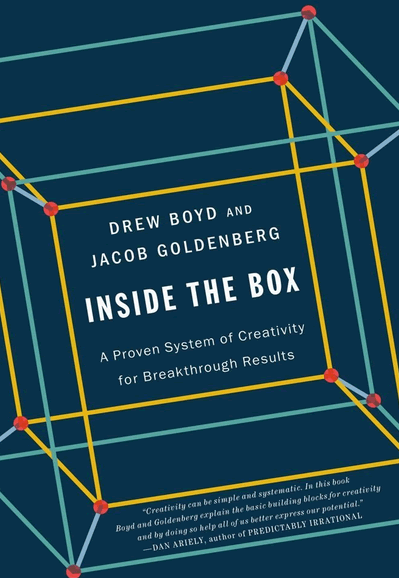
We at Decision Science News are big believers in systematic idea generation. More on that in other posts. For now, we’re happy to announce a new book by Drew Boyd and Jacob Goldenberg called Inside the Box: A Proven System of Creativity for Breakthrough Results. The gist of this research is to demystify the creative process by showing how good ideas can come about from rules and patterns. Being creative is not a mysterious, unstructured process attributable to only muses and luck.

What’s more, systematic creativity is fun. We’ve taken part in a seminar of theirs and it was really stimulating. If you take an improv theater class, you’ll learn that improv is, in essence, using constraints to improve the creative process.

May 14, 2013

1.5 percent of doctors, a quarter of malpratice reports

Filed in Ideas ,R ,Research News
Subscribe to Decision Science News by Email (one email per week, easy unsubscribe)
SOME DOCTORS GET MORE MALPRACTICE SUITS THAN OTHERS

malDocs.s

A month ago, we reported on a paper looking at complaints against doctors which found that 3% of doctors receive about half of the complaints.

This prompted our friend Jim, who is a lawyer, and a good one, to email, “you want to look at real complaints, check this out, it’s got lawsuits against doctors. So we did. This turned out to be the National Practitioner Data Bank, a publicly available database of complaints among doctors and other professions.

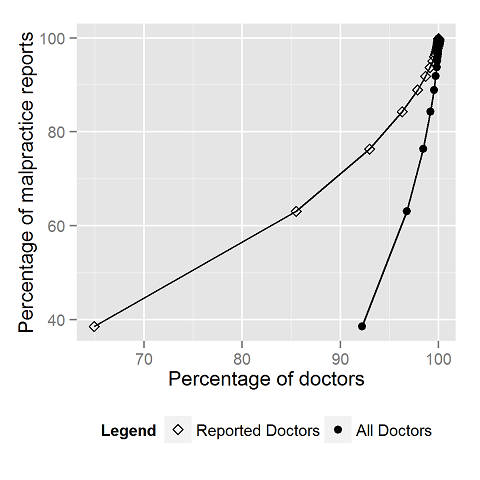
We did the same analysis as in the paper cited last month, except that now we looked at malpractice reports filed against doctors in the United States. The result, shown in the graph above, is that malpractice reports are quite skewed as well. (See last month’s post for some useful annotations that may help reading the graph). Our takeaway is for malpractice reports:

1.5% of doctors receive 24% of malpractice reports
3.2% of doctors receive 37% of malpractice reports
7.8% of doctors receive 61% of malpractice reports
22.2% of doctors receive 100% of malpractice reports (i.e. 78% of docs receive none)

This was kind of a quick and dirty analysis, so no guarantees this is correct. If you’re interested in the data, drop us a line.

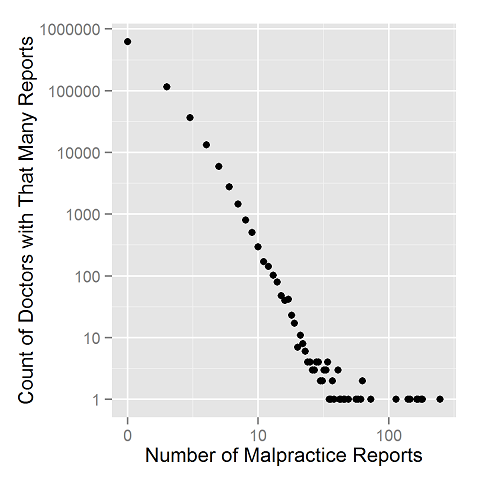
Powerlaw fans (and there are so, so many out there) may want to know that the data plot out thusly on a log-log scale:

malDist.s

Plots were made using the R language for statistical computing and Hadley Wickham‘s ggplot2 package.

May 10, 2013

Two IJRM special issues

Filed in Research News
Subscribe to Decision Science News by Email (one email per week, easy unsubscribe)

INTERNATIONAL JOURNAL OF RESEARCH IN MARKETING (IJRM): SPECIAL ISSUES ON DIGITAL BRANDING, ENTERTAINMENT

ijrm

The International Journal of Research in Marketing ( IJRM ) announces two special issues:

IJRM Special Issue on BRANDING IN A DIGITALLY-EMPOWERING WORLD
Guest Editors: Tulin Erdem (New York University), Kevin Lane Keller (Dartmouth College), Dmitri Kuksov (University of Texas at Dallas) and Rik Pieters (Tilburg University).

The International Journal of Research in Marketing invites submissions for a special issue on Branding in a Digitally Empowered World. The last decade has seen technological developments that have transformed markets and marketing. Both consumers and firms have new capabilities that they could not have even dreamed of a few short years ago (see below). Empowered consumers are meeting equally empowered firms as both groups have access to increasingly detailed information about just about anything or anyone. Consumers can choose to become as involved as they want with a brand, with their influence ranging from just posting comments and evaluations at one end of a continuum to actually determining the nature and direction of a brand at the other end. Similarly, firms can choose to become as involved as they wish with consumers, from hosting a brand web site at one end of the continuum to actively engaging and interacting with consumers in product and brand development at the other end. Many of the rules of branding are changing and many new rules are being introduced in this new digital era. This special issue of IJRM will focus on the latest thinking and research in branding that reflects the enhanced consumer and firm capabilities in a digitally-empowering world.
New consumers capabilities enable the consumers to:
Use the Internet as a powerful information and purchasing aid
Collect fuller and richer information on products, services, brands, and firms
Search, communicate, and purchase on the move
Tap into social media to share opinions and express loyalty with others
Interact actively with firms
Digitally receive ads, coupons, and other marketing materials
Easily compare prices and seek discounts

New firms capabilities enable the firms to:
Use the Internet as a powerful information and sales channel
Collect fuller and richer information about markets, customers, prospects, and competitors
Reach consumers on the move with mobile marketing
Tap into social media to amplify their brand message
Facilitate and speed external communication among customers
Send targeted ads, coupons, samples, and information to customers
Dynamically set prices to reflect different levels of supply and demand

This special issue aims to capture and publish the latest thinking on Branding in a Digitally Empowered World. Without limiting the scope of the papers to be submitted, we encourage original empirical, behavioral, analytical, or managerial work studying the following:

• How much control do firms have over their brands in this environment? How much control should they exert over their brands when consumers may want to redefine the brand? Are some of the brands really owned by the consumers and if so, what does it mean in terms of brand management?
• How should firms develop fully integrated channel and communication strategies to best reflect the wide variety of digital options? How to evaluate the consistency of messages across so many touch points in this environment? How to measure the effectiveness of an integrated branding communications campaign?
• How to capture the dynamics of brand evolution in such an environment?
• What factors affect consumer’s sense of empowerment and level of engagement with brands in general or for any particular brand?
• What are the optimal metrics and response strategies that firms should employ with social media?
• How are ads, promotions and other communications processed by consumers differently digitally as compared to their traditional counterparts?
• What are the costs and benefits of firms adopting yield pricing strategies to optimize supply and demand?

The deadline for initial submission to this special issue is March 31, 2014. The review process will feature a maximum of two rounds and final decisions will be made before April 2015. Given the limited time-window for revising papers, the editors’ aim in most cases is to make a decision on the first round. It is therefore important that submissions are as polished as possible. When submitting a paper (http://ees.elsevier.com/ijrm), authors should mention that the paper should be considered for this special issue. Inquiries can be sent to editor-ijrm@idc.ac.il.

IJRM Special Issue on THE ENTERTAINMENT INDUSTRY
Guest Editors: Jehoshua Eliashberg (University of Pennsylvania), Thorsten Hennig-Thurau (University of Münster and City University London), Charles B. Weinberg (University of British Columbia) and Berend Wierenga (Erasmus University Rotterdam).

The International Journal of Research in Marketing invites submissions for a special issue on The Entertainment Industry. Although early academic research on the entertainment industry focused on the TV and movie industries, recent work has expanded to consider such fields as home video, games, music, performing and visual arts, sports events, books, and apps. In this special issue we take a broad approach to the entertainment industry, which is characterized by three elements: it is creativity-driven, its products are experiential in nature, and, marketing has played an increasingly important, but sometimes controversial, role in research and practice.
There are many reasons for an increased interest in the entertainment industry. First, the industry has high economic importance in the global economy, with global entertainment industry revenues exceeding US$ 1.7 trillion in 2012. Second, technical innovations have changed the dynamics of traditional industries and led to the development of new ones, making entertainment a hotbed of innovation in both content creation and distribution. Technology has also dramatically changed the market scope and competitive structure from largely being locally based to now often being globally oriented, and presenting new challenges such as piracy. Third, digitization of the media has also influenced the way people consume entertainment; the industry has to adapt to consumers becoming increasingly active and networked. For example, many consumers now multi-task, use multiple platforms, and use multiple media formats (e.g., movies, games, and social media) interdependently. Fourth, the entertainment industry has high social and cultural significance. The tension between “mass culture” and “high culture,” and between global markets and local tastes, and claims such as the “internet is free” are only some of the sources of controversy and research attention.
This special issue of IJRM will focus on the latest thinking and research in the field of entertainment. Our goal is to be broad in terms of the research questions and methodologies employed and in the range of topics to be studied. In this special issue, we anticipate providing researchers with an editorial team of expert reviewers passionately devoted to the entertainment industry and readers with a focused place to find the most creative research in the field at the highest level of research quality. While we invite a broad array of research approaches and topics, as indicated above, we are particularly interested in high-quality research that has an impact on practice. Examples of topics include, but are not limited to, the following:
• The role of creativity in generating new products and distribution mechanisms
• Products and product development for entertainment
• Distribution channels, including digital channels
• Diffusion and adoption of entertainment goods, including the role of social media
• Consumer behavior, demand prediction and advertising for entertainment media
• Business models and pricing in the entertainment industry
• Managerial, organizational, and institutional issues
• Marketing across entertainment types and media formats
• The influence of mobility on entertainment
The deadline for initial submission to this special issue is May 31, 2014. The review process will feature a maximum of two rounds and final decisions will be made before November 30, 2015. Given the limited time-window for revising papers, the editors’ aim in most cases is to make a decision on the first round. It is therefore important that submissions are as polished as possible. When submitting a paper (http://ees.elsevier.com/ijrm), authors should mention that the paper should be considered for this special issue. Inquiries can be sent to editor-ijrm@idc.ac.il.

May 2, 2013

TESS (not of the d’Urbervilles)

Filed in Programs ,Research News
Subscribe to Decision Science News by Email (one email per week, easy unsubscribe)
TIME-SHARING EXPERIMENTS FOR THE SOCIAL SCIENCES (TESS)

TESSLogo

Tess-1979-dvd

James Druckman and Jeremy Freese pass this message along:

We are pleased to announce that Time-Sharing Experiments for the Social Sciences ( TESS ) was renewed for another round of funding by NSF starting last Fall. TESS allows researchers to submit proposals for experiments to be conducted on a nationally-representative, probability-based Internet platform, and successful proposals are fielded at no cost to investigators. More information about how TESS works and how to submit proposals is available at http://www.tessexperiments.org.

Additionally, we are pleased to announce the development of two new proposal mechanisms. Time-Sharing Experiments for the Social Science’s Short Studies Program (SSP) is accepting proposals for fielding very brief population-based survey experiments on a general population of at least 2000 adults. SSP recruits participants from within the U.S. using the same Internet-based platform as other TESS studies. More information about SSP and proposal requirements is available at http://www.tessexperiments.org/ssp.html.

TESS’s Special Competition for Young Investigators is accepting proposals from June 15th-September 15th. The competition is meant to enable younger scholars to field large-scale studies and is limited to graduate students and individuals who are no more than 3 years post-Ph.D. More information about the Special Competition and proposal requirements is available at http://www.tessexperiments.org/yic.html.

For the current grant, the principal investigators are Jeremy Freese and James Druckman of Northwestern University, who are assisted by a new team of over 65 Associate PIs and peer reviewers across the social sciences. More information about our APIs is available at http://www.tessexperiments.org/associatepi.html.

James Druckman and Jeremy Freese

Principal Investigators

April 22, 2013

Two submission deadlines: SJDM 2013 Toronto (Deadline June 17) & Crowdsourcing and Online Behavioral Experiments 2013 Philadelphia (Deadline April 26)

Filed in Conferences ,SJDM ,SJDM-Conferences
Subscribe to Decision Science News by Email (one email per week, easy unsubscribe)
1) 2013 CALL FOR ABSTRACTS: ANNUAL MEETING OF THE SOCIETY FOR JUDGMENT AND DECISION MAKING (SJDM)

Capture

The Society for Judgment and Decision Making (SJDM) invites abstracts for oral presentations, posters, and symposia* on any interesting topic related to judgment and decision making. Completed manuscripts are not required. (*Please note that historically, symposium submissions have had substantially lower acceptance rates than individual paper submissions due to requirements for high integration and quality across all papers in the session. Authors who feel that a grouping of presentations is essential to communicating their research can submit a symposium with the knowledge that they are rarely accepted and that a subset of papers within the symposium might be accepted even if the whole symposium is rejected.)

LOCATION, DATES, AND PROGRAM

SJDM’s annual conference will be held at the Sheraton Centre Hotel in Toronto, Ontario, Canada, during November 15-18, 2013. You may make reservations at $199 CAD per night (the Psychonomic convention rate). Early registration, a welcome reception, and a tribute to Duncan Luce will take place on the evening of Friday, November 15. The keynote address will be Sunday, November 17, with Susan Carey as the keynote speaker.

SUBMISSIONS

The deadline for submissions is June 17, 2013. Submissions for symposia, oral presentations, and posters should be made through the SJDM website at http://sql.sjdm.org/. Technical questions can be addressed to the webmaster, Jon Baron, at webmaster@sjdm.org. All other questions can be addressed to the program chair, Robyn LeBoeuf, at robyn.leboeuf at warrington.ufl.edu.

ELIGIBILITY

At least one author of each presentation must be a member of SJDM. Joining at the time of submission will satisfy this requirement. You may join SJDM at http://www.sjdm.org/jdm-member.html. An individual may give only one talk and present only one poster, but may be a co-author on multiple talks and/or posters. Please note that both the membership rule and the one-talk/ one-poster rule will be enforced.

AWARDS

The Best Student Poster Award is given for the best poster presentation whose first author is a student member of SJDM. The Hillel Einhorn New Investigator Award is intended to encourage outstanding work by new researchers. Applications are due June 17, 2013. Further details are available here. Questions can be directed to the chair of the Hillel Einhorn New Investigator Committee, Tim Pleskac, pleskact@msu.edu. The Jane Beattie Memorial Fund subsidizes travel to North America for a foreign scholar in pursuits related to judgment and decision research, including attendance at the annual SJDM meeting. Further details will be available at http://www.sjdm.org.

PROGRAM COMMITTEE
Robyn LeBoeuf (Chair), Bernd Figner, Jack Soll, Katy Milkman, Ellie Kyung, Anuj Shah, Katherine Burson, Ana Franco-Watkins, and Mare Appleby (conference coordinator)

2) 2013 CALL FOR PAPERS: WORKSHOP ON CROWDSOURCING AND ONLINE BEHAVIORAL EXPERIMENTS (COBE)

ec13-logo

A workshop at the 14th ACM Conference on Electronic Commerce, Philadelphia, June 17, 2013.

Submission Deadline: April 26, 2013

Official Web Page: http://www.decisionresearchlab.com/cobe/

OVERVIEW

The World Wide Web has resulted in new and unanticipated avenues for conducting large-scale behavioral experiments. Crowdsourcing sites like Amazon Mechanical Turk, oDesk, and Taskcn, among others, have given researchers access to a large participant pool that operates around the clock. As a result, behavioral researchers in academia have turned to crowdsourcing sites in large numbers. Moreover, websites like eBay, Yelp and Reddit have become places where researchers can conduct field experiments. Companies like Microsoft, Facebook, Google and Yahoo! conduct hundreds of randomized experiments on a daily basis. We may be rapidly reaching a point where most behavioral experiments will be done online.

This workshop seeks to bring together researchers and academics to present their latest online behavioral experiments.

TOPICS OF INTEREST:
Topics of interest for the workshop include but are not limited to:

* Crowdsourcing
* Online behavioral experiments
* Online field experiments
* Online natural or quasi-experiments
* Online surveys
* Human Computation

PAPER SUBMISSION:
Submit papers electronically by visiting https://www.easychair.org/conferences/?conf=cobe2013, logging in or creating an account, and clicking New Submission at the top left.

Submissions are non-archival, meaning contributors are free to publish their results subsequently in archival journals or conferences. There will be no published proceedings. Submissions should be up to 6 pages including references. Accepted papers will be presented as talks.

Deadline for submissions: April 26, 2013
Notification of acceptance: May 15, 2013

ORGANIZATION:

* Siddharth Suri, Microsoft Research
* Winter A. Mason, Stevens Institute of Technology
* Daniel G Goldstein, Microsoft Research

April 16, 2013

3% of doctors receive half the complaints

Filed in Articles ,Ideas ,Research News
Subscribe to Decision Science News by Email (one email per week, easy unsubscribe)

SOME DOCTORS GET COMPLAINED ABOUT MORE THAN OTHERS. SPECIALTY MATTERS.

F1.large

One topic in medical decision making that most people can relate to is the problem of choosing a doctor, especially when moving to a new town in which one knows few people from whom to receive references. One way to look at the problem is choosing a doctor you will likely not want to complain about. The likelihood of a doctor getting complaints is somewhat predictable, as shown in this recent article in BMJ Quality and Safety, based on a sample of almost 19,000 complaints filed by patients in Australia.

ABSTRACT

Objectives (1) To determine the distribution of formal patient complaints across Australia’s medical workforce and (2) to identify characteristics of doctors at high risk of incurring recurrent complaints.

Methods We assembled a national sample of all 18 907 formal patient complaints filed against doctors with health service ombudsmen (‘Commissions’) in Australia over an 11-year period. We analysed the distribution of complaints among practicing doctors. We then used recurrent-event survival analysis to identify characteristics of doctors at high risk of recurrent complaints, and to estimate each individual doctor’s risk of incurring future complaints.

Results The distribution of complaints among doctors was highly skewed: 3% of Australia’s medical workforce accounted for 49% of complaints and 1% accounted for a quarter of complaints. Short-term risks of recurrence varied significantly among doctors: there was a strong dose-response relationship with number of previous complaints and significant differences by doctor specialty and sex. At the practitioner level, risks varied widely, from doctors with <10% risk of further complaints within 2 years to doctors with >80% risk.

Conclusions A small group of doctors accounts for half of all patient complaints lodged with Australian Commissions. It is feasible to predict which doctors are at high risk of incurring more complaints in the near future. Widespread use of this approach to identify high-risk doctors and target quality improvement efforts coupled with effective interventions, could help reduce adverse events and patient dissatisfaction in health systems.

Before jumping to the conclusion that there good and bad apples in the world, realize that things that have little to do with the doctor, such as specialty, play a role:

spclty

That is, regardless of the doctor, those seeking plastic surgery are much more likely to file complaints than others.

Interestingly, experience doesn’t seem to help. In fact, doctors under 35 are significantly less likely to generate complaints than those age 36 and over.

REFERENCE
M. M. Bismark, M. J. Spittal, L. C. Gurrin, M. Ward, D. M. Studdert. Identification of doctors at risk of recurrent complaints: a national study of healthcare complaints in Australia. BMJ Quality & Safety, 2013; DOI: 10.1136/bmjqs-2012-001691

Full text
Supplementary materials

April 9, 2013

250 calories, 2.6 miles of walking, or 78 minutes of walking: which would cause you to eat less?

Filed in Articles ,Ideas ,Research News ,Tools
Subscribe to Decision Science News by Email (one email per week, easy unsubscribe)
MORE ON EXERCISE EQUIVALENTS VS CALORIE COUNTS ON MENUS

1-s2.0-S0195666312004655-fx1

We’ve written before about exercise equivalents over calorie counts, citing some initial encouraging data. Now there are more data, also encouraging.

The new article is called Potential effect of physical activity based menu labels on the calorie content of selected fast food meals. These authors tested four variant menus “(1) a menu with no nutritional information, (2) a menu with calorie information, (3) a menu with calorie information and minutes to walk to burn those calories, or (4) a menu with calorie information and miles to walk to burn those calories”. The authors found, as before that calorie counts decreased the amount of calories people chose to consume, and that exercise equivalents (telling you how much walking time or walking distance you’d need to burn off those calories) increased the effect.

We’d like to know the effect size of (3) vs (4) and are awaiting a full copy of the paper.

ABSTRACT

In this study we examined the effect of physical activity based labels on the calorie content of meals selected from a sample fast food menu. Using a web-based survey, participants were randomly assigned to one of four menus which differed only in their labeling schemes (n = 802): (1) a menu with no nutritional information, (2) a menu with calorie information, (3) a menu with calorie information and minutes to walk to burn those calories, or (4) a menu with calorie information and miles to walk to burn those calories. There was a significant difference in the mean number of calories ordered based on menu type (p = 0.02), with an average of 1020 calories ordered from a menu with no nutritional information, 927 calories ordered from a menu with only calorie information, 916 calories ordered from a menu with both calorie information and minutes to walk to burn those calories, and 826 calories ordered from the menu with calorie information and the number of miles to walk to burn those calories. The menu with calories and the number of miles to walk to burn those calories appeared the most effective in influencing the selection of lower calorie meals (p = 0.0007) when compared to the menu with no nutritional information provided. The majority of participants (82%) reported a preference for physical activity based menu labels over labels with calorie information alone and no nutritional information. Whether these labels are effective in real-life scenarios remains to be tested.

REFERENCE
Sunaina Dowray, Jonas J. Swartz, Danielle Braxton, Anthony J. Viera
Potential effect of physical activity based menu labels on the calorie content of selected fast food meals ☆
Appetite, Volume 62, 1 March 2013, Pages 173–181
http://dx.doi.org/10.1016/j.appet.2012.11.013