SOME DOCTORS GET COMPLAINED ABOUT MORE THAN OTHERS. SPECIALTY MATTERS.
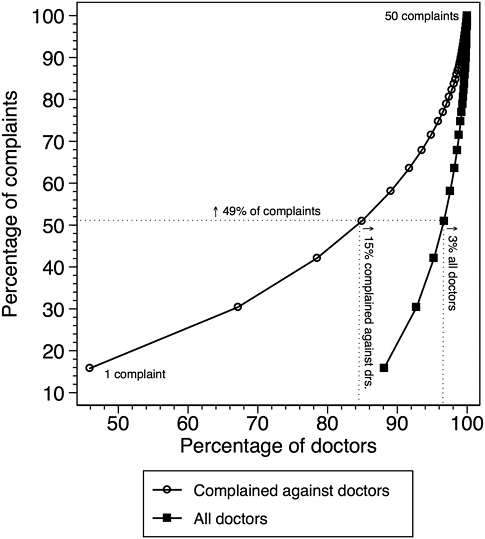
One topic in medical decision making that most people can relate to is the problem of choosing a doctor, especially when moving to a new town in which one knows few people from whom to receive references. One way to look at the problem is choosing a doctor you will likely not want to complain about. The likelihood of a doctor getting complaints is somewhat predictable, as shown in this recent article in BMJ Quality and Safety, based on a sample of almost 19,000 complaints filed by patients in Australia.
ABSTRACT
Objectives (1) To determine the distribution of formal patient complaints across Australia’s medical workforce and (2) to identify characteristics of doctors at high risk of incurring recurrent complaints.
Methods We assembled a national sample of all 18 907 formal patient complaints filed against doctors with health service ombudsmen (‘Commissions’) in Australia over an 11-year period. We analysed the distribution of complaints among practicing doctors. We then used recurrent-event survival analysis to identify characteristics of doctors at high risk of recurrent complaints, and to estimate each individual doctor’s risk of incurring future complaints.
Results The distribution of complaints among doctors was highly skewed: 3% of Australia’s medical workforce accounted for 49% of complaints and 1% accounted for a quarter of complaints. Short-term risks of recurrence varied significantly among doctors: there was a strong dose-response relationship with number of previous complaints and significant differences by doctor specialty and sex. At the practitioner level, risks varied widely, from doctors with <10% risk of further complaints within 2 years to doctors with >80% risk.
Conclusions A small group of doctors accounts for half of all patient complaints lodged with Australian Commissions. It is feasible to predict which doctors are at high risk of incurring more complaints in the near future. Widespread use of this approach to identify high-risk doctors and target quality improvement efforts coupled with effective interventions, could help reduce adverse events and patient dissatisfaction in health systems.
Before jumping to the conclusion that there good and bad apples in the world, realize that things that have little to do with the doctor, such as specialty, play a role:
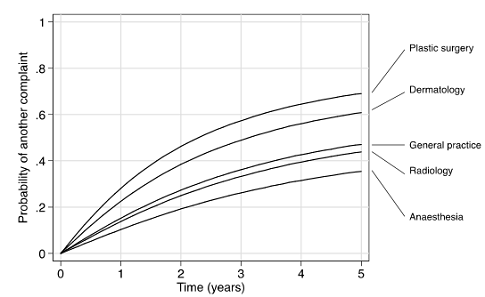
That is, regardless of the doctor, those seeking plastic surgery are much more likely to file complaints than others.
Interestingly, experience doesn’t seem to help. In fact, doctors under 35 are significantly less likely to generate complaints than those age 36 and over.
REFERENCE
M. M. Bismark, M. J. Spittal, L. C. Gurrin, M. Ward, D. M. Studdert. Identification of doctors at risk of recurrent complaints: a national study of healthcare complaints in Australia. BMJ Quality & Safety, 2013; DOI: 10.1136/bmjqs-2012-001691
Full text
Supplementary materials
MORE ON EXERCISE EQUIVALENTS VS CALORIE COUNTS ON MENUS
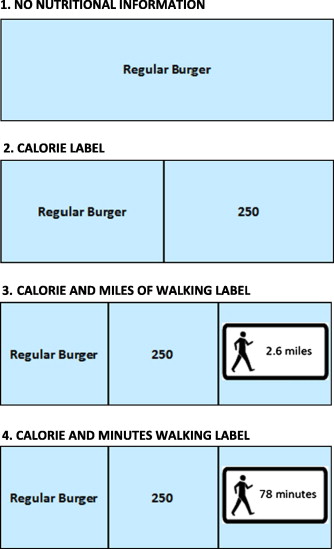
We’ve written before about exercise equivalents over calorie counts, citing some initial encouraging data. Now there are more data, also encouraging.
The new article is called Potential effect of physical activity based menu labels on the calorie content of selected fast food meals. These authors tested four variant menus “(1) a menu with no nutritional information, (2) a menu with calorie information, (3) a menu with calorie information and minutes to walk to burn those calories, or (4) a menu with calorie information and miles to walk to burn those calories”. The authors found, as before that calorie counts decreased the amount of calories people chose to consume, and that exercise equivalents (telling you how much walking time or walking distance you’d need to burn off those calories) increased the effect.
We’d like to know the effect size of (3) vs (4) and are awaiting a full copy of the paper.
ABSTRACT
In this study we examined the effect of physical activity based labels on the calorie content of meals selected from a sample fast food menu. Using a web-based survey, participants were randomly assigned to one of four menus which differed only in their labeling schemes (n = 802): (1) a menu with no nutritional information, (2) a menu with calorie information, (3) a menu with calorie information and minutes to walk to burn those calories, or (4) a menu with calorie information and miles to walk to burn those calories. There was a significant difference in the mean number of calories ordered based on menu type (p = 0.02), with an average of 1020 calories ordered from a menu with no nutritional information, 927 calories ordered from a menu with only calorie information, 916 calories ordered from a menu with both calorie information and minutes to walk to burn those calories, and 826 calories ordered from the menu with calorie information and the number of miles to walk to burn those calories. The menu with calories and the number of miles to walk to burn those calories appeared the most effective in influencing the selection of lower calorie meals (p = 0.0007) when compared to the menu with no nutritional information provided. The majority of participants (82%) reported a preference for physical activity based menu labels over labels with calorie information alone and no nutritional information. Whether these labels are effective in real-life scenarios remains to be tested.
REFERENCE
Sunaina Dowray, Jonas J. Swartz, Danielle Braxton, Anthony J. Viera
Potential effect of physical activity based menu labels on the calorie content of selected fast food meals ☆
Appetite, Volume 62, 1 March 2013, Pages 173–181
http://dx.doi.org/10.1016/j.appet.2012.11.013
THE LUCID PERCEPTION OF THE CROWD
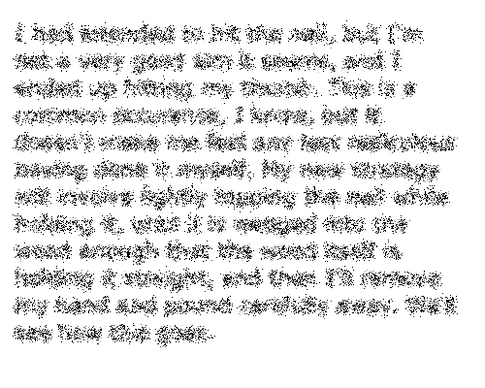
This is one of the most amazing things we’ve seen all week. What does the text block above say? You have no idea, right?
The folks running the Deneme blog over at MIT gave this task to experimental participants in Amazon’s Mechanical Turk labor market. By doing it in an iterative way, people were able to transcribe the blurry mess to English with only one mistake.
The iterative method is as follows:
* One person gives the transcription a try
* The next person sees the previous tries and tries to improve upon it
* Repeat until done
(We’re not sure if the workers can see all the previous attempts or just the last one).
This is what the iterative method came up with:
I had intended to hit the nail, but I’m not a very good aim it seems and I ended up hitting my thumb. This is a common occurence I know, but it doesn’t make me feel any less ridiculous having done it myself. My new strategy will involve lightly tapping the nail while holding it until it is embedded into the wood enough that the wood itself is holding it straight and then I’ll remove my hand and pound carefully away. We’ll see how this goes.
…and the only error was that ’embedded’ should have been ‘wedged’.
Remarkably, for the passage above, people got it. And in a non-iterative version, in which each person had no help from previous workers, everyone gave up. Details are here. That said in two other texts, neither the iterative or non-iterative method worked, but of course they only tried once per text.
We are curious to know how they’ve improved upon this very promising method.
P.S. We’ve found this task to be slightly easier when you scroll the blurry text up and down a bit in the browser. Try it on the full sized image on the original blog post.
P.P.S. When you iterate but only look at the last attempt (instead of the original plus the last attempts) things get worse, as in the game of telephone. Check out this cool example of how a straight line morphs into craziness by error propagation.

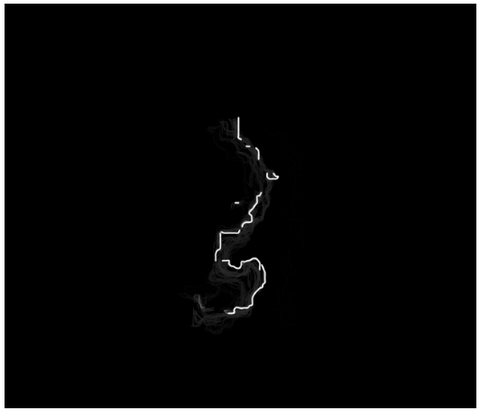
P.P.P.S. I remember my dad, a psychology professor, showing me results of a line copying experiment he did on his students at Carnegie Mellon in the 1970s. He passed a deck of index cards around the class. Each student looked at the image on the top of the deck, moved it to the bottom, and tried to reproduce it on the blank card on top, and then passed it on. The results were similarly crazy.
SOCIETY FOR JUDGMENT AND DECISION MAKING NEWSLETTER

Just a reminder that the quarterly Society for Judgment and Decision Making newsletter can be downloaded from the SJDM site:
http://sjdm.org/newsletters/
It features jobs, conferences, announcements, and more.

IN ADDITION: The hot new workshop on Crowdsourcing and Online Behavioral Experiments (COBE 2013) is now accepting submissions. For details, see:
http://www.decisionresearchlab.com/cobe/
Enjoy both!
Dan Goldstein
Decision Science News / SJDM Newsletter Editor
Filed in
Conferences
 Subscribe
 to Decision Science News by Email (one email per week, easy unsubscribe)
CALL FOR PAPERS
A workshop at the 14th ACM Conference on Electronic Commerce, Philadelphia, June 17, 2013.
Submission Deadline: April 26, 2013
Official Web Page: http://www.decisionresearchlab.com/cobe/
OVERVIEW
The World Wide Web has resulted in new and unanticipated avenues for conducting large-scale behavioral experiments. Crowdsourcing sites like Amazon Mechanical Turk, oDesk, and Taskcn, among others, have given researchers access to a large participant pool that operates around the clock. As a result, behavioral researchers in academia have turned to crowdsourcing sites in large numbers. Moreover, websites like eBay, Yelp and Reddit have become places where researchers can conduct field experiments. Companies like Microsoft, Facebook, Google and Yahoo! conduct hundreds of randomized experiments on a daily basis. We may be rapidly reaching a point where most behavioral experiments will be done online.
This workshop seeks to bring together researchers and academics to present their latest online behavioral experiments.
TOPICS OF INTEREST:
Topics of interest for the workshop include but are not limited to:
* Crowdsourcing
* Online behavioral experiments
* Online field experiments
* Online natural or quasi-experiments
* Online surveys
* Human Computation
PAPER SUBMISSION:
Submit papers electronically by visiting https://www.easychair.org/conferences/?conf=cobe2013, logging in or creating an account, and clicking New Submission at the top left.
Submissions are non-archival, meaning contributors are free to publish their results subsequently in archival journals or conferences. There will be no published proceedings. Submissions should be up to 6 pages including references. Accepted papers will be presented as talks.
Deadline for submissions: April 26, 2013
Notification of acceptance: May 15, 2013
ORGANIZATION:
* Siddharth Suri, Microsoft Research
* Winter A. Mason, Stevens Institute of Technology
* Daniel G Goldstein, Microsoft Research
Program committee and invited speakers will be announced soon.
MPI SUMMER SCHOOL 2013: DECISION MAKING IN A SOCIAL WORLD. DUNCAN WATTS KEYNOTE
Summer Institute on Bounded Rationality
Decision Making in a Social World
This summer Gerd Gigerenzer and Ralph Hertwig will host the annual Summer Institute on Bounded Rationality, with a focus on “Decision Making in a Social World”.
Dr. Duncan Watts of Microsoft Research, author of “Six Degrees: The Science of a Connected Age”, will give the keynote address. This year marks the first time the event is jointly presented by the Center for Adaptive Behavior and Cognition as well as the Center for Adaptive Rationality at the Max Planck Institute for Human Development in Berlin.
Join renowned faculty and international participants across various disciplines for talks and workshops during the one-week Summer Institute. 35 young scholars will have the opportunity to explore how bounded rationality helps the navigation of the complex social world, as well as present their research and receive feedback from and network with distinguished researchers and fellow young scholars.
We invite talented graduate students and post-doctoral fellows to apply before April 10, 2013. Details on the Summer Institute and the application process are available at http://www.mpib-berlin.mpg.de/de/forschung/adaptives-verhalten-und-kognition/summer-institute-on-bounded-rationality.
Questions are welcomed to summerinstitute2013@mpib-berlin.mpg.de.
Feel free to pass the information on to interested (and interesting) researchers.
Filed in
Ideas
Subscribe to Decision Science News by Email (one email per week, easy unsubscribe)
HERE ARE YOUR ANSWERS
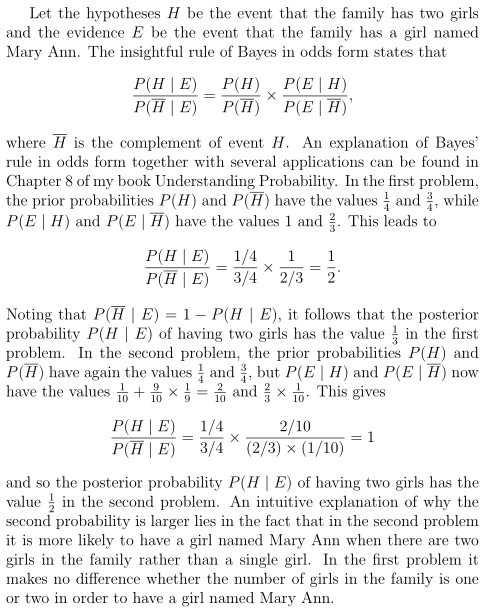
Last week we posted two fun probability problems. If you haven’t given them the old college try do so now, because this week we present you with the answer, provided by the man who supplied the problems, author and Professor of Operations Research and Probability Henk Tijms. Voila.
Enjoy this kind of thing? Try the Tuesday’s child is full of probability problems problem.
Filed in
Ideas
Subscribe to Decision Science News by Email (one email per week, easy unsubscribe)
COUNTERINTUITIVE PROBABILITIES REDUX

Drawn in by our post Tuesday’s child is full of probability problems, author and Professor of Operations Research and Probability Henk Tijms writes in with two new puzzles:
Problem 1:
An isolated island is ruled by a dictator. Every family on the island has two children. Each child is equally likely a boy or a girl. The dictator has decreed that each first-born girl (if any) in the family should bear the name Mary Ann (the name of the beloved mother-in-law of the dictator). Two siblings never have the same name. You are told that a randomly chosen family that is unknown to you has a girl named Mary Ann. What is the probability that this family has two girls?
Problem 2:
The dictator has passed away. His son, a womanizer, has changed the rules. For each first-born girl in the family a name must be chosen at random from 10 specific names including the name Mary Ann, while for each second-born girl in the family a name must be randomly chosen from the remaining 9 names. What is now the probability that a randomly chosen family has two girls when you are told that this family has a girl named Mary Ann? Can you intuitively explain why this probability is not the same as the previous probability?
If you need a hint, he adds this postscript:
P.S. As you know, the wording in this kind of problems is crucial. I found that the best approach to attack this kind of problems is to use Bayes’ rule in odds form. This specific form of Bayes forces you to make transparent the assumption you are (implicitly) making in solving the problem. I take the liberty to mention that in the recent third edition of my book Understanding Probability (Cambridge University Press, 2012), I advocate the use of Bayes’ rule in odds form (and Bayesian thinking in general).
Who can solve it first?
Filed in
Ideas ,
R
Subscribe to Decision Science News by Email (one email per week, easy unsubscribe)
EVERYDAY RISKY CHOICE
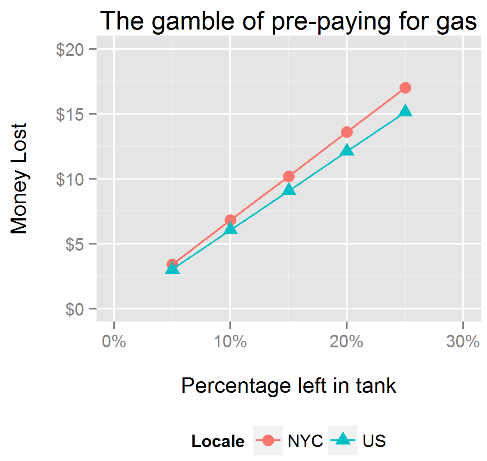
One question we get asked a lot is whether it’s worth it to pre-pay for the tank of gas when renting a car.
At first, blush it seems like something you should never do. In the best case, you pay market rate for gas, and in the worst case, you pay for a tank of gas you never consume (what if your trip gets cancelled)?
At second blush, it can be worth the risk to avoid the hassle of fueling up just before returning the car. If your time and peace of mind are worth something, then maybe you should pre-pay when you are reasonably sure you’ll return it below a certain percentage full. But what percentage?
To help with this decision, we’ve calculated the amount of money you waste when returning the car at various percentages full (above). We plugged in the New York City price of gas we face ($4) and the current national average ($3.56). For us, the hassle of refueling in the South Bronx after a weekend in the country is about $5, so we should probably pre-pay when we’re pretty sure we’ll return the car about 5-10% full.
We discussed this topic with Sid Suri and concluded that many factors go into this decision:
- Freedom from stress of having to fill up
- Stress of trying to run the tank down as low as possible without running out of gas (sure, it’s a commission of the sunk cost fallacy, but we’re humans)
- The thrill of returning the car right before it runs out of gas
- Time of day of return
- Cognitive costs of deciding how much gas to purchase during a trip so it’s nearly empty upon return
- Safety of gas station near return location
- Gas lines (we once pre-paid after Hurricane Sandy and avoided a several-hour long gas line)
- The “fee” for returning the car less than 100% full (something like $8 / gallon) vs. the expected loss by pre-paying
We think that:
- It would be much better if you could just pre-pay for a quarter tank instead of a tank. We’d even accept a small fee to do this.
- Most people who pre-pay are sticking it to their employers.
Graphs were made in R using Hadley Wickham’s ggplot2 package.
Code is here:
library(ggplot2)
library(scales)
NYC=4
NAT=3.56
pl=seq(.05,.25,.05)
gal=pl*17
nycost=gal*NYC
natcost=gal*NAT
mdf=data.frame(
Percentage_full=c(pl,pl),
Cost=c(nycost,natcost),
Locale=c(rep("NYC",length(pl)),rep("US",length(pl))))
p=ggplot(mdf,aes(Percentage_full,Cost,group=Locale,
        color=Locale,shape=Locale))
p=p+geom_point(size=3)+geom_line()
p=p+scale_x_continuous("\nPercentage left in tank",limits=c(0,.3),
	labels=percent_format())
p=p+scale_y_continuous("Money Lost\n",limits=c(0,20),
        labels=dollar_format())
p=p+theme(legend.position="bottom")
p=p+ggtitle("The gamble of pre-paying for gas")
p
DOES IT MATTER WHERE IT IS KICKED? ANALYSIS OF OVER 10,000 ATTEMPTS
Click to enlarge
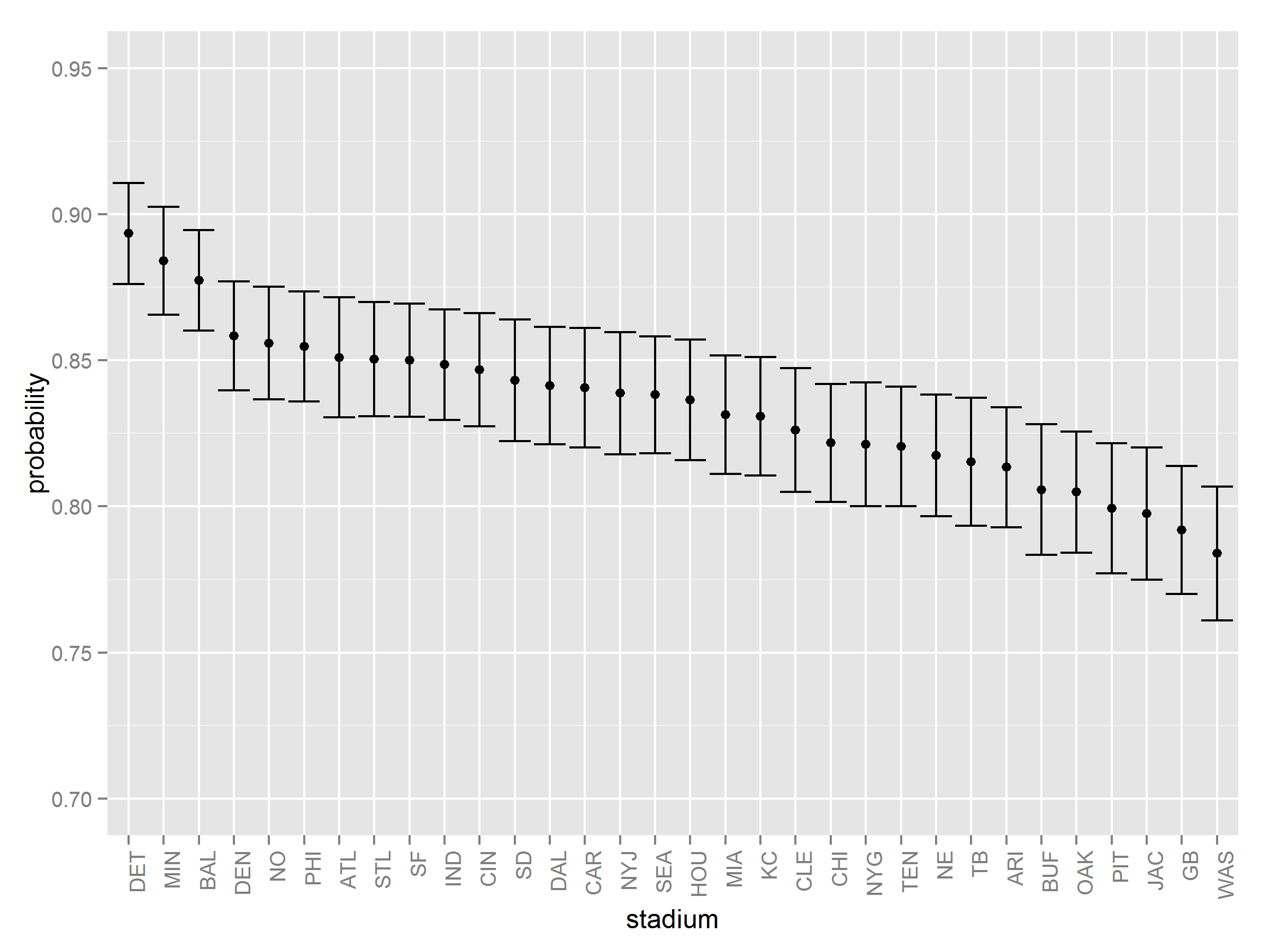
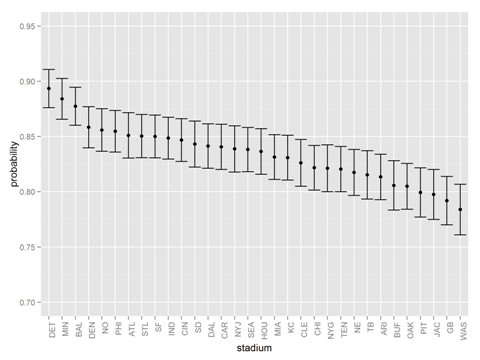
In our third of not one, not two, but three posts on kicking a football in the NFL, we take on a reader question of whether the stadium / home team matters for making a field goal. We pulled up the data on every field goal since 2002 (over 10,000) of them and plotted the probability of scoring as a function of the stadium in which the field goal was kicked. The results are above. Bars are +/- 1 standard error.
Is it a statistically significant effect? Apparently so:
Pearson's Chi-squared test
X-squared = 49.9556, df = 31, p-value = 0.01693
ADDENDUM 1
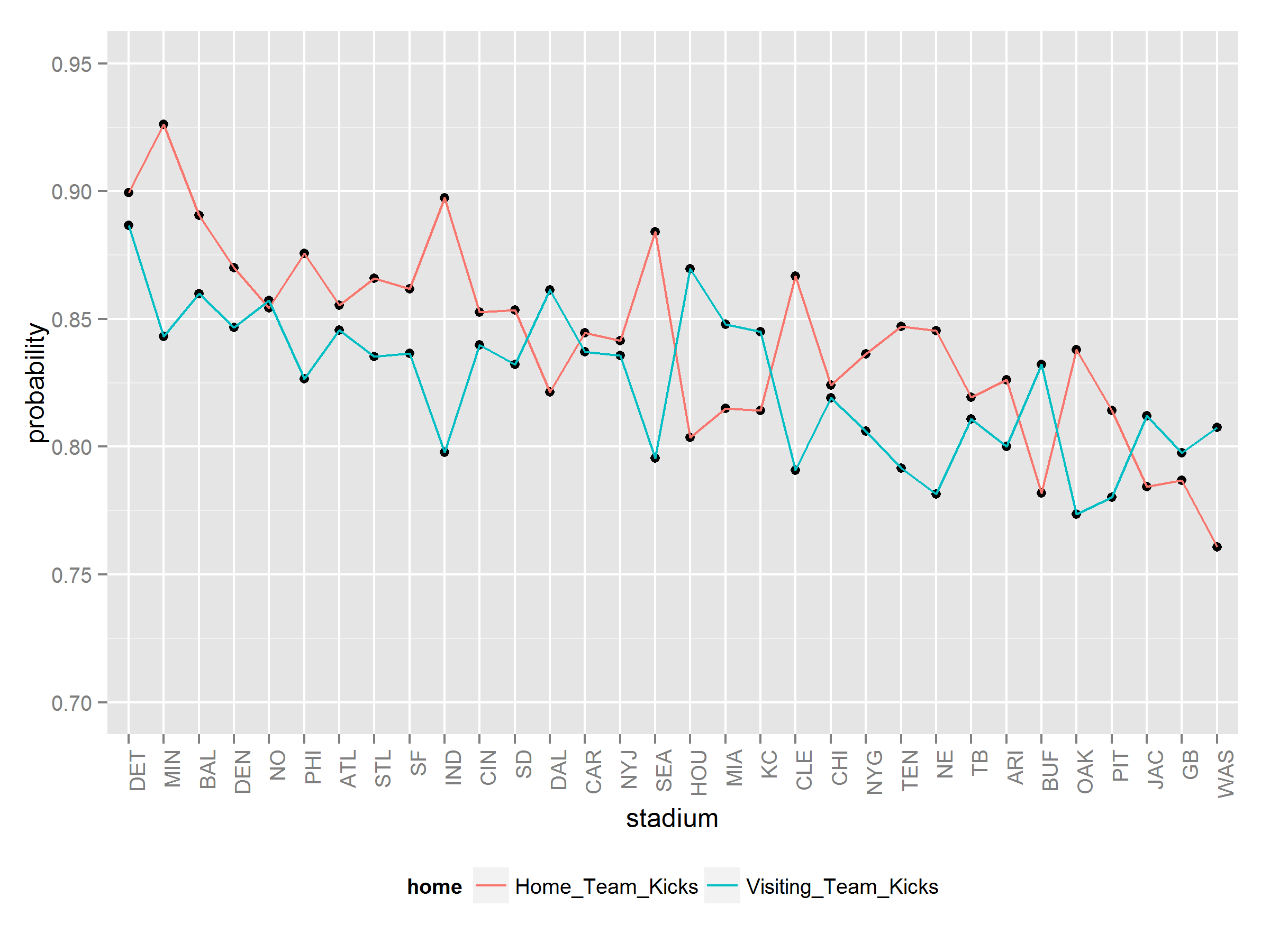
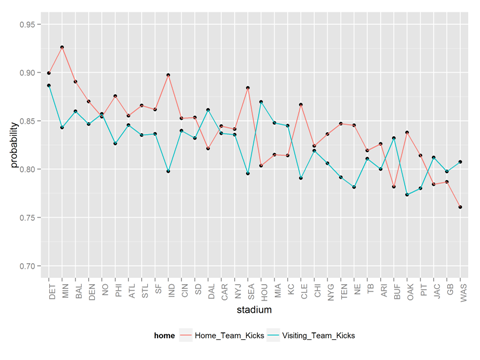
We had a request to see the broken down by home team or visiting team kicking. Here you go:
Click to enlarge
ADDENDUM 2:
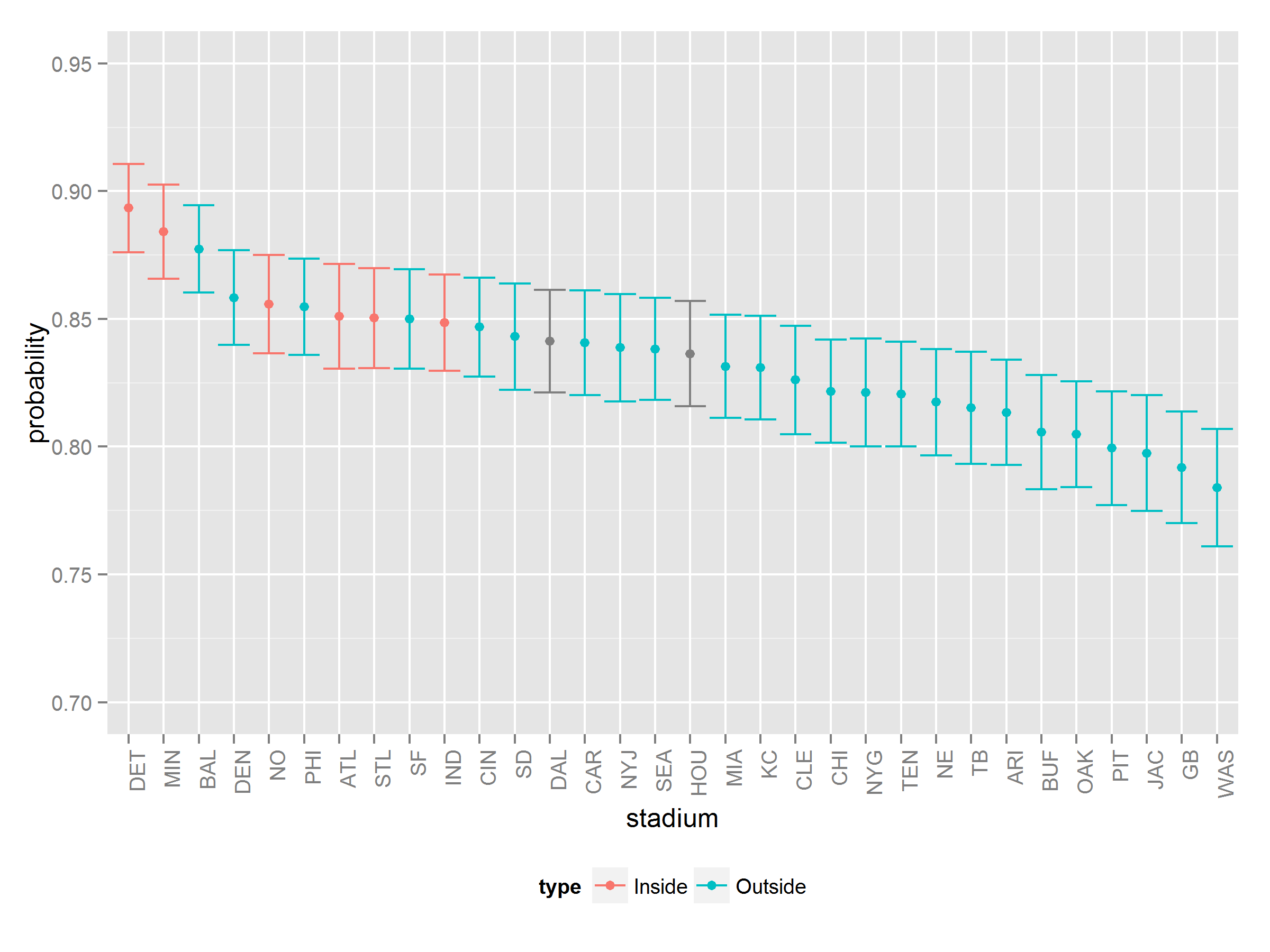
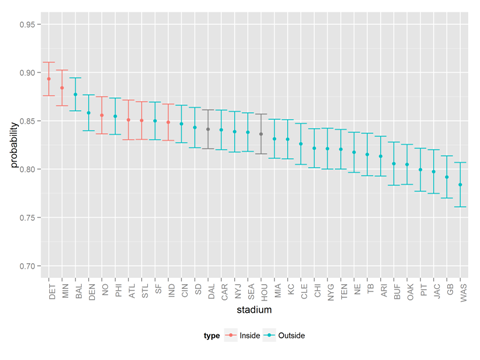
Owing to the generosity of the great reader / Scottish economist Adam Smith (see comments), we now have the stadiums broken down by door (indoor or outdoor). The gray stadiums are either convertible (Houston) or have a small hole in the roof (Dallas).
Correlation is not causation, but it sure does seem plausible that having an indoor stadium helps the kicker.
Click to enlarge
APPENDIX
To decode the team names, use this list:
ARI: Arizona Cardinals
ATL: Atlanta Falcons
BAL: Baltimore Ravens
BUF: Buffalo Bills
CAR: Carolina Panthers
CHI: Chicago Bears
CIN: Cincinnati Bengals
CLE: Cleveland Browns
DAL: Dallas Cowboys
DEN: Denver Broncos
DET: Detroit Lions
GB: Green Bay Packers
HOU: Houston Texans
IND: Indianapolis Colts
JAX: Jacksonville Jaguars
KC: Kansas City Chiefs
MIA: Miami Dolphins
MIN: Minnesota Vikings
NE: New England Patriots
NO: New Orleans Saints
NYG: New York Giants
NYJ: New York Jets
OAK: Oakland Raiders
PHI: Philadelphia Eagles
PIT: Pittsburgh Steelers
SD: San Diego Chargers
SEA: Seattle Seahawks
SF: San Francisco 49ers
STL: Saint Louis Rams
TB: Tampa Bay Buccaneers
TEN Tennessee Titans
WAS: Washington Redskins
Figure 1 Data:
Stadium   Miss Hit
ARI         67 292
ATL         45 257
BAL         45 322
BUF         61 253
CAR         51 269
CHI         64 295
CIN         53 293
CLE         56 266
DAL         53 281
DEN         50 303
DET         34 285
GB          72 274
HOU         53 271
IND         55 308
JAC         64 252
KC          58 285
MIA         58 286
MIN         35 267
NE          63 282
NO          48 285
NYG         59 271
NYJ         50 260
OAK         72 297
PHI         51 300
PIT         65 259
SD          48 258
SEA         55 285
SF          51 289
STL         50 284
TB          58 256
TEN         63 288
WAS         70 254
Figure 2 Data:
ARI     Home_Team_Kicks         32 152
        Visiting_Team_Kicks     35 140
ATL     Home_Team_Kicks         24 142
        Visiting_Team_Kicks     21 115
BAL     Home_Team_Kicks         23 187
        Visiting_Team_Kicks     22 135
BUF     Home_Team_Kicks         36 129
        Visiting_Team_Kicks     25 124
CAR     Home_Team_Kicks         23 125
        Visiting_Team_Kicks     28 144
CHI     Home_Team_Kicks         32 150
        Visiting_Team_Kicks     32 145
CIN     Home_Team_Kicks         28 162
        Visiting_Team_Kicks     25 131
CLE     Home_Team_Kicks         20 130
        Visiting_Team_Kicks     36 136
DAL     Home_Team_Kicks         30 138
        Visiting_Team_Kicks     23 143
DEN     Home_Team_Kicks         23 154
        Visiting_Team_Kicks     27 149
DET     Home_Team_Kicks         17 152
        Visiting_Team_Kicks     17 133
GB      Home_Team_Kicks         39 144
        Visiting_Team_Kicks     33 130
HOU     Home_Team_Kicks         32 131
        Visiting_Team_Kicks     21 140
IND     Home_Team_Kicks         19 166
        Visiting_Team_Kicks     36 142
JAC     Home_Team_Kicks         36 131
        Visiting_Team_Kicks     28 121
KC      Home_Team_Kicks         29 127
        Visiting_Team_Kicks     29 158
MIA     Home_Team_Kicks         32 141
        Visiting_Team_Kicks     26 145
MIN     Home_Team_Kicks         11 138
        Visiting_Team_Kicks     24 129
NE      Home_Team_Kicks         30 164
        Visiting_Team_Kicks     33 118
NO      Home_Team_Kicks         22 129
        Visiting_Team_Kicks     26 156
NYG     Home_Team_Kicks         27 138
        Visiting_Team_Kicks     32 133
NYJ     Home_Team_Kicks         26 138
        Visiting_Team_Kicks     24 122
OAK     Home_Team_Kicks         29 150
        Visiting_Team_Kicks     43 147
PHI     Home_Team_Kicks         25 176
        Visiting_Team_Kicks     26 124
PIT     Home_Team_Kicks         34 149
        Visiting_Team_Kicks     31 110
SD      Home_Team_Kicks         23 134
        Visiting_Team_Kicks     25 124
SEA     Home_Team_Kicks         19 145
        Visiting_Team_Kicks     36 140
SF      Home_Team_Kicks         25 156
        Visiting_Team_Kicks     26 133
STL     Home_Team_Kicks         22 142
        Visiting_Team_Kicks     28 142
TB      Home_Team_Kicks         30 136
        Visiting_Team_Kicks     28 120
TEN     Home_Team_Kicks         28 155
        Visiting_Team_Kicks     35 133
WAS     Home_Team_Kicks         39 124
        Visiting_Team_Kicks     31 130
Figure 3 Data: See Figure 1 data plus the comments
Graphs were made in R using Hadley Wickham’s ggplot2 package. Pointer to the data can be found at our previous post.