ANNOUNCING THE JUDGMENT AND DECISION MAKING JOURNAL

Jon Baron has announced A new online journal for judgment and decision making.
A new journal is always a risk. If people will read it and cite it, submitting there now is wise. If nobody will read it or cite it, submitting there now is foolish.
In an exclusive interview, DSN asked Jon Baron the following questions :
Before a journal has a reputation, what should one do? Submit early? Or wait and see? If you submit early, you may have good chances of getting in, and your article may get great exposure if the journal succeeds, but if the journal fails, your article may slip into oblivion. If you wait and see before submitting, and others do too, the journal will surely fail.
Should a pre-tenure academic who needs articles in certain reputation journals publish in a new journal? Or just senior people who care more about exposure than building a tenure case.
What makes this journal a safe bet? I believe that unlike most journals, this one will be reachable by search engines, so articles there may get more exposure than one in a traditional journal.
Jon Baron replies:
“I think there are a few answers about “why submit,” and I didn’t want to harp on some of them in a general post sent everywhere.
1. As you point out, this gets lots of exposure.
2. By going after short articles, we are looking for good ones that get rejected from Psychological Science, of which there are
many. There is no other outlet for these. Most main-line journals do not take short ones, e.g., with one experiment. Moreover, the Psychological Science review process has become slow, so it is a bigger risk to send things there, and you might want to try us first. (I don’t know if you should say the last thing. Say it if you agree with it, but perhaps don’t attribute it to me. It is, however, true.)
3. There are successful on-line journals of societies, e.g., the Journal of Vision (published by ARVO).
4. This seems to have a lot of support, as indicated by those who agreed to be on the board.
5. The usual journals (OBHDP and JBDM) have very low penetration and citation rates. This is, I think, largely because most institutional libraries do not get them. As a result, they don’t really count as “prestigious” when people come up for tenure. So there is little to lose. See the proposal for documentation.
In sum, yes, this is a risk, but I’m really not sure it is a very big risk. A publication in a refereed journal is, after all, a publication in a refereed journal. And our rejection rate will, I think, be high.”
Filed in
Conferences
 Subscribe
 to Decision Science News by Email (one email per week, easy unsubscribe)
STANFORD SUMMER SCHOOL IN NEUROECONOMICS 2006
This year’s Summer School in Neuroeconomics will take place July 17 – July 28, 2006 at Stanford. The application deadline is March 15th, 2006, so you’d better hurry.
The organizers inlcude Colin Camerer (Caltech), Paul Glimcher (NYU), and Antonio Rangel (Stanford). The aim of the Stanford Summer School in Neuroeconomics is to provide an introduction to the new field of neuroeconomics to graduate students and post-docs in neuroscience, psychology, and economics.
Part of the meeting will focus on “computational neuroeconomics”, which provides the unifying framework for the field, and a common language for the three related fields. This part of the program describes state-of-the art models of how the brain makes economic decisions (Which variables are computed? How are they computed? How do they interact with each other to generate choices?) The other part of the program covers several experimental techniques and their applications to neuroeconomics. The program also includes daily research talks by leading scholars in the field and a student project.
Graduate students and post-doctoral scholars in neuroscience, psychology, and economics are invited to apply. Those interested in attending the course should send the materials listed below by e-mail no later MARCH 15, 2006. 40 applicants will be selected and notified by email in mid-April, 2006.
For more information visit http://neuroeconomics-summerschool.stanford.edu/
THE RECOGNITION HEURISTIC ON ESPN.COM

Bill Simmons just ran a nice interview with Malcolm Gladwell, in which he draws on a recognition heuristic example of when more knowledge is worse than less.
“Simmons: While we’re on the subject of the Knicks, please enlighten the readers on your convoluted theory about why Isiah Thomas is a terrible GM, because he’s one of my favorites.
Gladwell: Here’s the real question. If I was GM of the Knicks, would I be doing a better job of managing the team than Thomas? I believe, somewhat immodestly, that the answer is yes. And I say this even though it is abundantly clear that Thomas knows several thousand times more about basketball than I do. I’ve never picked up a basketball. I couldn’t diagram a play to save my life. I would put my level of basketball knowledge, among hard core fans, in the 25th percentile.
So why do I think I would be better? There’s a famous experiment done by a wonderful psychologist at Columbia University named Dan Goldstein. He goes to a class of American college students and asks them which city they think is bigger — San Antonio or San Diego. The students are divided. Then he goes to an equivalent class of German college students and asks the same question. This time the class votes overwhelmingly for San Diego. The right answer? San Diego. So the Germans are smarter, at least on this question, than the American kids. But that’s not because they know more about American geography. It’s because they know less. They’ve never heard of San Antonio. But they’ve heard of San Diego and using only that rule of thumb, they figure San Diego must be bigger. The American students know way more. They know all about San Antonio. They know it’s in Texas and that Texas is booming. They know it has a pro basketball team, so it must be a pretty big market. Some of them may have been in San Antonio and taken forever to drive from one side of town to another — and that, and a thousand other stray facts about Texas and San Antonio, have the effect of muddling their judgment and preventing them from getting the right answer.
I’d be the equivalent of the German student. I know nothing about basketball, so I’d make only the safest, most obvious decisions. ”
“The point is that knowledge and the ability to make a good decision correlate only sporadically, and there are plenty of times when knowledge gets in the way of judgement.”
“By the way, while we’re on this topic, let’s play a real world application of this. Let’s say I’m so dumb about basketball that all I know is that the best college programs in the country are Duke and UConn, and so as a GM my rule is only draft and/or trade for the first and second team players, in any given year, from those two schools. So I fire all my scouts….[Describes the team he’d end up with]…Is that the best team in the league? No. It is better than the Knicks? Absolutely. The point is that clinging to a very simple rule of thumb here — that doesn’t require knowing much about basketball — can leave you looking pretty smart.”
NOTE
We asked Germans and Americans to infer which of San Diego or San Antonio has a larger population, and scored their responses, in 1994. The populations of the cities were:
In 1994 as today, San Diego is bigger than San Antonio by city-limits measures and by metro area measures. Currently, the San Diego metro area has a population of 2.9 million (city limits 1.26), while that of San Antonio is 1.8 million (city limits 1.24 source, source). In an exciting development, by city-limits measures, San Antonio might well pass San Diego in the years to come (though by metro areas, San Antonio would need to gain over 1 million people). It is this explosive growth in the southwest that some of the Americans may have been factoring into their inference that San Antonio was larger in 1994. Many of the Germans had never heard of San Antonio, and none thought it was larger.
One nice thing about the recognition heuristic is that it predicts when people will get the right answer and when they will get the wrong one based on the state of the world, the question asked, and the state of memory. It is the case in a great many domains that recognized objects are larger than unrecognized ones. The recognition heuristic predicts when people who know less can be more accurate than those who know more on particular items.
For aficionados of this sort of thing, the relationship between recognition and the thing predicted (here, population) is called the recognition validity of a domain. Much more detail is found in the recognition heuristic article and the book Simple Heuristics that Make Us Smart.
AN EASY MANAGEMENT MISTAKE TO MAKE

Regression to the mean is like the cicada, just as you forget about it, you hear its buzz. The man who taught DSN the history of statistics, Prof. Steve Stigler of the University of Chicago, said this of it:
“Galton’s completion of his discovery of this phenomenon [regression to the mean] in the 1880s should rank should rank with the greatest individual events in the history of scienceâat a level with William Harvey’s discovery of the circulation of blood and with Isaac Newton’s of the separation of light.”
A nice example of a manager not appreciating regression to the mean is found in Tversky & Kahneman’s famous 1974 Science article:
“The failure to recognize the import of regression can have pernicious consequences, as illustrated by the following observation. In a discussion of flight training, experienced instructors noted that praise for an exceptionally smooth landing is typically followed by a poorer landing on the next try, while harsh criticism after a rough landing is usually followed by an improvement on the next try. The instructors concluded that verbal rewards are detrimental to learning, while verbal punishments are beneficial, contrary to accepted psychological doctrine. This conclusion is unwarranted because of the presence of regression toward the mean. As in other cases of repeated examination, an improvement will usually follow a poor performance and a deterioration will usually follow an outstanding performance, even if the instructor does not respond to the trainee’s achievement on the first attempt. Because the instructors had praised their trainees after good landings and admonished them after poor ones, they reached the erroneous and potentially harmful conclusion that punishment is more effective than reward.”
Thanks for Ralph Hertwig of Basel for the reference.
Reference:
Tversky, A., & Kahneman, D. Judgment under uncertainty: Heuristics and biases. Science, 1974, 185, 1124-1131.
POSTDOC AT THE UNIVERSITY OF CHICAGO GSB

The University of Chicago Graduate School of Business, Center for Decision Research anticipates hiring a Postdoctoral Fellow for a period of one to two years, with a starting date of August 2006. The Postdoctoral Fellow will serve as the lab manager of the Graduate School of Business’s Decision Research Laboratory, and will coordinate laboratory research projects for the faculty and PhD students. We anticipate that the lab manager will be a half-time position. Depending on qualifications and interests, the position may also offer teaching responsibilities. Salary will be competitive.
The Center for Decision Research at University of Chicago includes a group of researchers interested in the study of judgment and decision making, social psychology, marketing, organizational behavior, and behavioral and experimental economics (Nicholas Epley, Ayelet Fishbach, Linda Ginzel, Uri Gneezy, Reid Hastie, Chistopher Hsee, Joshua Klayman, Aparna Labroo, Ann McGill, Tanya Menon, Suresh Ramanathan, Richard Thaler, Bernd Wittenbrink, and George Wu). The group runs weekly workshop and brownbag seminars. More information on the group and our activities is available at: www.chicagocdr.org.
This position is open to candidates who have recently earned their Ph.D., or who are expecting their degree in 2006, in any area of psychology, organizational behavior, or marketing. Familiarity with methods of experimentation is important. In particular, experience in conducting computer, web-based, and interpersonal interaction-based experiments is desirable.
Applicants should submit a curriculum vitae, two letters of recommendation, and a cover letter describing their research interests. Applicants may also wish to detail experience relevant to the lab manager duties. Selection will be based largely on the applicant’s ability to work collaboratively on research with one or more of the Center for Decision Research faculty members. The applicant should indicate one or two faculty members with whom they would be most interested in working (see www.chicagocdr.org for a list of the faculty and links to their homepages).
Review of applications will commence on March 15, 2006 and will continue until the position is filled.
Applications should be sent to
Professor George Wu
Graduate School of Business
University of Chicago
5807 S. Woodlawn Avenue
Chicago, IL 60637
wu at gsb dot uchicago dot edu
(773) 834-0519
Applicants are encouraged to apply via electronic mail.
Questions concerning the position can be addressed by electronic mail to George Wu: wu at gsb dot uchicago dot edu
The University of Chicago is an Affirmative Action, Equal Opportunity Employer.
DSN is a proud alumni of the U of C.
Filed in
Conferences
Subscribe to Decision Science News by Email (one email per week, easy unsubscribe)
RISK ANALYSIS 2006

Risk Analysis 2006 will be held 19 – 21 June 2006 in Malta, Spain. Risk Analysis 2006 is the fifth in this popular conference series on “Computer Simulation in Risk Analysis and Hazard Mitigation”. Covering a series of important topics, which are of current research interest and have practical applications, the conference is concerned with all aspects of risk analysis and hazard mitigation, ranging from specific assessment of risk to mitigation associated with both natural and anthropogenic hazards.
The analysis and management of risk and the mitigation of hazards is of fundamental importance to planners and researchers around the world. We live in an increasingly complex society with the potential for disasters on a worldwide scale. The advances in computational methods and the ability to model systems more precisely now enable hazards to be quantified, their effects to be simulated and risk analysis to be pursued with greater accuracy, providing far more effective risk management. These developments are not only important for all areas of human endeavor but have particular relevance to environmental issues where the risks involved are increasingly seen as substantial. Effective risk management and the mitigation of possible hazards have become a high priority of government and public concern.
Risk 2006 follows on from the other successful meetings in this series, which first started in Valencia, Spain (1998) and continued in Bologna, Italy (2000), Sintra, Portugal (2002) and most recently in Rhodes, Greece (2004).
Who Should Attend?
Engineers and managers involved in the development of simulated risk analysis as well as researchers in academia and industry who are concerned with these problems. The meeting acts as an interdisciplinary forum for the discussion of problems of common interest.
Topics:
Methodology
– Risk mitigation
– Estimation of risk
– Hazard prevention, management and control
– Data collection and analysis
– Information society technologies in risk
Specific Issues
– Man-made risk
– Seismic hazard
– Marine and maritime risk
– Landslides and slope movements
– Floods and droughts
– Soil, water and air contamination
– Health issues
– Policy and decision making
– Risk and sustainability
Operational issues
– Energy response
– Risk communication
– Risk perception
More at the Risk Analysis 2006 Homepage
THE EFFECT OF BRAND RECOGNITION ON HOW WE BUY

The recognition heuristic makes a prediction that in specific domains, recognized (previously-encountered) items will be chosen over unrecognzied (completely novel) items. Wayne D. Hoyer and Steven P. Brown ran studies in 1990 to see to what degree brand recognition affected consumer choice.
They found two brands of peanut butter, one which was rated as being significantly higher quality in a pre-test. Without knowing which peanut butter was which, people could identify the higher-quality peanut butter from a set of 3 samples 59% of the time. Just guessing would lead to 33% correct, so it seems people can taste the difference.
With another group, the experimenters then put labels on the peanut butters. Two were brands the participants had never heard of before, and one was a nationally recognized brand. Sometimes the scientists put the higher quality peanut butter in one of the unrecognized-brand jars. In this situation, would people still be able to identify the best tasting peanut butter 59% of the time?
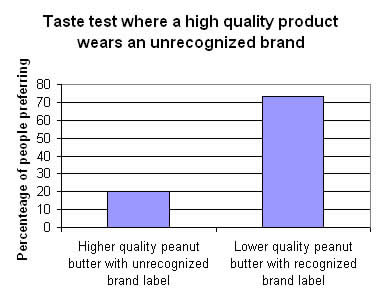
No. They chose the highest-quality product 20% of the time when it was labelled as an unrecognized brand. They preferred the one labelled as the recognized brand 73% of the time, despite it being lower quality. Recognition can be more influential than taste perception.
In their next genius manipulation, they gave people the exact same peanut butter in 3 different jars, two with unrecognzied brand labels and one with a recognized brand label. Which did people prefer?
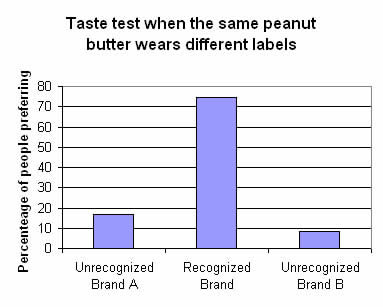
75% chose the recognized brand despite it being the same as the other two jars. Amazing.
About the authors:
Wayne D. Hoyer
Steven P. Brown
Reference:
Hoyer, W. D., & Brown, S. P. (1990). Effects of Brand Awareness on Choice for a Common, Repeat-Purchase Product. Journal of Consumer Research, 17(2), 141-48.
COLLABORATIVE DECISION RESEARCH WITH WIKIS


DSN has talked and worked with several labs that use Wikis and Blogs to organize lab research. Instead of emailing files to one another, lab members can simply post them to a lab wiki. Parts of wikis and be password protected, as can blogs offered by typepad.com.
Free online wikis that need no installation are offered by PBwiki and jot.com.
INTERUNIVERSITY DECISION BEHAVIOR TEACHING REPOSITORY

The Interuniversity Decision Behavior Teaching Repository is a harbor for materials on teaching decision making from the world over. The project was started up by J. Frank Yates, with the help of a National Science Foundation grant. In his words:
“The future of judgment and decision making scholarship depends directly on how widely and how well the subject is taught, at the undergraduate, graduate, and professional levels.
The Repository is intended to be a living storehouse of materials useful to anyone who is interested in teaching decision behavior topics in a dedicated course (e.g., Decision Processes) or within more general courses (e.g., Introduction to Political Science, Finance, Operations Management, Interpersonal Relationships, Clinical Diagnosis).”
Decision researchers are urged to use the resources already in the Repository and to contribute their own: syllabi, exercises, readings, demonstrations, commentaries, assignments, and beyond.
DSN will keep its eyes on the repository and hopes to find much to promote there.
35TH EUROPEAN MARKETING ACADEMY CONFERENCE IN ATHENS GREECE

The 35th European Marketing Academy Conference will take place in Athens, Greece from May 23rd to May 26th, 2006. The self-described aim of the conference is “to determine and interpret the conditions that are necessary for marketing leadership, while relating the findings of academic research with actionable business directions.”
Nearly 1,000 papers have been reviewed for the conference’s 20 tracks. It should be quite a show.
Registration information.
Hotel information.