WHEN TO STOP INFORMATION SEARCH?
Today’s highlight article comes from Dan Gilbert’s mention of it in his recent New York Times Op-Ed piece:
“Two psychologists, Peter Ditto and David Lopez, told subjects that they were being tested for a dangerous enzyme deficiency. Subjects placed a drop of saliva on a test strip and waited to see if it turned green. Some subjects were told that the strip would turn green if they had the deficiency, and others were told that the strip would turn green if they did not. In fact, the strip was just an ordinary piece of paper that never changed color.
So how long did subjects stare at the strip before accepting its conclusion? Those who were hoping to see the strip turn green waited a lot longer than those who were hoping not to. Good news may travel slowly, but people are willing to wait for it to arrive.
The same researchers asked subjects to evaluate a student’s intelligence by examining information about him one piece at a time. The information was quite damning, and subjects were told they could stop examining it as soon as they’d reached a firm conclusion. Results showed that when subjects liked the student they were evaluating, they turned over one card after another, searching for the one piece of information that might allow them to say something nice about him. But when they disliked the student, they turned over a few cards, shrugged and called it a day.”
For over a quarter century we’ve known that people use heuristics to make decisions. The challenge of the next quarter century is to figure out what governs which heuristics are pulled from the toolbox when. When do we choose between a heuristic that cuts search short and one that digs through information? These kinds of considerations, and not fat (as in overweighted) linear models, are a start.
Reference: Motivated Skepticism: Use of Differential Decision Criteria for Preferred and Nonpreferred Conclusions. Peter H. Ditto and David F. Lopez. Journal of Personality and Social Psychology 1992, Vol. 63, No. 4, 568-584.
Filed in
Conferences
 Subscribe
 to Decision Science News by Email (one email per week, easy unsubscribe)
MOTIVATION AND AFFECT IN DECISION MAKING CONFERENCE, DEAD SEA, ISRAEL, DECEMBER 12-15 2006
Keynote speaker: Nobel Laureate Daniel Kahneman
Venue: Crowne Plaza Hotel, Ein Boqeq, The Dead Sea
Submission deadline: July 10, 2006
The Decision Making and Economic Psychology Center at Ben-Gurion University of the Negev and the Behavioral Decision Making group at the UCLA Anderson School of Management invite submissions of papers for the above conference. The conference will include mostly one-track talks by invited participants. Submitted papers, if accepted, will be assigned to either a parallel session section or a poster session. While most of the invited talks focus on the relationship between affect, motivation, and decision making, submission of papers in other areas of decision making is also possible.
For more information about the program, invited participants, registration and other relevant issues, please consult the conference website, at http://www.bgu.ac.il/~dmep
Filed in
Jobs
Subscribe to Decision Science News by Email (one email per week, easy unsubscribe)
DECISION SCIENCES TENURE TRACK JOB AT IESE
Spain has some of the finest decision scientists anywhere. Consider living the good life and applying for the following post.
The Decision Sciences department at IESE Business School (Barcelona) invites applications for a tenure track position (assistant professor level). Applicants should have a research interest in managerial decision making, broadly defined, and show ability do mathematical modelling as well as experimental research work. IESE is an international business school with top-ranked MBA and executive programs. The school has campuses in Barcelona and Madrid, and offers regular programs in Munich and Sao Paulo.
Interested candidates should send a cv, research statement, and representative paper/s by E-mail to mbaucells at iese.edu. Candidates should also arrange for two or three letters of recommendation to be sent separately. Review of materials will begin on May, 5th, 2006, and will continue until the position is filled.
ASSESSING RISK TOLERANCE WITH A SIMPLE GAMBLE
Want to estimate risk tolerance with just one question? Thanks to Bob Clemen who has written a nice piece about it in the Decision Analysis Newsletter, and to the SJDM mailing list, here’s the one question:
“Suppose you face a gamble where you can win $x with probability 0.5 or lose $x/2 with probability 0.5. What is the largest x for which you would be just willing to take this gamble? Iâm looking for the largest x that makes you just indifferent between taking the gamble or not.”
In Clemen’s book Making Hard Decisions, in the solutions manual, he gives a derivation of how to get from the respose to that question into an estimate of the risk tolerance parameter R in the exponential utility function U(x) = 1-exp(-x/R).

Another way to estimate risk tolerance is using the Distribution Builder
WHO TALKS TO WHOM: INTRA- AND INTERDISCIPLINARY COMMUNICATION OF ECONOMICS JOURNALS
A talk by Jeffrey Pfeffer currently touring the world cites some stats from Who Talks to Whom? Intra- and Interdisciplinary Communication of Economics Journals, a 2002 paper by Rik Pieters and Hans Baumgartner:
” * 90% of citations in economics is intradisciplinary
* The 5 economics journals studied made no citations to management, marketing, anthropology, or psychology journals
* Economics is cited 4333 times by its sister disciplines between 1995 & 1997, while economics cites other disciplines (mostly finance at 79%) 601 times”
ABSTRACT of Pieters and Baumgartner:
Citation patterns between 42 journals in economics from 1995 to 1997 are examined, plus between economics and anthropology, political science, psychology, sociology and five business disciplines. Building on social network theory, we identify a hierarchical organization of journals in economics and seven journal clusters. Major citation flows are found from all areas of economics to the general interest and theory and method clusters, but not the other way around. Economics emerges as a significant source of interdisciplinary knowledge for the other social sciences and business. However, no area of economics appears to build substantially on insights from its sister disciplines.
Also note this recent piece in Foreign Policy by Moisés NaÃm suggest economics is overly inward gazing given its limited ability to preform its bread and butter task of forecasting the future(a point also made in a forthcoming book by Nassim Taleb).
AUTHORS:
Jeffrey Pfeffer
Rik Pieters
Hans Baumgartner
R STATISTICAL LANGUAGE MULTI-SITE SEARCH
Image (C) R Foundation, from http://www.r-project.org
Decision researchers and fellow bloggers Jon Baron and Andrew Gelman are big fans and supporters of the R project for statistical computing.
Searching for information on R can be difficult (though Baron’s R search tool is a great help), so DSN has put together a search widget that only queries R sites:
R Statistical Language Multi-Site Search
Simply click the image above to search and see the results from many sites. Sites searched include:
finzi.psych.upenn.edu
cran.r-project.org
wiki.r-project.org
lib.stat.cmu.edu/S
lib.stat.cmu.edu/R
tolstoy.newcastle.edu.au/R
and DSN welcomes suggestions for additions and deletions.
Filed in
Books
Subscribe to Decision Science News by Email (one email per week, easy unsubscribe)
INFORMATION SCIENCE

When DSN was visiting Stanford’s Department of Management Science and Engineering in the late 90s, it was called “Engineering-Economic Systems and Operations Research”. A change for the better, no? One thing that hasn’t changed is the excellence of the people there.
We just got our copy David Luenberger’s new Information Science. Not only is it a handsome book (big but not heavy, with cottony paper), it’s like an entire college education on a field you never knew existed, looking at everything from file compression to marketing to microeconomics through one beautiful framework set forth by Claude Shannon in 1949. It includes a nice Shannon quote, from 1953:
The first [method] I might speak about is simplification. Suppose that you are given a problem to solve, I don’t care what kind of problemâa machine to design, or a physical theory to develop, or a mathematical theorem to prove or something of that kindâprobably a very powerful approach to this is to attempt to eliminate everything from the problem except the essentials; that is, cut it down to size. Almost every problem that you come across is befuddled with all kinds of extraneous data of one sort or another; and if you can bring this problem down into the main issues, you can see more clearly what you are trying to do an perhaps find a solution. Now in so doing you may have stripped away the problem you’re after. You may have simplified it to the point that it doesn’t even resemble the problem that you started with; but very often if you can solve this simple problem, you can add refinements to the solution of this until you get back to the solution of the one you started with.
Luenberger comments “Shannon’s approach of abstraction to an essence should become clear as we study his contributions throughout this text. His work is a testament to the power of the method.”
REFERENCE:
Shannon, Claude E. Creative Thinking. Mathematical Sciences Research Center, AT&T, 1993.
Filed in
Books
Subscribe to Decision Science News by Email (one email per week, easy unsubscribe)
WEB EXPERIMENTS MUST BE GOOD WEB SITES

To do a good web-based experiment, a researcher needs to keep the drop-out rate as low as possible. Good Web design is key to getting people to take experiments seriously and to finish what they start. By encouraging good coding practices, it also improves cross-platform and cross-browser performance.
DSN likes the simple heuristics-based approach of the book Defensive Design for the Web by 37signals, Matthew Linderman, and Jason Fried, which contains 40 practical guidelines for how to improve a site.
VISUAL LEAST SQUARES
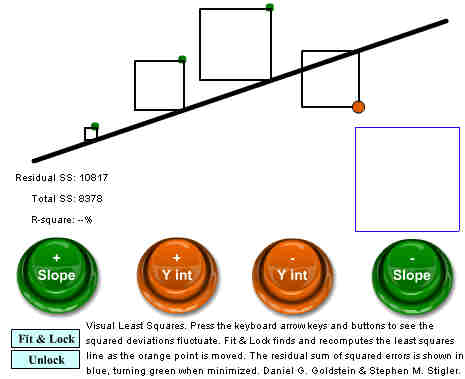
(Click on the image to interact with the tool)
Back when the DSN editor was a student at Chicago, he learned Statistics and History of Statistics from Steve Stigler, who proposed a visual demonstration of least squares regression. Together they came out with a now-obsolete Mac version. Today, DSN is proud to announce a version that will run on any browser that does Flash.
The demonstration should be self-explanatory to anyone who understands simple regression, and if not, might suffice as a tutor. And if not, there is always the linear regression article in Wikipedia.
FAQ
Can I use this to teach my class?
Yes, and please let us know how it goes! A benefit of the web-based version is that it can be reached from any place with a Web connection. This program is made available through a Creative Commons License (Attribution-NonCommercial-NoDerivs) which means that you are welcome to use it for non-commercial purposes.
Can you make a convenient URL for this tool?
Yes, how about http://www.dangoldstein.com/regression.html
RUNAWAY POPULARITY EFFECTS IN MUSIC DOWNLOADING

Back when DSN was headquatered at Columbia, it helped out a bit with Matt Salganik and Duncan Watts’ project on runaway popularity effects in music downloading. The paper is now out in Science (vol 311, page 854): Experimental Study of Inequality and Unpredictability in an Artificial Cultural Market.
It’s a fascinating look at how popularity breeds popularity in a controlled but realistic setting with an enormous sample size of over 14,000 people. Have a read.
Quote
“One explanation for the observed inequality of outcomes [in cultural markets] is that the mapping from quality to success is convex (i.e., differences in quality correspond to larger differences in success), leading to what has been called the superstar effect, or winner-take-all markets. Because models of this type, however, assume that the mapping from quality to success is deterministic and that quality is known, they cannot account for the observed unpredictability of outcomes. An alternate explanation that accounts for both inequality and unpredictability asserts that individuals do not make decisions independently, but rather are influenced by the behavior of others”
Books by Duncan Watts
* Small Worlds
* Six Degrees