[ View menu ]

June 21, 2012

2012 guide to the American Marketing Association job market interviews for aspiring professors

Filed in Gossip ,Ideas ,Jobs
Subscribe to Decision Science News by Email (one email per week, easy unsubscribe)

EVERYTHING YOU EVER WANTED TO KNOW ABOUT THE AMA INTERVIEWS (2012 edition)

PhD students in Marketing, Psychology, and Economics should send their “packets” out by the fourth of July in the hopes of lining up interviews at the annual AMA Summer Educator’s Conference. Each year DSN reprints this sort of “what to expect while you’re applying” guide, first published here by Dan Goldstein in 2005.

SHARE YOUR OWN AMA TIPS
I am more than happy to publish AMA tips, updated information, or just AMA horror stories as part of this post. You can reach me at dan at dangoldstein dot com and let me know if you want to be anonymous or nonymous.

WHY AM I WRITING THIS?
I’ve seen the Marketing job market turn happy grad students into quivering masses of fear. I want to share experiences that I and others have contributed, and provide a bit advice to make the whole process less mysterious.

WHY SHOULD ANYONE LISTEN TO ME?
I’ve been on the AMA job market twice (mid 2000s), the Psychology market once (late 90s). As a professor I’ve conducted 20 AMA interviews and been a part of dozens of hiring decisions. I’ve been on the candidate end of about 40 AMA interviews, and experienced numerous campus visits, face-to-face interviews, offers, and rejections. I’m an outsider to Marketing who went on the market older and with more experience than the average rookie (35 years of age, with 8 years of research scientist, postdoc, visiting scholar, and industry positions). I’ve hired many people for many academic posts, so I know both sides.

HOW TO GET INTO THE AMA JOB MARKET
First, at least a couple months before the conference, find where it will be. It’s called the American Marketing Association Summer Educator’s Conference. Strange name, I know. Insiders just call it “The AMA”. Get yourself a room in the conference hotel, preferably on the floor where the express elevator meets the local elevator for the upper floors. You’ll be hanging out on this floor waiting to change elevators anyway, so you might as well start there.

Next, get your advisor / sponsor to write a cover letter encouraging people to meet with you at AMA. It helps if this person is in Marketing. Get 1 or 2 other letters of recommendation, a CV, and some choice pubs. Put them in an envelope and mail them out to a friend of your sponsor at the desired school. It should look like the letter is coming from your sponsor, even though you are doing the actual assembly and mailing. Repeat this process a bunch of times. It’s a good idea to hit a school with 2 packets, 3 if you suspect they’re a little disorganized. Certainly send one to the recruiting coordinator (you might find their name on hiring announcements, which are often sent to your home department’s secretary) and one to your sponsor’s friend. Mail to schools regardless of whether they are advertising a position or not. This is academia: nobody knows anything. This means you may be sending 50 or more packets. You want to have them mailed by the 4th of July.

THEN WHAT?
Wait to get calls or emails from schools wishing to set up AMA interviews with you. These calls may come in as late as one week before the conference. Often they come when you are sitting outside having a drink with friends. Some schools will not invite you for totally unknown reasons. You may get interviews from the top 10 schools and rejected from the 30th-ranked one. Don’t sweat it. Again, this is the land of total and absolute unpredictability that you’re entering into. Also, know that just because you get an interview doesn’t mean they have a job. Sometimes schools don’t know until the last minute if they’ll have funding for a post. Still, you’ll want to meet with them anyway. Other times, schools are quite certain they have two positions, but then later university politics shift and they turn out to have none.

After the AMA, you’ll hopefully get “fly-outs,” that is, offers to come and visit the campus and give a talk. This means you’ve made the top five or so. Most offers go down in December. There’s a second market that happens after all the schools realize they’ve made offers to the same person. Some schools over-correct for this and don’t make offers to amazing people who would have come. We need some kind of market mechanism to work out this part of the system.

THE “IT’S ALL ABOUT FRIENDSHIP” RULE
Keep in mind that you will leave this process with 1 or 0 jobs. Therefore, when talking to a person, the most likely thing is that he or she will not be your colleague in the future. You should then think of each opportunity as a chance to make a friend. You’ll need friends to collaborate, to get tenure, get grants, and to go on the market again if you’re not happy with what you get.

HOW DO YOU FIND OUT IN WHICH ROOM TO INTERVIEW?
The schools will leave messages for you telling you in which rooms your interviews will be. You’ll get calls, emails, and notes held for you at the hotel reception. Some schools will fail to get in touch with you so you have to try to find them. Many profs ask the hotel to make their room number public, but for some reason many hotel operators will still not give you the room number. Naturally having a mobile internet connection allows for emailing of room numbers. Try to take care of this early on the first day.

HOW TO TREAT YOURSELF WHILE THERE
My sponsor gave me the advice of not going out at night and getting room service for breakfast and dinner. This worked for me. Also, the ridiculously high price of a room-service breakfast made me feel like I was sparing no expense, which I found strangely motivating.

HOW DO THE ACTUAL AMA INTERVIEWS GO?
At the pre-arranged time you will knock on their hotel room door. You will be let into a suite (p=.4) or a normal hotel room (p=.5, but see below). In the latter case, there will be professors with long and illustrious titles—people you once imagined as dignified—sitting on beds in their socks. The other people in the room may not look at you when you walk in because they will be looking for a precious few seconds at your CV. For at least some people in the room, this may be the first time they have concentrated on your CV. Yikes is right. Put the important stuff early in your CV so nobody can miss it.

THE SEAT OF HONOR
There will be one armchair in the room. Someone will motion towards the armchair, smile, and say, “You get the seat of honor!” This will happen at every school, at every interview, for three days. I promise.

THE TIME COURSE
There will be two minutes of pleasant chit-chat. They will propose that you talk first and they talk next. There will be a little table next to the chair on which you will put your flip book of slides. You will present for 30 minutes, taking their questions as they come. They will be very nice. When done, they will ask you if you have anything to ask them. You of course do not. You hate this question. You make something up. Don’t worry, they too have a spiel, and all you need to do is find a way to get them started on it. By the time they are done, it’s time for you to leave. The whole experience will feel like it went rather well.

PREDICTING IF YOU WILL GET A FLY-OUT
It’s impossible to tell from how it seems to have gone whether they will give you a fly-out or not. Again, this is the land of staggering and high-impact uncertainty. They might not invite you because you were too bad (and they don’t want you), or because you were too good (and they think they don’t stand a chance of getting you and they don’t want to waste a precious fly-out on you). The latter fact means that “playing hard to get” is a bad idea.

DO INTERVIEWS DEVIATE FROM THAT MODEL?
Yes.

Sometimes instead of a hotel room, they will have a private meeting room (p=.075). Sometimes they will have a private meeting room with fruit, coffee, and bottled water (p=.025). Sometimes, they will fall asleep while you are speaking (p=.05). Sometimes they will be rude to you (p=.025). Sometimes a key person will miss an early interview due to a hangover (p=.025). Sometimes, if it’s the end of the day, they will offer you alcohol (p=.18, conditional on it being the end of the day).

HOW YOU THINK THE PROCESS WORKS
The committee has read your CV and cover letter and looked at your pubs. They know your topic and can instantly appreciate that what you are doing is important. They know the value of each journal you have published in and each prize you’ve won. They know your advisor and the strengths she or he instills into each student. They ignore what they’re supposed to ignore and assume everything they’re supposed to assume. They’ll attach a very small weight to the interview and fly you out based on your record, which is the right thing to do according to a mountain of research on interviews.

HOW THE PROCESS REALLY WORKS
The interviewers will have looked at your CV for about one minute a couple months ago, and for a few seconds as you walked in the room. They will never have read your entire cover letter, and they will have forgotten most of what they did read. They could care less about your advisor and will get quite annoyed that you didn’t cite their advisor. They’ll pay attention to everything they’re supposed to ignore and assume nothing except what you repeat five times. Flouting 50 years of research in judgment and decision-making, they’ll attach a small weight to your CV and fly you out based on the interview and their gut feeling.

IF ENGLISH IS NOT YOUR MOTHER TONGUE
Your ability to speak English well won’t get you a good job, but your inability to do so will eliminate you from consideration at every top school. Understand that business schools put a premium on teaching. If the interviewers don’t think you can communicate in the classroom, they’re probably not going to take a chance on you. If you are just starting out and your spoken English is shaky, my advice is to work on it as hard as you are working on anything else. Hire a dialect coach (expensive) or an english-speaking actor or improviser (cheaper) to work with you on your English pronunciation. In the Internet age, it’s quite easy to download samples of English conversational speech, for instance from podcasts, for free. It’s also very easy to get a cheap headset and a free audio recorder (like Audacity) with which to practice.

TWO WAYS TO GIVE YOUR SPIEL
1) The plow. You start and the first slide and go through them until the last slide. Stop when interrupted and get back on track.

2) The volley. Keep the slides closed and just talk with the people about your topic. Get them to converse with you, to ask you questions, to ask for clarifications. When you need to show them something, open up the presentation and show them just that slide.

I did the plow the first year and the volley the second year. I got four times more fly-outs the second year. Econometricians are working hard to determine if there was causality. I would not attempt the volley unless you are generally considered to be good with words.

HOW TO ACT
Make no mistake, you are an actor auditioning for a part. There will be no energy in the room when you arrive. You have to be like Santa Claus bringing in a large sack of energy. The interviewers will be tired. They’ve been listening to people in a stuffy hotel room from dawn till dusk for days. If you do an average job, you lose: You have to be two standard deviations above the mean to get a fly-out. So audition for the part, and make yourself stand out. If you want to learn how actors audition, read Audition by Michael Shurtleff.

SOCIAL SKILLS MATTER
From the candidate’s point of view, everything is about the CV and the correctness of the mathematical proofs in the job market paper. However, for better or for worse, extra-academic qualities matter. Here are two examples. 1) The Social Lubricant factor. Departments get visitors all the time: guest speakers, visiting professors, job candidates, etc. Some departments are a bunch of folks who stare at their shoes when introduced to a new person. These departments have a real problem: they have nobody on board who can make visitors feel at ease, and sooner or later word starts to spread about how socially awkward the people at University X are. To fix such problems, departments sometimes hire socially-skilled types who know how to make people comfortable in conversation, and who know how to ask good questions during talks. Also, interviewers assume that people who can talk a good game will be star teachers. 2) The Soft Sell factor. Many people succeed in academia not because they are often right, but also because they are masters of making other people feel like they aren’t wrong. Defensiveness or determination to embarrass when responding to critique is an effective way to blow an interview.

HAVE A QUIRK
One of the biggest risks facing you is that you will be forgotten. Make sure the interviewers know something unusual about you. My quirk is that I worked internationally as an actor and theater director for over a decade; I even had a bit part in a Conan O’Brien sketch on TV. It has nothing to do my research, but people always bring up this odd little fact when I do campus visits. Some bits of trivia are just more memorable than others.

DON’T GIVE UP
Never think it’s hopeless. Just because you’re not two SDs above the mean at the school of your dreams, it does not mean you’re not the dream candidate of another perfectly good school.

Many candidates don’t realize the following: The students are competing for schools but the schools are also competing for students. If you strike out, you can just try again next year. I know a person in Psychology who got 70 rejections in one year. I know a person in Marketing who was told he didn’t place in the top 60 candidates at the 20th ranked school. The subsequent year, both people got hired by top 5 departments. One of them is ridiculously famous and considered among the smartest people in Marketing!

RUMORS
Gossip can mess with your chances. Gossip that you are doing well can hurt you because schools will be afraid to invite you if they think you won’t come. Gossip that you are doing poorly can hurt you because schools that like you will be afraid to invite you if they think no one else does. Sometimes people will ask a prof at your school if you would come to their school, and the prof will then ask you. To heck with that. Just say that if they want to talk to you, they should talk with you directly.

The danger of rumors can be summed up by the following story. At ACR in 2003, I was having a beer with someone who confessed, “you know, my friend X at school Y told me that they want to hire you, but they’re afraid your wife won’t move to Z”. I was single.

**ADDENDUM**
Ethan Pew let me know about a few useful Web links:
http://www.marketingphdjobs.com/ has general information about the Marketing job market, including a job board showing who is advertising jobs. This site also has information about the times when jobs are announced.
and
Candidates on the market can make themselves known to schools by filling out this form.

About timing, Ethan says:

July 4 is still largely the target for sending out packets, however schools seem to be moving to more of a just-in-time process. Last year, 53 positions were announced between July 4 and AMA. There were also 24 positions announced the last week in June — and presumably those schools didn’t expect packets by July 4. In total, those 77 positions accounted for 40% of the jobs announced prior to AMA last year.

It also seems to be the case that schools expect/require candidates to fill out the online HR application form (or submit materials to the mktgsearch@university.edu address set up for the application process). E-mailing a packet to the department chair may not be sufficient for getting into the consideration set for AMA interviews.

June 13, 2012

SJDM 2012 Call for Papers

Filed in Conferences
Subscribe to Decision Science News by Email (one email per week, easy unsubscribe)

SOCIETY FOR JUDGMENT AND DECISION MAKING ANNUAL CONFERENCE, MINNEAPOLIS, NOVEMBER 16-19, 2012

DEADLINE June 15, 2012! Get on it!

SJDM’s annual conference will be held in the Minneapolis Convention Center and the Hilton Minneapolis Hotel, Minneapolis, Minnesota, during November 16-19, 2012. Early registration and welcome reception will take place the evening of Friday, November 16. Hotel reservations at the $170/night Psychonomic convention rate are available here.

Below is the Call for Abstracts. The submission page (after you read the Call) is at http://sql.sjdm.org. Information about applying for special awards is there too.

2012 CALL FOR ABSTRACTS: ANNUAL MEETING OF THE SOCIETY FOR JUDGMENT AND DECISION MAKING

The Society for Judgment and Decision Making (SJDM) invites abstracts for oral presentations, posters, and symposia* on any interesting topic related to judgment and decision making. Completed manuscripts are not required. (*Please note that historically, symposium submissions have had substantially lower acceptance rates than individual paper submissions due to requirements for high integration and quality across all papers in the session. Authors who feel that a grouping of presentations is essential to communicating their research, can submit a symposium with the knowledge that they are rarely accepted and that a subset of papers within the symposium might be accepted even if the whole symposium is rejected.)

LOCATION, DATES, AND PROGRAM

SJDM’s annual conference will be held in the Minneapolis Convention Center and the Hilton Minneapolis Hotel, Minneapolis, Minnesota, during November 16-19, 2012. Early registration and welcome reception will take place the evening of Friday, November 16. Hotel reservations at the $170/night Psychonomic convention rate are available.

KEYNOTE: Brian Wansink will be the keynote speaker.

SUBMISSIONS

The deadline for submissions is June 15, 2012. Submissions for symposia, oral presentations, and posters should be made through the SJDM website at http://sql.sjdm.org. Technical questions can be addressed to the webmaster at www@sjdm.org. All other questions can be addressed to the program chair, Bernd Figner, at bf2151@columbia.edu.

ELIGIBILITY

At least one author of each presentation must be a member of SJDM. Joining at the time of submission will satisfy this requirement. You can join through the SJDM website at http://www.sjdm.org/join.html. An individual may give only one talk (podium presentation) and present only one poster, but may be a co-author on multiple talks and/or posters.

AWARDS

The Best Student Poster Award is given for the best poster presentation whose first author is a student member of SJDM. To be eligible for the award, posters much be submitted in advance by email. More information to come.

The Hillel Einhorn New Investigator Award is intended to encourage outstanding work by new researchers. Applications are due June 15, 2012. Further details will are available at http://www.sjdm.org/awards/einhorn.html. Questions can be directed to the chair of the Hillel Einhorn New Investigator Committee, Tim Pleskac, pleskact@msu.edu

The Jane Beattie Memorial Fund subsidizes travel to North America for a foreign scholar in pursuits related to judgment and decision research, including attendance at the annual SJDM meeting. For details, see http://www.sjdm.org/awards/beattie.html.

PROGRAM COMMITTEE

Bernd Figner (Chair), Nathan Novemsky, Robyn LeBeouf, Jack Soll, Gretchen Chapman, Wandi Bruine de Bruin, Ellie Kyung, Anuj Shah, Katherine Burson

June 6, 2012

If you bet that you’ll lose weight, do you regain it when the bet is over?

Filed in Articles ,Ideas ,Research News ,Tools
Subscribe to Decision Science News by Email (one email per week, easy unsubscribe)

A LONGER-TERM STUDY OF WHAT HAPPENS WHEN COMMITMENT CONTRACTS EXPIRE

A popular kind of commitment device is betting that you’ll lose weight.

At Decision Science News, we love the commitment devices. But, as we’ve have spoken about, we have mixed feelings about them, including the nagging concern that commitment devices may not lead to deep-seated changes or habit formation.

When the commitment device is gone, do the good habits remain?

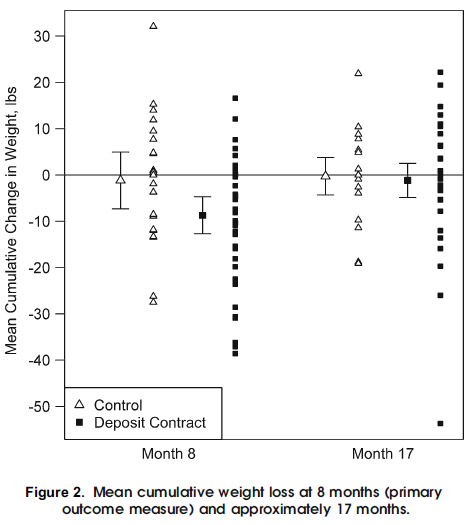
This week, we got some empirical evidence on that question. We were down at Penn, attending the Annual Symposium put on by the Penn CMU Roybal P30 Center in Behavioral Economics and Health, and Leslie John and colleagues presented a longer-run study spanning an eight month period during which a commitment contract was in place, and a follow-up period of 9 months. As the figure above shows, at Month 8 the devices worked: People lost about 10 pounds

But what happened when the commitment devices expired? When all bets were off, all the weight was regained (Month 17 in the figure above).

This is the first study we know of that looks at the longer-term consequences of commitment contracts. It’s hard to generalize from one study, but we think it shows that if you want a commitment device to work, you simply can’t let it drop. You have to keep renewing. So, if commitment devices are going to help folks, we need to find ways to get people to renew them. Or seek deep-seated changes so that people will do the right thing even when the device is absent.

REFERENCE
Leslie K. John, George Loewenstein, Andrea B. Troxel, Laurie Norton, Jennifer E. Fassbender, and Kevin G. Volpp. (2011). Financial Incentives for Extended Weight Loss: A Randomized, Controlled Trial. Journal of General Internal Medicine. DOI: 10.1007/s11606-010-1628-y

ADDENDUM
Reader Alex V writes in with another experiment of this type, and one that does find longer run effects (at 12 months). We wonder if it is easier to stay off cigarettes than to stay off food. That is, quitting smoking is *very* hard, but once one has crossed over, perhaps it is easier not to relapse.

Put Your Money Where Your Butt Is: A Commitment Contract for Smoking Cessation
American Economic Journal: Applied Economics, 2(4): 213-35, October 2010, with Xavier Gine and Dean Karlan.

This paper tested a voluntary commitment product (CARES) for smoking cessation, where smokers were offered a savings account in which they deposit funds for 6 months, after which they take urine tests for nicotine and cotinine. If they pass, the money is returned; otherwise it is forfeited. 11% of smokers offered CARES take it up, and smokers randomly offered CARES were 3% more likely to pass a 6-month test than the control group.

The effect persists in surprise tests at 12-months. So this is just one more paper that looks at the longer-term effects of commitment contracts! (albeit not that far into the future).

June 1, 2012

The hot hand effect in volleyball

Filed in Articles ,Books ,Ideas ,Research News
Subscribe to Decision Science News by Email (one email per week, easy unsubscribe)

IS THE HOT HAND SPORT SPECIFIC?

Belief in the hot hand in sports is the belief that someone who makes a shot has an increased probability of making the next shot (above what his or her long run stats would suggest), and that someone who misses a shot has a decreased probability of making the next shot (below what his or her long run stats would suggest).

There is much debate about the hot hand effect. The Wikipedia article on the topic calls it the hot hand fallacy, and the debate is whether it is really a fallacy. What if, in certain sports, there really are times when players are hot or cold relative to their long run averages? Belief in the hot hand would be sensible.

There is much written on the topic. JDMer Alan Reifman has a hot hand website and a hot hand book: Hot Hand: The Statistics Behind Sports’ Greatest Streaks

In a recent paper, Markus Raab et al. claim there is evidence of the hot hand in volleyball, and that it’s not a fallacy to believe in it there. According to Wikipedia, many in volleyball believe in and act on the hot hand effect. Alan Reifman has commented on it the Raab article here, with some suggested minor improvements.

Here’s the paper’s reference and abstract.

REFERENCE Raab, M., Gula, B. & Gigerenzer, G. (2011). The Hot Hand Exists in Volleyball and Is Used for Allocation Decisions. Journal of Experimental Psychology: Applied, 18 (1), 81-94. [Download]

ABSTRACT

The “hot hand” belief in sports refers to the conviction that a player has a higher chance of making a shot after two or three successful shots than after two or three misses (resulting in “streaks”). This belief is usually considered a cognitive fallacy, although it has been conjectured that in basketball the defense will attack a “hot” player and prevent streaks from occurring. To address this argument, we provide the first study on the hot hand in volleyball, where the net limits direct defensive counterstrategies, meaning that streaks can more likely emerge if a player is hot. We first establish that athletes believe in the hot hand in volleyball (Study 1A). Analyzing the top 26 first-division players, we then show that streaks do exist for half of the players (Study 1B). Coaches can detect players’ performance variability and use it to make strategic decisions (Study 2A). Playmakers are also sensitive to streaks and rely on them when deciding to whom to allocate the ball (Study 2B). We conclude that for volleyball the hot hand exists, coaches and playmakers are able to detect it, and playmakers tend to use it “adaptively,” which results in more hits for a team.

SEE ALSO
Gilovich, Thomas; Tversky, A. & Vallone, R. (1985). “The Hot Hand in Basketball: On the Misperception of Random Sequences”. Cognitive Psychology 3 (17), 295–314

Photo credit:http://www.flickr.com/photos/spasmoid/2224941051/

May 23, 2012

The 500 calorie meal

Filed in Ideas
Subscribe to Decision Science News by Email (one email per week, easy unsubscribe)

CHANGING YOUR WEIGHT BY CHANGING THE ENVIRONMENT

One of Decision Science News’ rules of thumb for losing weight was never eat more than 500 calories at at time.

In Japan(*), they have institutionalized this at the Tanita Shokudo restaurant, which serves a daily 500 calorie meal.

We at DSN believe this will work, as we’ve seen our own weights decrease after moving to small-portion-size countries and increase after moving back to the States. We admit to following a simple  heuristic of “eat what you get till it’s gone”.

(*) BTW, we’ve noticed that people pay more attention when you preface things with “In Japan, …”.

May 17, 2012

Ecological Rationality: A New Book

Filed in Books
Subscribe to Decision Science News by Email (one email per week, easy unsubscribe)

INTELLIGENCE IN THE WORLD

Ecological Rationality: Intelligence in the World is a new book by Peter Todd, Gerd Gigerenzer and the ABC Research Group (including your Decision Science News editor). It is much of the same team who brought you Simple Heuristics That Make Us Smart, with a number of new voices in the mix.


Here is a blurb:

Ecological Rationality: Intelligence in the World explores how people can be effective decision makers by using simple heuristics that fit well into the structure of the environment. When we wield the right tool from the mind’s adaptive toolbox for a particular situation, we can make good choices with little information or computation. Thus, simple strategies excel by exploiting the reliable patterns in the world. Heuristics are not good or bad, “biased” or “unbiased,” on their own, but only in relation to the setting in which they are used. The authors demonstrate this principle through case studies of heuristics and environments fitting together to produce good decisions, in situations including sports competitions, the search for a parking space, business group meetings, and doctor/patient interactions. The message of Ecological Rationality is to study mind and environment in tandem. Intelligence is not only in the mind but also in the world, captured in the structures of information around us.

The interdisciplinary research presented in this book, by turns theoretical, empirical, and applied, will be interesting and inspiring for all those concerned with how people make decisions. With specific examples in a variety of domains, it shows psychologists, economists, philosophers, cognitive scientists, and ethologists how to study the mind together with the decision environment, and the perils of ignoring their vital interaction. Furthermore, this book provides guidance to practitioners who aim to design environments and institutions that help people make better choices.

May 11, 2012

11th TIBER Symposium on Psychology and Economics

Filed in Conferences
Subscribe to Decision Science News by Email (one email per week, easy unsubscribe)

GEORGE LOEWENSTEIN AND COLIN CAMERER KEYNOTE SPEAKERS

TIBER, the Tilburg Institute for Behavioral Economics Research is happy to announce the 11 Tiber Symposium on Psychology and Economics, to be held on August 24, 2012.

The symposium aims to bring together Economists, Psychologists, Marketing researchers and others who work on Behavioral Decision Making, either in individual or interdependent settings. The symposium will be held at Tilburg th University and consists of two keynotes, a number of parallel sessions with presentations of about 20 to 30 minutes, and a poster session.

This year’s keynote speakers are:

– George Loewenstein
– Colin Camerer

The goal of this series of symposia is to establish contact and discussion between researchers of the different fields. We look for empirical contributions from diverse fields, such as Individual Decision Making, Consumer Behavior, Bargaining, Social Dilemmas, Experimental Games, Emotions, Fairness and Justice, Rational Choice, and related subjects.

CALL FOR PAPERS
If you would like to contribute to this symposium by presenting a paper, we ask you to send an abstract of max. 300 words via email to Diana Vingerhoets (D.Vingerhoets@tilburguniversity.edu). Please use subject: TIBER XI in your email.
On the basis of these abstracts we will select presenters for the symposium. Please indicate whether you would be willing to present your research in a poster session by adding Poster: Yes or Poster: No to your submission.

IMPORTANT DATES
18th of April Call for papers
1st of June Deadline for submission of abstracts
18th of June Selection of speakers
11th of August Normal registration deadline (late registration fee applies after this date)
24th of August Symposium at Tilburg University

More information about the program of the symposium and the keynote speakers, as well as the location of the symposium and the registration forms will soon be available here.

If you have any questions regarding the conference, please contact Job van Wolferen (J.vanWolferen@tilburguniversity.edu). Again, please use subject: TIBER XI. Other organizers include Ilja van Beest, Rik Pieters, Jan Potters, and Marcel Zeelenberg.

May 3, 2012

We’re moving to Microsoft NYC

Filed in Gossip ,Jobs ,Research News
Subscribe to Decision Science News by Email (one email per week, easy unsubscribe)

FOUNDING MEMBERS OF MICROSOFT RESEARCH’S NEW YORK CITY LAB

As reported in the New York Times (Microsoft Taps Yahoo Scientists for New York Research Lab) and elsewhere, we’re moving to Microsoft. Your Decision Science News editor will be one of the founding members of a brand new Microsoft Research Lab in New York City.

The founding members, so far, are:

Sharad Goel web twitter
Dan Goldstein web twitter
Jake Hofman web twitter
John Langford web
Dave Pennock web twitter
Dave Rothschild web twitter
Sid Suri web twitter
Duncan Watts web twitter

Managing Directors of the lab are:
Jennifer Chayes
Christian Borgs

SELECTED REFERENCES:

NEW YORK TIMES
Microsoft Taps Yahoo Scientists for New York Research Lab

PC MAGAZINE
Microsoft Opens New York Research Lab With Former Yahoo Scientists

COMPUTERWORLD
Microsoft opens New York research lab, hires mainly Yahoo researchers

CNET
Microsoft snags Yahoo scientists for new research lab

ALL THINGS D
Microsoft Hires 14 Yahoo Researchers to Kick-Start New NYC Research Lab

MIT TECHNOLOGY REVIEW
Microsoft’s New Lab Hunts for Value in User Data

PRESS RELEASES
Start Spreading the News … Announcing Microsoft Research New York City!

Microsoft Research Debuts N.Y.C. Lab

Microsoft Research sets up home in NYC

MANY MORE REFERENCES:
Search Microsoft “New York”

April 25, 2012

Evil genius ad that uses the psychology of persuasion

Filed in Encyclopedia ,Ideas
Subscribe to Decision Science News by Email (one email per week, easy unsubscribe)

FAMILIARITY-LIKING EFFECTS VIA CAPTCHAS

Decision Science News was creating a new account online and had to fill out the above-pictured CAPTCHA (*) to proceed. It’s an ad and a CAPTCHA in one. It gets people to spend time and effort typing the name of the brand. [If you don’t know what a CAPTCHA is see Wikipedia, or the Official CAPTCHA Site]

That time and effort should serve the advertiser well.

Cognitive psychologists know that the longer people spend processing a thing the more likely they are to remember it. By getting you to type the name of the brand, you become more likely to remember it, which is what advertisers want.

But this manipulation does double duty. Psychologists have also uncovered the familiarity-liking effect in which repeated stimuli (e.g. songs) become liked simply for being familiar. These studies randomly assign people to various stimuli, repeat the stimuli over time, and measure liking, which tends to increase. Each subsequent impression of an ad has this effect on you, but some ad impressions go unnoticed. By getting you to type the name of the brand, you are pretty sure to notice it. [Another thing that determines whether people notice ads is the amount of time they are in view, see our recent papers on this here and here].

What’s next? Will they go after the frequency-validity effect, by which familiar statements are judged as more likely to be true? If so, the CAPTCHAs of the future will ask you to type things like “I’m going to buy a Prius C right away!”

REFERENCES

Arkes, H. R., Hackett, C. and Boehm, L. (1989), The generality of the relation between familiarity and judged validity. Journal of Behavioral Decision Making, 2,  81–94.

Bornstein, Robert F.  (1989) Exposure and affect: Overview and meta-analysis of research, 1968–1987. Psychological Bulletin, 106(2), 265-289.

Hintzman, Douglas L. and Richard A. Block (1971). Retition and memory: Evidence for a multiple-trace hypothesis. Journal of Experimental Psychology, 88(3), 297-306.

(*) One of the inventors of the CAPTCHA (the original one, not this manipulative version) is John Langford, a colleague of mine at Yahoo Research.

April 18, 2012

Scarred?

Filed in Ideas
Subscribe to Decision Science News by Email (one email per week, easy unsubscribe)

STRANGE WORD IN FRONT PAGE HEADLINES OF TWO NATIONAL NEWSPAPERS ON SAME DAY


A friend of Decision Science News awoke in a hotel on April 3rd of this year and found two newspapers outside the door. The Wall Street Journal used the word “scarred” in its front page headline, which was weird enough, but all was made far weirder by the USA Today, which used the same word, also in a front page headline, also above the fold, on the same day.

We could overfit and say that “scarred” is the hot buzzword of 2012, or underfit and act as though there’s nothing to this at all, but instead we’ll just put it out there.

Scarred. Consider it out there.