Filed in Encyclopedia Subscribe to Decision Science News by Email (one email per week, easy unsubscribe)
PIONEER OF MATHEMATICAL PSYCHOLOGY
Duncan Luce passed away earlier this year. William Batchelder has written (for the Society for Mathematical Psychology) the following biography of Duncan Luce’s intellectual contributions:
FACETS OF DUNCAN LUCE’S RESEARCH CAREER
Duncan Luce (1925-2012) was one of the pioneers in establishing mathematical psychology as a field of study. It is arguable that without Duncan’s leadership, intellect, and scholarly skills, the field would not have existed. He was the main force behind the publication of the two readings volumes and the three handbook volumes in mathematical psychology edited by Luce, Robert Bush, and Eugene Galanter from 1963-65. These five books together served to define our field. Later, he played a crucial role in starting our flagship journal, the Journal of Mathematical Psychology, as well as our Society. While everyone in the Society for Mathematical Psychology knows about Duncan and some aspects of his work, there are facets of his work that many members may be unaware of. The main purpose of this note is to celebrate Duncan’s work by focusing on a few of these facets.
Duncan received his PhD in Mathematics at M.I.T. in 1950. His thesis was titled “On Semigroups,” an area in abstract algebra. His earliest work in the social and behavioral sciences was in the area now called social networks. In his very first paper, published in 1949 with A. D. Perry, he mathematically defined the concept of clique and exploited the idea of representing graphs in matrix form, where matrix manipulations could be used to reveal the structure in a graph. This approach to analyzing graphic structures has become standard in the field of computer science, an area that hardly existed at the time of Duncan’s early work.
Duncan’s first academic position was as co-director of a network laboratory at M.I.T. from 1950-53, and his first tenure track position was as an Assistant Professor of Mathematical Statistics and Sociology at Columbia University (1954-57). It was in this period that Duncan acquired his lifelong interest in decision theory, and his 1957 book with Howard Raiffa, Games and Decisions: Introduction and Critical Survey, has become a classic in the economic sciences.
Perhaps the earliest hint of his future interest in psychology is seen in a paper with L. S. Christie in 1956 titled “Decision structure and time relations in simple choice behavior.” This paper foreshadowed the publication of Duncan’s well-received book, Response Times, published 30 years later. Apart from this 1956 paper almost all his early work was in the areas of social structure and decision theory, areas well outside of psychology at that time.
In 1959 Duncan published a very influential book, Individual Choice Behavior: A Theoretical Analysis. It is in this small book with a red cover that Luce’s choice axiom is proposed. One consequence of the choice axiom is the so-called ratio rule, namely if several possible choice alternatives have positive valued strengths, then the probability of any one of them being selected is its strength divided by the sum of the strengths of all the other available alternatives. The ratio rule has been employed by a number of cognitive modelers in moving from latent representations of response strengths into actual manifest responses. It is perhaps ironic that the ratio rule is only a small consequence of Luce’s choice axiom, which also includes the case where one or more of the choice alternatives has zero strength in certain contexts. In fact, his book explores the consequences of the choice axiom in many areas including paired-comparison scaling, Fechnerian scaling, signal detection, utility theory, and learning theory.
The style of the 1959 book, like almost all of Duncan’s work, is to proceed rationally with definitions, axioms, theorems, and proofs. The primary goal is to make progress by discovering the consequences of simple, non-trivial assumptions, rather than, say, inventing complex hypothetical structures with the primary goal of fitting data. Nevertheless, in all cases the aim of Duncan’s work is to discover the testable consequences of one’s assumptions. Duncan did not pose the choice axiom as the ‘correct theory’ of choice behavior. Instead, it was intentionally posed as an elegantly simple theory with many surprising consequences. Then when some choice phenomena is found not to satisfy the consequences of the choice axiom, it is often clear exactly what aspects of the axioms are in need of elaboration. Indeed, later work by others on choice theory has worked in the important concepts of item similarity, context effects, and time to respond that were intentionally missing from the choice axiom.
In 1959, Duncan published another classic work, “On the possible psychophysical laws.” In it he shows that given only knowledge of the scale type (ratio, interval, etc.) of an independent and dependent variable, one can determine the possible functional forms relating the two variables that are invariant under permissible scale transformations. That paper was not without controversy, because in many scientific laws there are dimension-absorbing constants that free up possible functional forms and thus delimit the applicability of Duncan’s results. Nevertheless, the 1959 paper was seminal in directing his interest to dimension analysis, an area associated at that time with mathematical physics. This interest in dimensional analysis was one of the strands that lead to Duncan’s long-term interest in the foundations of measurement discussed later.
In addition to the axiomatic/theorem approach, the 1959 paper on psychophysical scales reveals another hallmark of Duncan’s approach to formal theory. The idea is that a theory formulated by empirically motivated axioms can give rise to functional equations whose solution provides the possible functional relationships between theoretical and behavioral variables. The solutions to these equations can suggest experiments that have the potential to falsify the theory, and if falsified one can look at specific axioms for what went wrong and how to fix it. In Duncan’s later efforts to exploit this approach to theory construction, others assisted him, including the mathematician János Aczél, perhaps the World’s most respected solver of functional equations.
Foundations of measurement became a central topic of Duncan’s research from the middle 1960s up to the publication of the second and third volumes of the Foundations of Measurement in 1990, with Patrick Suppes, David Krantz, and Amos Tversky. In addition to the co-authors of the three foundational volumes, other mathematically savvy colleagues such as Louis Narens, Jean-Claude Falmagne, and Tony Marley joined him in this monumental effort. The thrust of the work was more directed to philosophy of science rather than to psychology. For this reason, the approach was mostly concerned with finding proper axiomatic formulations in idealized, error free settings rather than in more realistic settings involving measurement error. Despite the lack of concern with measurement error, some of the axiomatic work in foundations has been very influential in psychology such as Duncan’s 1964 paper with the statistician John Tukey on conjoint measurement. This paper has guided experimental psychologists to more carefully regard the hypothesis of an interaction between experimental variables.
Much of Duncan’s more empirical work was in the areas of psychophysics, with a special interest in acoustics. This work started in the middle 1960s, and much of it was carried out with his close association with David M. Green. Green’s active acoustics laboratory and Duncan’s mathematical ideas gave rise to some influential theoretical papers such as his 1972 paper with Green, “ A neural timing theory for response times and the psychophysics of intensity.” Somewhat uncharacteristically for Duncan, he published an undergraduate text, “Sound and Hearing,” in 1993, based on a course he developed at Harvard. I am certain many of us can understand how difficult it must have been for Duncan to find things to teach at the undergraduate level in an American university.
In his last ten years, Duncan published over fifty papers, and in these papers all the themes discussed above were represented many times over. Much of this work was coauthored with others mentioned earlier, and some of it was greatly assisted on the empirical side by his research association with Ragnar Steingrimsson.
William H. Batchelder
On behalf of The Society for Mathematical Psychology
Filed in Encyclopedia ,Ideas Subscribe to Decision Science News by Email (one email per week, easy unsubscribe)
ONE METHOD OF MANGO CUTTING
Not long ago, we at Decision Science News did not know how to cut a mango. Then we learned. After that, we made this subtitled tutorial video on a cool way to cut a mango.
Filed in Jobs Subscribe to Decision Science News by Email (one email per week, easy unsubscribe)
WORK IN THE UK’S FAMOUS “NUDGE UNIT”
We at Decision Science News have gotten to know and respect the UK Government’s Behavioral Insights Team as a member of its Academic Advisory Group. The team (aka the “nudge unit”) is a smart, small, and highly effective group inside the Cabinet Office (Number 10 Downing Street) that uses behavioral economics to improve government and policy in the UK. They do very good work and have had a number of visible “wins” in their first few years as a team. For this reason, we are excited to pass on the news that they are hiring and have four posts to fill. See a blurb below, with a full posting at: http://tinyurl.com/bit-job
Join the Behavioural Insights Team in the Cabinet Office/Number 10
The Behavioural Insights Team (more commonly referred to as the Nudge Unit) was set up in 2010 to help apply behavioural economics and behavioural psychology to public policy in the UK. It is generally regarded as one of the most innovative parts of the UK Government.
Having built a small, high performing team within the Cabinet Office, we are now looking to build our capacity in response to the growing demand across the public sector. We are looking to recruit up to 4 candidates.
Successful candidates will need to show that they:
1. have a good understanding of the behavioural science literature
2. have an understanding and ideally ability to conduct randomised controlled trials to test policy interventions; and
3. are highly motivated individuals capable of developing innovative solutions to often complex policy problems.
4. are strong team players
Candidates should be prepared to work on potentially any aspect of government or wider public sector policy. For example, over the past year the team has led work on health, energy, fraud, electoral registration, charitable giving, consumer affairs, the labour market, and access to finance for SMEs.
We would welcome applications from individuals looking to join the team on a part-time basis, for example while finishing PhDs.
Joining Cabinet Office – Flexible Resourcing and Development (FRD)
Joining us means you become part of the Cabinet Office Flexible Resourcing arrangements, the benefits of which include an opportunity to work in an organisation where the emphasis is placed on development as well as delivery, helping ensure people get the most out of the experience during their time with us.
In addition to working on interesting and challenging project work you will also get a dedicated development manager and join one of our 9 development streams. You will be actively encouraged and supporting to think about your development plan and share your skills, experience and expertise with others.
Filed in Articles ,Ideas Subscribe to Decision Science News by Email (one email per week, easy unsubscribe)
TRICKING PEOPLE INTO THINKING YOUR SCIENTIFIC SHOTS NEVER MISS
You visit the farm of a Texan, Joe, who claims to be a sharpshooter. When walking past his barn, you see a chalk target drawn on the wall with a bunch of tightly-grouped bullet holes in the bullseye. After observing that Joe can’t shoot well at all, you realize that he drew the bullseye after firing the shots.
The tale of the Texas sharpshooter resonates with JDM (Judgment and Decision-Making) research on perceiving illusory patterns, and a topic of recent interest, detecting bogus experimental results. In a recent paper, Ulrich Schimmack talks about multi-study research papers in this way. When you see 10 studies in a single paper that confirm a hypothesis, can you conclude that the basic effect is replicable and robust?
One problem in science is that reading a research article is a bit like visiting Joe’s farm. Readers only see the final result, without knowing how the final results were created. Is Joe a sharpshooter who drew a target and then fired 10 shots ar the target? Or was the target drawn after the fact?
-Schimmack, in press
We have been looking into the roots of the Texas Sharpshooter vignette in academic writing. The earliest and most common “initial” cite we found after a quick search was Grufferman’s from 1977, with no claims that this is the earliest use:
Here it is.
There have been several dramatic time-space clusters of leukemia reported in which, following an initial observation of two or more cases in a locality, a time unit and geographical area are selected so as to best define a time-space cluster. Such a posteriori clusters are analogous to the story of the Texas sharpshooter who would shoot his rifle at the side of a barn and then carefully draw a target around each bullet-hole so that each bullet-hole passed exactly through the center of the “bull’s-eye.” Although a posteriori clusters do serve to demonstrate that cases can cluster in time and space, they do not allow for determining whether this is more than a chance occurrence.
-Grufferman (1977)
REFERENCES
Grufferman S. (1977). Clustering and aggregation of exposures in Hodgkin’s disease. Cancer 39, 1829-1833
Schimmack, U. (in press). The Ironice Effect of Significant Results on the Credibility of Multiple Study Articles. Psychological Methods.
Filed in Books ,Ideas Subscribe to Decision Science News by Email (one email per week, easy unsubscribe)
EVOKING FRANKLIN TO GET PEOPLE TO BUY
In response to last week’s post about Franklin’s rule, your loyal Editor’s mother sends along this passage from the story “Can I Just Sit Here for a While?” from Ron Hansen’s Nebraska: Stories (also published in the Atlantic Monthly).
In the story, the salesman is telling an acquaintance that he “discovered a gimmick, a tool which handn’t failed him yet. It was called the Benjamin Franklin close.”
Say you get a couple who’re wavering over the purchase of a car. You take them into your office and close the door and say, ‘Do you know what Benjamin Franklin would do in situations like this?’ That’s a toughie for them so you let them off the hook. You take out a tablet and draw a line down the center of the page, top to bottom. ‘Benjamin Franklin,’ you say, ‘would list all the points in favor of buying this car and then he’d list whatever he could against it. Then he’d total things up.’ The salesman handles all the benefits. You begin by saying, “So okay, you’ve said your old car needs an overhaul. That’s point one. You’ve said you want a station wagon for the kids; that’s point two. You’ve told me that a particular shade of brown is your favorite.’ And so on. Once you’ve tabulated your pitches, you flip the tablet around and hand across the pen. ‘Okay,’ you tell them. ‘Now Benjamin Franklin would write down whatever he had against buying that car.’ And you’re silent. As noiseless as you can be. You don’t say boo to them. They stare at that blank side of the paper and they get flustered. They weren’t expecting this at all. Maybe the wife will say, ‘We can’t afford it,’ and the husband will hurry up and scribble that down. Maybe he’ll say, “It’s really more than we need for city driving.’ He’ll glance at you for approval but you won’t even nod your head. You’ve suddenly turned to stone. Now they’re struggling. They see two reasons against and twelve reasons for. You decide to help them. You say, ‘Was it the color you didn’t like?’ Of course not, you dope. You put that down as point three in favor. But the wife will say, ‘Oh no, I like that shade of brown a lot.’ You sit back in your chair and wait. You wait four or five minutes if you have to, until they’re really uncomfortable, until you’ve got them feeling like bozos. Then you take the tablet from them and make a big show of making the tally. They think you’re an idiot anyway; counting out loud won’t surprise them. And when you’ve told them they have twelve points in favor, two points against, you sit back in your chair and let that sink in. You say, ‘What do you think Benjamin Franklin would do in this situation?; You’ve got them cornered and they know it and they can’t think of any way out because there’s only one way and they never consider it. Pressed against the wall like that the only solution is for the man or woman to say, I-Just-Don’t-Feel-Like-It-Now.’ All the salesman can do is recapitulate. If they want to wait, if the vibes don’t feel right, if they don’t sense it’s the appropriate thing to do, they’ve got him. I just don’t feel like it now. There’s no way to sell against that.
Mom writes “I hope you found this an interesting use (misuse?) of old Ben Franklin’s technique!”.
Despite all our decision science researching, we’ve never come across the idea of using a (unit) weighted rule as a sales tactic. You’d think it wouldn’t really work, as the customer could always generate reasons against buying. We wonder if this works because of social pressure against listing things like “I don’t trust: this guy / this dealership / the stuff he’s telling me / that quoted price as all-inclusive”. If such things aren’t listed, the tally will favor buying over not buying.
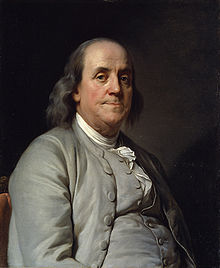
Ben Franklin had views on how to make a decision. In a letter to Joesph Preistley, he wrote
To Joseph Priestley
London, September 19, 1772
Dear Sir,
In the Affair of so much Importance to you, wherein you ask my Advice, I cannot for want of sufficient Premises, advise you what to determine, but if you please I will tell you how.
When these difficult Cases occur, they are difficult chiefly because while we have them under Consideration all the Reasons pro and con are not present to the Mind at the same time; but sometimes one Set present themselves, and at other times another, the first being out of Sight. Hence the various Purposes or Inclinations that alternately prevail, and the Uncertainty that perplexes us.
To get over this, my Way is, to divide half a Sheet of Paper by a Line into two Columns, writing over the one Pro, and over the other Con. Then during three or four Days Consideration I put down under the different Heads short Hints of the different Motives that at different Times occur to me for or against the Measure. When I have thus got them all together in one View, I endeavour to estimate their respective Weights; and where I find two, one on each side, that seem equal, I strike them both out: If I find a Reason pro equal to some two Reasons con, I strike out the three. If I judge some two Reasons con equal to some three Reasons pro, I strike out the five; and thus proceeding I find at length where the Ballance lies; and if after a Day or two of farther Consideration nothing new that is of Importance occurs on either side, I come to a Determination accordingly.
And tho’ the Weight of Reasons cannot be taken with the Precision of Algebraic Quantities, yet when each is thus considered separately and comparatively, and the whole lies before me, I think I can judge better, and am less likely to take a rash Step; and in fact I have found great Advantage from this kind of Equation, in what may be called Moral or Prudential Algebra.
Wishing sincerely that you may determine for the best, I am ever, my dear Friend,
Yours most affectionately
B. Franklin
A fair bit of academic research has been done on the quality of Franklin’s rule for making decisions. See for example:
* Gigerenzer, G. & Goldstein, D. G. (1999). Betting on one good reason: The Take The Best heuristic. In Gigerenzer, G., Todd, P. M. & the ABC Research Group, Simple Heuristics That Make Us Smart. New York: Oxford University Press.
* Czerlinski, J., Gigerenzer, G., & Goldstein, D. G. (1999). How good are simple heuristics? In Gigerenzer, G., Todd, P. M. & the ABC Research Group, Simple Heuristics That Make Us Smart. New York: Oxford University Press. [Download]
For analysis of an even simpler, unweighted variant, see:
* Dawes, R. M. The robust beauty of improper linear models in decision making. American Psychologist, 1979, 34, 571-582.
Source of Franklin quote: There is a copy of this quote online at http://www.procon.org/view.background-resource.php?resourceID=1474 which cites:
* Mr. Franklin: A Selection from His Personal Letters. Contributors: Whitfield J. Bell Jr., editor, Franklin, author, Leonard W. Labaree, editor. Publisher: Yale University Press: New Haven, CT 1956.
Filed in Gossip ,Ideas Subscribe to Decision Science News by Email (one email per week, easy unsubscribe)
FAST POLLING AND CELEBRITY WRANGLERS
We recently connected through London’s Heathrow Airport, and learned a couple things.
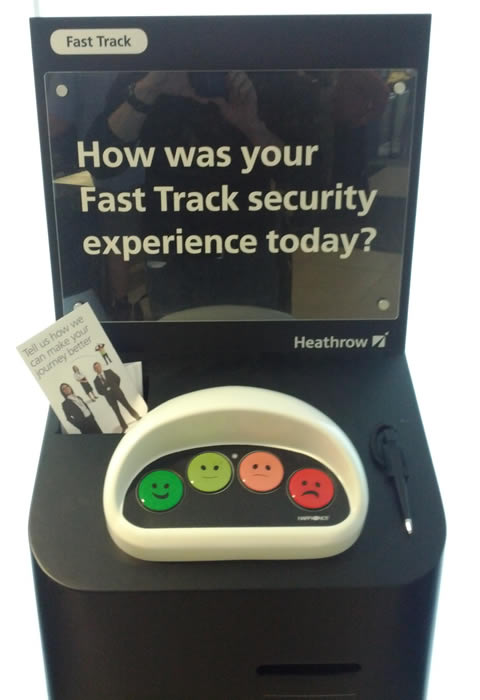
1. Fast, easy customer satisfaction surveys are possible. As you finish the security check at this airport, you walk past these machines (above) that ask you to rate how your experience by simply pushing one button. The machines are placed right in the middle of your path, not off to the side, so you can vote as you walk by without stopping. If you want to fill in a comment card, they had those and pens, too. We really like the idea of getting lots of data in a way that doesn’t slow people down or compromise anonymity. They could use the responses to figure out when the experience is the worst and take measures to fix it. The only negative here is that we think these machines are only at the “fast track” lanes (for frequent fliers), making it a bit classist.
2. On the inter-terminal bus, we eavesdropped on two uniformed celebrity wranglers, whose job it is to look after VIPs as they pass through Heathrow. Apparently, VIPs (actors, pop stars, politicians, etc.) get escorted from place to place, are popped into their first class seats just before take off, and get to hang out in some private lounge before flights. As you might imagine, wranglers talk about which celebrities are naughty or nice. Allegedly, Smokey Robinson is “sooooo nice” while will.i.am was a “stuck-up little ____”.
Filed in Ideas ,R Subscribe to Decision Science News by Email (one email per week, easy unsubscribe)
DIFFERENT CITIES TELL DIFFERENT STORIES
Last spring we looked at the state of the housing bubble in the US. The question on readers’ minds then was “where is it going next”? Since Decision Science News is looking for a place to buy, it is on our minds as well.
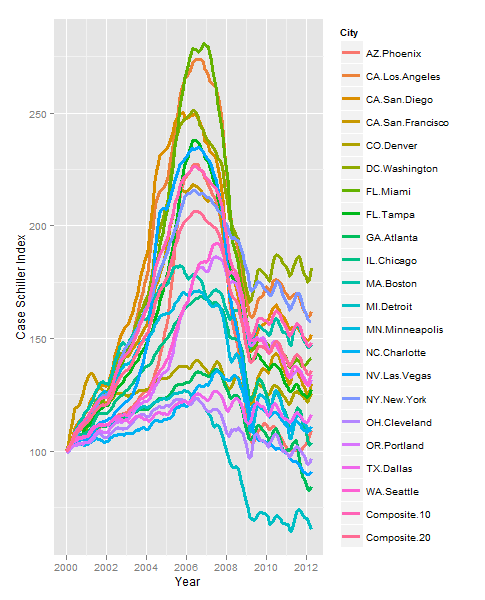
It’s been more than a year, so let’s have a look. Above, we see the plot for all cities. We realize the colors are hard to follow, so if you want to track your city, download the spreadsheet.
In January 2011, the average index value across the cities represented here was 127, in April 2012 (the latest data we have) it was 124. The “composite 10” score in January 2011 was 154, it went to 148. Similarity the “composite 20” value went from 141 to 136. So, things have continued to drop a bit.
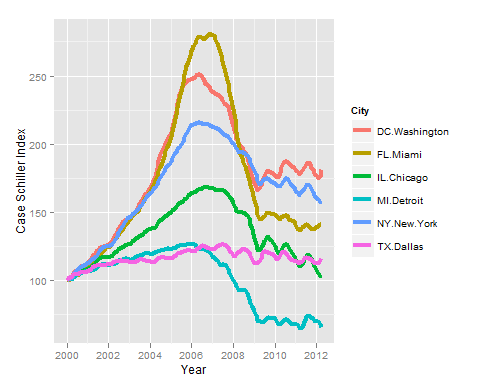
All depends on the local market, however. This is an Olympic year, so we really should highlight a few exceptional stories (the same ones we profiled in 2011):
Want to reproduce these graphs yourself? Go right ahead! Here’s the code. Plots are made with R and Hadley Wickham‘s ggplot2.
library(ggplot2)

library(reshape)

## Read in data, available from:

#www.standardandpoors.com/indices/sp-case-shiller-home-price-indices/en/us/?indexId=spusa-cashpidff--p-us----

#Delete the 2nd row and make 1st col 1st row say YEAR

dat=read.csv("CSHomePrice_History.csv")

mdf=melt(dat,id.vars="YEAR")

mdf$Date=as.Date(paste("01-",mdf$YEAR,sep=""),"%d-%b-%y")

names(mdf)=c("MonthYear","City","IndexValue","Date")

mdf$yr=format(mdf$Date,"%Y")

mdf=subset(mdf,yr>1999)

ggplot(data=mdf,aes(x=Date,y=IndexValue)) + geom_line(aes(color=City),size=1.25) +

scale_x_date("Year", minor_breaks="years") + scale_y_continuous("Case Schiller Index")

sm=subset(mdf,City %in% c('NY.New.York','FL.Miami','CA.Los Angeles','MI.Detroit',

'TX.Dallas','IL.Chicago','DC.Washington'))

sm$City=droplevels(sm$City)

ggplot(data=sm,aes(x=Date,y=IndexValue)) + geom_line(aes(color=City),size=1.5) +

scale_x_date("Year", minor_breaks="years") + scale_y_continuous("Case Schiller Index")
In 2011 and 2012, Sid Suri, Preston McAfee, and Dan Goldstein published a couple papers putting forth and improving the idea of time-based internet advertising:
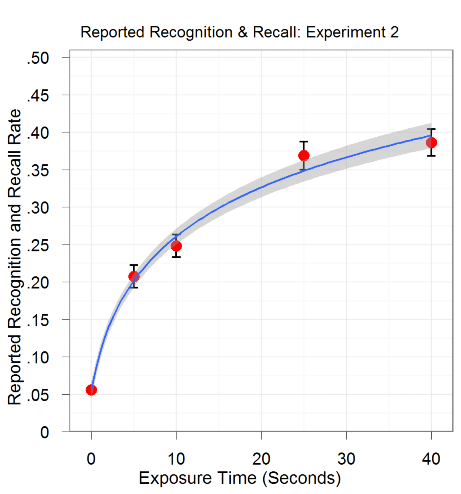
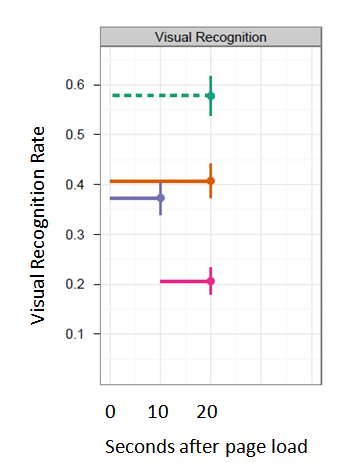
How does it work? Well, there are a couple primary forces at play. First, the longer an ad is in view, the more likely people are to remember it later. This can be seen in the graph above, based on an experiment in which the time an ad was in view was manipulated randomly. Second, ads that appear soon after the page loads are more likely to be remembered than ads that appear a longer time after the page loads. This can be seen below.
From Goldstein, Suri, McAfee (2012)
These data are based on an experiment in which an ad was made to appear during certain seconds after the page loaded.
The vertical axis shows the probability of recognizing an ad after the experiment. The horizontal axis shows the number of seconds that have elapsed after a page loads. For example, the short line running from 0 to 10 seconds shows the probability of recognition of an ad that was present for the first ten seconds after the page loaded. The short line running from 10 to 20 seconds shows the probability of recognition of an ad that was shown for the second 10 seconds after the page loaded. Clearly, the ad that was shown immediately after the page loads is more likely to be remembered. We hypothesize that people are visually scanning the page soon after it loads and that after a while, they start reading and do not notice ads anymore. (The vertical line segments are standard error bars)
The long line that hits the vertical axis at about .4 shows roughly the recognition rate you get by leaving an ad up for the first 20 seconds after the page loads. The line at top shows the recognition rate you get by advertising in the first 10 seconds on one page load and the second 10 seconds on another page load (the sum of the bottom two lines). This shows that two ten-second exposures are better than one 20-second exposure, even if one of the ten-second exposures takes place in the less desirable second slot (seconds 10 to 20 after the page loads). To learn more, check out Goldstein, Suri and McAfee (2012).
Schools that are interviewing at the AMA and are interested in an excellent and computationally-skilled rookie should arrange to interview Yvetta Simonyan who is completing her PhD under myself and others at London Business School.
Plots in this post made with Hadley Wickham’s ggplot2 in R
Decision Science News is a website about Behavioral Economics, Data Science, Statistics, Marketing, Management, Psychology, Computer Science, Medicine, Policy, & Law
 Subscribe to Decision Science News by Email (one email per week, easy unsubscribe)




 (also published in the Atlantic Monthly).