[ View menu ]

SJDM News

JDM 2011, Seattle, Nov 5-7. Abstract deadline July 1.

Filed in Conferences ,SJDM ,SJDM-Conferences
Subscribe to Decision Science News by Email (one email per week, easy unsubscribe)

2011 CALL FOR ABSTRACTS ANNUAL MEETING OF THE SOCIETY FOR JUDGMENT AND DECISION MAKING

The Society for Judgment and Decision Making (SJDM) invites abstracts for symposia, oral presentations, and posters on any interesting topic related to judgment and decision making. Completed manuscripts are not required.

LOCATION, DATES, AND PROGRAM
SJDM’s annual conference will be held in the Sheraton Seattle Hotel, Seattle, Washington, during November 5-7, 2011. Early registration and welcome reception will take place the evening of Friday, November 4.

Hotel reservations at the $186/night Psychonomic convention rate will be available.

Ed Diener will be the keynote speaker.

SUBMISSIONS
The deadline for submissions is July 1, 2011. Submissions for symposia, oral presentations, and posters should be made through the SJDM website at http://sql.sjdm.org. Technical questions can be addressed to the webmaster at www@sjdm.org. All other questions can be addressed to the program chair, Nathan Novemsky, at nathan.novemsky at yale.edu.

ELIGIBILITY
At least one author of each presentation must be a member of SJDM. Joining at the time of submission will satisfy this requirement. To join, see http://www.sjdm.org/join.html. An individual may submit only one talk (podium presentation) as presenter and only one poster, but may be a co-author on multiple talks and/or posters.

AWARDS

The Best Student Poster Award is given for the best poster presentation whose first author is a student member of SJDM.

The Hillel Einhorn New Investigator Award is intended to encourage outstanding work by new researchers. Applications are due July 1, 2011. Further details are available at http://www.sjdm.org.

The Jane Beattie Memorial Fund subsidizes travel to North America for a foreign scholar in pursuits related to judgment and decision research, including attendance at the annual SJDM meeting. Further details will be available at http://www.sjdm.org.

PROGRAM COMMITTEE
Nathan Novemsky (Chair), Michel Regenwetter, Bernd Figner, Robyn LeBeouf, Gretchen Chapman, Ulf Reips, Wandi Bruine de Bruin, Ellie Kyung, Anuj Shah

Photo credit: http://upload.wikimedia.org/wikipedia/commons/2/24/SeattleMontage.png

This entry was posted on Tuesday, May 10th, 2011.

10th TIBER symposium on Psychology and Economics

Filed in Conferences ,SJDM ,SJDM-Conferences
Subscribe to Decision Science News by Email (one email per week, easy unsubscribe)

DAN ARIELY, JAMES ANDREONI KEYNOTE SPEAKING. DEADLINE JUNE 1, 2011


“If only I could find paper and envelopes to match my skirt and jacket”

(This photo has little to do with behavioral economics,
but that didn’t stop them from using it on the TIBER Web site)

Join Ilja van Beest, Rik Pieters, Jan Potters, Diederik Stapel, and Marcel Zeelenberg in one of DSN’s favorite places this summer as …

You are invited to attend the 10th Tilburg Institute for Behavioral Economics Research (TIBER) symposium on Psychology and Economics, to be held at Tilburg University, August 19th, 2011.

We are happy to announce that Dan Ariely and James Andreoni are confirmed keynote speakers.

We invite contributions from the fields of psychology, economics, and marketing.

If you would like to present your work (in a 20-30 minute talk), please send an abstract (max. 300 words) to tibersymposium@uvt.nl before June 1st, 2011. You are also very much welcome to attend the symposium if you do not present your work.

Further information will soon be available from the website.

This entry was posted on Friday, April 22nd, 2011.

SJDM March 2011 Newsletter is ready for download

Filed in Books ,Conferences ,Gossip ,Ideas ,Jobs ,Programs ,Research News ,SJDM ,SJDM-Conferences
Subscribe to Decision Science News by Email (one email per week, easy unsubscribe)

SOCIETY FOR JUDGMENT AND DECISION MAKING NEWSLETTER

Society for Judgment and Decision Making Newsletter Editor Dan Goldstein reports that the March 2011 SJDM newsletter is ready for download.

http://www.sjdm.org/newsletters/11-mar.pdf

Enjoy!

This entry was posted on Wednesday, March 23rd, 2011.

SJDM newsletter is out

Filed in Conferences ,Jobs ,Research News ,SJDM ,SJDM-Conferences
Subscribe to Decision Science News by Email (one email per week, easy unsubscribe)

SOCIETY FOR JUDGMENT AND DECISION MAKING NEWSLETTER

Society for Judgment and Decision Making Newsletter Editor Dan Goldstein reports that the final SJDM newsletter of 2010 is ready for download.

http://www.sjdm.org/files/newsletters/

Enjoy!

This entry was posted on Friday, December 31st, 2010.

Professorships at Yale Management and Carnegie Mellon SDS

Filed in Jobs ,SJDM
Subscribe to Decision Science News by Email (one email per week, easy unsubscribe)

ONE POST, TWO JOBS

The YALE SCHOOL OF MANAGEMENT is seeking additional faculty members at all levels in the areas of economics and organizational behavior. Ph.D. or equivalent is required; research and teaching interest in theory and application preferred, as well as an interdisciplinary orientation. Appointments will be made for the 2011 – 2012 academic year.

To apply online click here.

Please note that only electronic applications are accepted this year.

The deadlines for receipt of all materials is October 15, 2010.

For more information visit: http://mba.yale.edu/faculty/faculty_openings.shtml

Yale is an equal opportunity, affirmative action employer and especially encourages applications from women and members of minority groups.

————

THE DEPARTMENT OF SOCIAL AND DECISION SCIENCES AT CARNEGIE MELLON UNIVERSITY seeks candidates to fill a junior tenure-track position in decision making and public policy.

Candidates should have a strong commitment both to applying decision-making research to public policy and to creating the scientific foundations for such applications. Their letter of application should describe a research program designed to influence public policy and contribute to basic knowledge. Although policy interests could be in any area, the department has strengths in environment, energy, health, safety, finance, national security, and risk. Teaching would support the department’s educational programs.

The department is interdisciplinary, with faculty members from psychology, economics, political science, decision science, and history. Several have joint appointments in other departments, notably Engineering and Public Policy. Collaboration is a hallmark of the Department and University.

For more information, please visit: http://www.hss.cmu.edu/departments/sds/

Applicants should send a CV, two papers, three letters of recommendation, and a statement of research interests to:

Chair, Behavioral Decision Research and Policy Search Committee
Carnegie Mellon University
Department of Social and Decision Sciences
Pittsburgh, PA 15213-3890.

Please submit applications by December 1.

Carnegie Mellon University is an Affirmative Action/ Equal Opportunity employer. We encourage minorities, women, and individuals with disabilities to apply.

CMU Baker & Porter Halls photo credit: http://www.flickr.com/photos/aschultz/3254899110/

This entry was posted on Thursday, September 30th, 2010.

ACR 2010 Jacksonville uses green defaults

Filed in Conferences ,SJDM
Subscribe to Decision Science News by Email (one email per week, easy unsubscribe)

ASSOCIATION FOR CONSUMER RESEARCH CONFERENCE, OCT 7-10, 2010

What: The Association for Consumer Research Annual North American Conference [Website]
Where: Jacksonville, FL
Hotel: The Hyatt Regency [Map] [Booking]
When: OCT 7-10, 2010
Registration: Available now online
Early-bird deadline: Sept 1. Second price hike at Sept 25th.

ACR 2010 Jacksonville is open for registration!

Decision Science News notices that this year, the conference uses “green defaults”. Innovative! Check it out:

  • You will have the option to opt out of the complete program given at the conference. You can build your own program on the ACR website by going to www.acrweb.org/acr and signing in. Once there, choose the “program” option, and you will see the new tool which you can utilize. Print your customized program and bring it with you!
  • The default meal is vegetarian. You will have the option to opt out of the vegetarian meal.

Build-your-own-program is neat. We usually look at about half of the program, and end up needing about 20% of it at the conference. They have some other nudges as well:

  • You will have the option of buying carbon offsets for your flight.
  • You can choose the electronic version of the proceedings instead of a hardcover copy and receive a $20 discount.

The discount for the e-proceedings seems like a classic incentive. Decision Science News just registered and found that they used no default (forced choice) for this question. They could have made the default the green one and said “hardcover available for an extra $20”. In any case, we are glad to see research put to use.

This entry was posted on Thursday, August 5th, 2010.

First of two JDM special issues on the Recognition Heurisitic

Filed in Articles ,Ideas ,Research News ,SJDM
Subscribe to Decision Science News by Email (one email per week, easy unsubscribe)

SPECIAL ISSUE: RECOGNITION PROCESSES IN INFERENTIAL DECISION MAKING

The journal Judgment and Decision Making today published a special issue on “Recognition processes in inferential decision making” edited by Julian N. Marewski, Rüdiger F. Pohl and Oliver Vitouch. The special issue turns out to be the first of two special issues, something the editors had not anticipated:

What was originally planned as one issue consisting of about 6 contributions turned into two volumes with about 20 submitted articles, some of which are still under review. All submissions were and are subject to Judgment and Decision Making’s peer review process, under the direction of the journal’s editor, Jonathan Baron, and us.

Here is how the editors describe the contents of the two special issues:

Let us briefly provide an overview of the contents of the two issues. The first issue presents 8 articles with a range of new mathematical analyses and theoretical developments on questions such as when the recognition heuristic will help people to make accurate inferences; as well as experimental and methodological work that tackles descriptive questions; for example, whether the recognition heuristic is a good model of consumer choice.

The forthcoming second issue strives to give an overview of the past, current, and likely future debates on the recognition heuristic, featuring comments on the debates by some of those authors who have been heavily involved, early experiments on the recognition heuristic that were run decades ago, but thus far never published, as well as new experimental tests of the recognition heuristic and alternative approaches. Finally, in the second issue, we will also provide a discussion of all papers in the two issues, and speculate about what we should possibly learn from these papers.

In allocating accepted articles to the two issues, we strove to strike a balance between the order of submission, the order of acceptance, and the topical fit of the papers. We apologize to those authors who feel disfavored by our attempts to establish such a balance; either because they preferred to see their contributions appear in the first, or alternatively, in the second issue.

Also surprising to Decision Science News was that although the topic was recognition processes in inference, all the articles address one particular rule of thumb, Goldstein & Gigerenzer’s recognition heuristic.

Goldstein, D. G. & Gigerenzer, G. (2002). Models of ecological rationality: The recognition heuristic. Psychological Review, 109, 75-90. [Download]

In other RH news, editor Marewski et al has a 2010 paper on the heuristic and editor Pohl also has a 2010 recognition heuristic paper.

CONTENTS OF THE FIRST SPECIAL ISSUE

Recognition-based judgments and decisions: Introduction to the special issue (Vol. 1), pp. 207-215 (html). Julian N. Marewski, Rüdiger F. Pohl and Oliver Vitouch

Why recognition is rational: Optimality results on single-variable decision rules, pp. 216-229 (html). Clintin P. Davis-Stober, Jason Dana and David V. Budescu

When less is more in the recognition heuristic, pp. 230-243 (html). Michael Smithson

The less-is-more effect: Predictions and tests, pp. 244-257 (html). Konstantinos V. Katsikopoulos

Less-is-more effects without the recognition heuristic, pp. 258-271 (html). C. Philip Beaman, Philip T. Smith, Caren A. Frosch and Rachel McCloy

Precise models deserve precise measures: A methodological dissection, pp. 272-284 (html). Benjamin E. Hilbig

Physiological arousal in processing recognition information: Ignoring or integrating cognitive cues?, pp. 285-299 (html). Guy Hochman, Shahar Ayal and Andreas Glöckner

Think or blink — is the recognition heuristic an intuitive strategy?, pp. 300-309 (html). Benjamin E. Hilbig, Sabine G. Scholl and Rüdiger F. Pohl

I like what I know: Is recognition a non-compensatory determiner of consumer choice?, pp. 310-325 (html). Onvara Oeusoonthornwattana and David R. Shanks

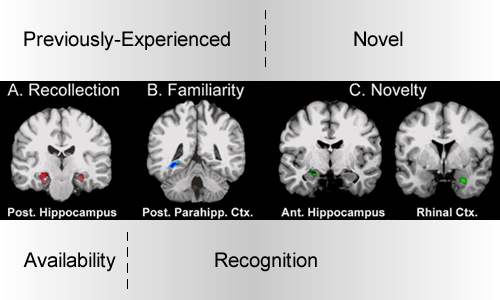
Photo adapted from S. M. Daselaar, M. S. Fleck, and R. Cabeza. (2006) Triple Dissociation in the Medial Temporal Lobes: Recollection, Familiarity, and Novelty. Journal of Neurophysiology 96, 1902-1911.

This entry was posted on Friday, July 30th, 2010.

JDM 2010 Conference, St. Louis, November 19-22

Filed in Conferences ,SJDM ,SJDM-Conferences
Subscribe to Decision Science News by Email (one email per week, easy unsubscribe)

31st ANNUAL MEETING OF THE SOCIETY FOR JUDGMENT AND DECISION MAKING 2010

SJDM’s 31st annual conference will be held in the Drury Plaza Hotel, St. Louis, Missouri, during November 19-22, 2010. Early registration and welcome reception will take place the evening of Friday, November 19.

Hotel reservations at the $125/night Psychonomic convention rate can be made by clicking here.

JDMers can also stay at the Millenium Hotel at the conference rate of $134/night by clicking here, or $107/night for students here.

SUBMISSIONS
The deadline for submissions is June 21, 2010. Current call for abstracts is here. Submissions for symposia, oral presentations, and posters should be made through the SJDM website at http://sql.sjdm.org. Technical questions can be addressed to the webmaster, Jon Baron, at www@sjdm.org. All other questions can be addressed to the program chair, Michel Regenwetter, at regenwet@uiuc.edu.

ELIGIBILITY
At least one author of each presentation must be a member of SJDM. Joining at the time of submission will satisfy this requirement. A membership form may be downloaded from the SJDM website at http://www.sjdm.org/jdm-member.html. An individual may give only one talk (podium presentation) and present only one poster, but may be a co-author on multiple talks and/or posters.

AWARDS
The Best Student Poster Award is given for the best poster presentation whose first author is a student member of SJDM.

The Hillel Einhorn New Investigator Award is intended to encourage outstanding work by new researchers. Applications are due July 1, 2010. Further details are available at http://www.sjdm.org.

The Jane Beattie Memorial Fund subsidizes travel to North America for a foreign scholar in pursuits related to judgment and decision research, including attendance at the annual SJDM meeting. Further details will be available at http://www.sjdm.org.

PROGRAM COMMITTEE
Michel Regenwetter (Chair), Craig McKenzie, Nathan Novemsky, Bernd Figner, Gretchen Chapman, Gal Zauberman, Ulf Reips, Wandi Bruine de Bruin, Ellie Kyung

This entry was posted on Friday, May 14th, 2010.

You won, but how much was luck and how much was skill?

Filed in Encyclopedia ,Ideas ,R ,Research News ,SJDM
Subscribe to Decision Science News by Email (one email per week, easy unsubscribe)

THE ABILITY OF WINNERS TO WIN AGAIN

Even people who aren’t avid baseball fans (your DSN editor included) can get something out of this one.

When two baseball teams play each other on two consecutive days, what is the probability that the winner of the first game will be the winner of the second game?

[If you like fun, write down your prediction.]

DSN’s father-in-law told him that recently the Mets beat the Phillies 9 to 1, but the very next day, the Phillies beat the Mets 10 to 0. How could this be? If the Mets were so good as to win by 8 points, how could the exact same players be so bad as to lose by 10 points to the same opponents 24 hours later?

Let’s call this situation (in which team A beats team B one one day, but team B beats team A the very next day) a “reversal”, and we’ll say the size of the reversal is the smaller of the two margins of victory. In the above example, the size of the reversal was 8.

Using R (code provided below), DSN obtained statistics on all major league baseball games played between 1970 and 2009 and calculated how often each type of reversal occurs per 100,000 pairs of consecutive games. The result is in the the graph above. Big reversals are rare. A reversal of size 8 occurs in only 174 of 100,000 games; a size 12 reversal happens but 10 times per 100k. A size 13 reversal never happened in those 40 years. One might think this is because it would be uncommon for a team that is so good to suddenly become so bad and vice versa, but note that big margins of victory are rare: only 4% of games have margins of victory of 8 points or larger.

Back to our question:

If a team wins on one day, what’s the probability they’ll win against the same opponent when they play the very next day?

We asked two colleagues knowledgeable in baseball and the mathematics of forecasting. The answers came in between 65% and 70%.

The true answer: 51.3%, a little better than a coin toss.

That’s right. When you win in baseball, there’s only a 51% chance you’ll win again in more or less identical circumstances. The careful reader might notice that the answer is visible in the already mentioned chart. The reversals of size 0, (meaning no reversal, meaning the same team won twice) occur 51,296 times per 100,000 pairs of consecutive games.

[At this point, DSN must admit that it is entirely possible that it has made a computational error. It welcomes others to reproduce the analysis with the code or pre-processed data at the end of this post.]

What of the adage “the best predictor of future performance is past performance”? It seems less true than Sting’s observation “History will teach us nothing“. Let’s continue the investigation.

Here were plot the probability of winning the second game based on obtaining various margins of victory in the first game. We simply calculated the average win rate for each margin of victory up to 11 games, which makes up 98% of the data, and bin together the remaining 2%, comprising margins of victory from 12 to 27 points. (Rest assured, the binning makes the graph look prettier, but does not affect the outcome.)

The equation of the robust regression line is: Probability(Win_Second_Game) = .498 + .004*First_Game_Margin which suggests that even if you win the first game by an obscene 20 points, your chance of winning the second game is only 57.8%

Still in disbelief? Here we do no binning and plot the margin of victory (or loss) of the first game winner as a function of its margin of victory in the first game. The clear heteroskedasticity is dealt with by iterative reweighted least squares in R’s rlm command. Similar results are obtained by fitting a loess line. This model is Expected_Second_Game_Margin = -.012 + .030*First_Game_Margin

One final note. The 51.3% chance you’ll win the second game given you’ve won the first is smaller than the so called “home team advantage”, which we found to be a win probability of 54.2% on first games and 53.8% on second games.

When the home team wins the first game, it wins the second game 54.7% of the time.
When the home team loses the first game, it wins the second game 52.8% of the time.
When the visitor wins the first game, it wins the second game 47.2% of the time.
When the visitor loses the first game, it wins the second game 45.3% of the time.

Surprisingly, when it comes to winning the second game, it’s better to be the home team who just lost than the visitor who just won. So much for drawing conclusions from winning. Decision Science News has always wondered why teams are so eager to fire their coaches after they lose a few big games. Don’t they realize that their desired state of having won those same few big games would have been mostly due to luck?

There you have it. Either we have made an egregious error in calculation or recent victories are surprisingly uninformative.

Do your own analysis alternative 1: The pre-processed data
If you wish, you can cheat and get the pre-processed data at http://www.dangoldstein.com/flash/bball/reversals.zip

This may be of interest for people who don’t use R or for impatient types who just want to cut to the chase.

No guarantee that our pre-processing is correct. It should be all pairs of consecutive games between the same two teams.

Do your own analysis alternative 2: The code

I’ll provide the column names file for your convenience at http://www.dangoldstein.com/flash/bball/cnames.txt. I left out a bunch of columns names I didn’t care about. The complete list is at: http://www.dangoldstein.com/flash/bball/glfields.txt

R CODE
(Don’t know R yet? Learn by watching: R Video Tutorial 1, R Video Tutorial 2)

#Data obtained from http://www.retrosheet.org/
#Go for the files http://www.retrosheet.org/gamelogs/gl1970_79.zip through
#http://www.retrosheet.org/gamelogs/gl2000_09.zip and unzip each to directories
#named "gl1970_79", "gl1980_89", etc, reachable from your working directory.

library(MASS) #For robust regression, can omit if you don't want to fit lines

#Column headers, Can get from www.dangoldstein.com/flash/bball/cnames.txt
#If you want all the headers, create from www.dangoldstein.com/flash/bball/glfields.txt
LabelsForScript=read.csv("cnames.txt", header=TRUE)

#Loop to get together all data
dat=NULL
for (baseyear in seq(1970,2000,by=10))
{
endyear=baseyear+9
#string manupulate pathnames
#reading in datafiles to one big dat goes here
for (i in baseyear:endyear)
{
mypath=paste("gl",baseyear,"_",substr(as.character(endyear),start=3,stop=4),"/GL",i,".TXT",sep="")
cat(mypath,"\n")
dat=rbind(dat,read.csv(mypath, col.names=LabelsForScript$Name))
}
}

rel=dat[,c("Date", "Home","Visitor","HomeGameNum","VisitorGameNum","HomeScore","VisitorScore")] #relevant set

rel$PrevVisitorGameNum=rel$VisitorGameNum-1
rel$PrevHomeGameNum=rel$HomeGameNum-1
rel$year=substr(rel$Date,start=1,stop=4)

rm(dat)

head(rel,20); summary(rel)

relmerge=merge(rel,rel,
by.x=c("Home","Visitor","year","HomeGameNum","VisitorGameNum"),
by.y=c("Home","Visitor","year","PrevHomeGameNum","PrevVisitorGameNum")
)

relmerge=relmerge[,c(
"Home", "Visitor", "Date.x", "HomeScore.x", "VisitorScore.x",
"Date.y", "HomeScore.y", "VisitorScore.y"
)]

relmerge$dx=relmerge$HomeScore.x-relmerge$VisitorScore.x
relmerge$dy=relmerge$HomeScore.y-relmerge$VisitorScore.y

#Eliminate ties
relmerge=with(relmerge,relmerge[(dx!=0) & (dy!=0),])

relmerge$reversal=-.5*(sign(relmerge$dx)*sign(relmerge$dy))+.5
relmerge$revsize=relmerge$reversal*pmin(abs(relmerge$dx),abs(relmerge$dy))
relmerge$winnerMarginVicG1=with(relmerge,sign(dx)*dx)
relmerge$winnerMarginVicG2=with(relmerge,sign(dx)*dy)

write.csv(relmerge,"reversals.csv")

mat=NULL
mat= data.frame(cbind(
ReversalSize=0:12,
Count=table(relmerge$revsize),
Prob=table(relmerge$revsize)/length(relmerge$revsize),
Per100k=table(relmerge$revsize)/length(relmerge$revsize)*100000
))
mat
cat("Probability previous winner wins again: ", mat[1,3],"\n")

##Graph Size of Reversal Frequency
png("SizeOfReversal.png",width=450)
plot(mat$ReversalSize,mat$Per100k,xlab="Size of Reversal",ylab="Frequency in 100,000 games",type="lines")
dev.off()

##Graph Chance of Winning Given Previous Win of Various Margins
png("WinGivenMargin.png",width=450)
brks=cut(relmerge$winnerMarginVicG1,breaks=c(0,1,2,3,4,5,6,7,8,9,10,11,27))
winsVsMargin=tapply(relmerge$winnerMarginVicG2>0,brks,mean)
names(winsVsMargin)=1:12
plot(winsVsMargin,ylim=c(0,1),axes=FALSE,xlab="Margin of Victory in First Game",ylab="Chance of Winning Second Game")
axis(1,1:12,labels=c("1","2","3","4","5","6","7","8","9","10","11","12+"))
axis(2,seq(0,1,.1))
winModel=rlm(winsVsMargin~ as.numeric(names(winsVsMargin)))
abline(winModel)
dev.off()

##Graph Expected Margin of Victory Given Past Margin of Victory
png("MarVic.png",width=450)
mm2=rlm(relmerge$winnerMarginVicG2 ~ relmerge$winnerMarginVicG1)
plot(jitter(relmerge$winnerMarginVicG1),
jitter(relmerge$winnerMarginVicG2),xlab="Margin of Victory in Game 1",
ylab="Margin of Victory of Game 1 Winner in Game 2")
abline(mm2)
dev.off()

#Probability of team winning game two if they won game 1 by n points
winModel$coefficients[1]+winModel$coefficients[2]*20

#Expected margin of victory in game two given win in game 1
mm2$coefficients[1]+mm2$coefficients[2]*33

#Home Team Advantage: First game, second game
with(relmerge,{cat(mean(dx > 0), mean(dy > 0))})

#Home team advantage second game given home won first game
# Equals 1- Visitor p win second game given visitor lost the first game
with(relmerge[relmerge$dx > 0,],mean(dy > 0))

#Home team advantage second game given home lost first game
#Equals 1 - Visitor p win second game given visitor won first game
with(relmerge[relmerge$dx < 0,],mean(dy > 0))

This entry was posted on Wednesday, May 5th, 2010.

2010 guide to the American Marketing Association job market interviews for aspiring professors

Filed in Conferences ,Gossip ,Jobs ,SJDM
Subscribe to Decision Science News by Email (one email per week, easy unsubscribe)

EVERYTHING YOU EVER WANTED TO KNOW ABOUT THE AMA INTERVIEWS (2010 edition)

PhD students in Marketing, Psychology, and Economics are now gearing up to get their “packets” ready to mail out by the fourth of July in the hopes of lining up interviews at the annual AMA Summer Educator’s Conference. Each year DSN reprints this sort of “what to expect while you’re applying” guide, first published here by Dan Goldstein in 2005.

WHY AM I WRITING THIS?
I’ve seen the Marketing job market turn happy grad students into quivering masses of fear. I want to share experiences that I and others have contributed, and provide a bit advice to make the whole process less mysterious.

WHY SHOULD ANYONE LISTEN TO ME?
I’ve been on the AMA job market twice (mid 2000s), the Psychology market once (late 90s). As a professor I’ve conducted 20 AMA interviews and been a part of dozens of hiring decisions. I’ve been on the candidate end of about 40 AMA interviews, and experienced numerous campus visits, face-to-face interviews, offers, and rejections. I’m an outsider to Marketing who went on the market older and with more experience than the average rookie (35 years of age, with 8 years of research scientist, postdoc, visiting scholar, and industry positions). I’ve hired many people for many academic posts, so I know both sides.

HOW TO GET INTO THE AMA JOB MARKET
First, at least a couple months before the conference, find where it will be. It’s called the American Marketing Association Summer Educator’s Conference. Strange name, I know. Insiders just call it “The AMA”. Get yourself a room in the conference hotel, preferably on the floor where the express elevator meets the local elevator for the upper floors. You’ll be hanging out on this floor waiting to change elevators anyway, so you might as well start there.

Next, get your advisor / sponsor to write a cover letter encouraging people to meet with you at AMA. It helps if this person is in Marketing. Get 1 or 2 other letters of recommendation, a CV, and some choice pubs. Put them in an envelope and mail them out to a friend of your sponsor at the desired school. It should look like the letter is coming from your sponsor, even though you are doing the actual assembly and mailing. Repeat this process a bunch of times. It’s a good idea to hit a school with 2 packets, 3 if you suspect they’re a little disorganized. Certainly send one to the recruiting coordinator (you might find their name on hiring announcements, which are often sent to your home department’s secretary) and one to your sponsor’s friend. Mail to schools regardless of whether they are advertising a position or not. This is academia: nobody knows anything. This means you may be sending 50 or more packets. You want to have them mailed by the 4th of July at the absolute latest.

THEN WHAT?
Wait to get calls or emails from schools wishing to set up AMA interviews with you. These calls may come in as late as one week before the conference. Often they come when you are sitting outside having a drink with friends. Some schools will not invite you for totally unknown reasons. You may get interviews from the top 10 schools and rejected from the 30th-ranked one. Don’t sweat it. Again, this is the land of total and absolute unpredictability that you’re entering into. Also, know that just because you get an interview doesn’t mean they have a job. Sometimes schools don’t know until the last minute if they’ll have funding for a post. Still, you’ll want to meet with them anyway. Other times, schools are quite certain they have two positions, but then later university politics shift and they turn out to have none.

After the AMA, you’ll hopefully get “fly-outs,” that is, offers to come and visit the campus and give a talk. This means you’ve made the top five or so. Most offers go down in December. There’s a second market that happens after all the schools realize they’ve made offers to the same person. Of course, some schools get wise to this and don’t make offers to amazing people who would have come. We need some kind of market mechanism to work out this part of the system.

THE “IT’S ALL ABOUT FRIENDSHIP” RULE
Keep in mind that you will leave this process with 1 or 0 jobs. Therefore, when talking to a person, the most likely thing is that he or she will not be your colleague in the future. You should then think of each opportunity as a chance to make a friend. You’ll need friends to collaborate, to get tenure, get grants, and to go on the market again if you’re not happy with what you get.

HOW DO YOU FIND OUT IN WHICH ROOM TO INTERVIEW?
The schools will leave messages for you telling you in which rooms your interviews will be. You’ll get calls, emails, and notes held for you at the hotel reception. Some schools will fail to get in touch with you so you have to try to find them. Many profs ask the hotel to make their room number public, but for some reason many hotel operators will still not give you the room number. Naturally having a laptop and internet connection allows for emailing of room numbers. Try to take care of this early on the first day.

HOW TO TREAT YOURSELF WHILE THERE
My sponsor gave me the advice of not going out at night and getting room service for breakfast and dinner. This worked for me. Also, the ridiculously high price of a room-service breakfast made me feel like I was sparing no expense, which I found strangely motivating.

HOW DO THE ACTUAL AMA INTERVIEWS GO?
At the pre-arranged time you will knock on their hotel room door. You will be let into a suite (p=.4) or a normal hotel room (p=.5, but see below). In the latter case, there will be professors with long and illustrious titles—people you once imagined as dignified—sitting on beds in their socks. The other people in the room may not look at you when you walk in because they will be looking for a precious few seconds at your CV. For at least some people in the room, this may be the first time they have concentrated on your CV. Yikes is right. Put the important stuff early in your CV so nobody can miss it.

THE SEAT OF HONOR
There will be one armchair in the room. Someone will motion towards the armchair, smile, and say, “You get the seat of honor!” This will happen at every school, at every interview, for three days. I promise.

THE TIME COURSE
There will be two minutes of pleasant chit-chat. They will propose that you talk first and they talk next. There will be a little table next to the chair on which you will put your flip book of slides. You will present for 30 minutes, taking their questions as they come. They will be very nice. When done, they will ask you if you have anything to ask them. You of course do not. You hate this question. You make something up. Don’t worry, they too have a spiel, and all you need to do is find a way to get them started on it. By the time they are done, it’s time for you to leave. The whole experience will feel like it went rather well.

PREDICTING IF YOU WILL GET A FLY-OUT
It’s impossible to tell from how it seems to have gone whether they will give you a fly-out or not. Again, this is the land of staggering and high-impact uncertainty. They might not invite you because you were too bad (and they don’t want you), or because you were too good (and they think they don’t stand a chance of getting you).

DO INTERVIEWS DEVIATE FROM THAT MODEL?
Yes.

Sometimes instead of a hotel room, they will have a private meeting room (p=.075). Sometimes they will have a private meeting room with fruit, coffee, and bottled water (p=.025). Sometimes, they will fall asleep while you are speaking (p=.05). Sometimes they will be rude to you (p=.025). Sometimes a key person will miss an early interview due to a hangover (p=.025). Sometimes, if it’s the end of the day, they will offer you alcohol (p=.18, conditional on it being the end of the day).

HOW YOU THINK THE PROCESS WORKS
The committee has read your CV and cover letter and looked at your pubs. They know your topic and can instantly appreciate that what you are doing is important. They know the value of each journal you have published in and each prize you’ve won. They know your advisor and the strengths she or he instills into each student. They ignore what they’re supposed to ignore and assume everything they’re supposed to assume. They’ll attach a very small weight to the interview and fly you out based on your record, which is the right thing to do according to a mountain of research on interviews.

HOW THE PROCESS REALLY WORKS
The interviewers will have looked at your CV for about one minute a couple months ago, and for a few seconds as you walked in the room. They will never have read your entire cover letter, and they will have forgotten most of what they did read. They could care less about your advisor and will get offended that you didn’t cite their advisor. They’ll pay attention to everything they’re supposed to ignore and assume nothing except what you repeat five times. Flouting 50 years of research in judgment and decision-making, they’ll attach a small weight to your CV and fly you out based on your interview.

IF ENGLISH IS NOT YOUR MOTHER TONGUE
Your ability to speak English well won’t get you a good job, but your inability to do so will eliminate you from consideration at every top school. Understand that business schools put a premium on teaching. If the interviewers don’t think you can communicate in the classroom, they’re probably not going to take a chance on you. If you are just starting out and your spoken English is shaky, my advice is to work on it as hard as you are working on anything else. Hire a dialect coach (expensive) or an english-speaking actor or improviser (cheaper) to work with you on your English pronunciation. In the Internet age, it’s quite easy to download samples of English conversational speech, for instance from podcasts, for free. It’s also very easy to get a cheap headset and a free audio recorder (like Audacity) with which to practice.

TWO WAYS TO GIVE YOUR SPIEL
1) The plow. You start and the first slide and go through them until the last slide. Stop when interrupted and get back on track.

2) The volley. Keep the slides closed and just talk with the people about your topic. Get them to converse with you, to ask you questions, to ask for clarifications. When you need to show them something, open up the presentation and show them just that slide.

I did the plow the first year and the volley the second year. I got four times more fly-outs the second year. Econometricians are working hard to determine if there was causality.

HOW TO ACT
Make no mistake, you are an actor auditioning for a part. There will be no energy in the room when you arrive. You have to be like Santa Claus bringing in a large sack of energy. The interviewers will be tired. They’ve been listening to people in a stuffy hotel room from dawn till dusk for days. If you do an average job, you lose: You have to be two standard deviations above the mean to get a fly-out. So audition for the part, and make yourself stand out. If you want to learn how actors audition, read Audition by Michael Shurtleff.

SOCIAL SKILLS MATTER
From the candidate’s point of view, everything is about the CV and the correctness of the mathematical proofs in the job market paper. However, for better or for worse, extra-academic qualities matter. Here are two examples. 1) The Social Lubricant factor. Departments get visitors all the time: guest speakers, visiting professors, job candidates, etc. Some departments are a bunch of folks who stare at their shoes when introduced to a new person. These departments have a real problem: they have nobody on board who can make visitors feel at ease, and sooner or later word starts to spread about how socially awkward the people at University X are. To fix such problems, departments sometimes hire socially-skilled types who know how to make people comfortable in conversation, and who know how to ask good questions during talks. Also, interviewers assume that people who can talk a good game will be star teachers. 2) The Soft Sell factor. Many people succeed in academia not because they are often right, but also because they are masters of making other people feel like they aren’t wrong. Defensiveness or determination to embarrass when responding to critique is a sure way to blow an interview.

HAVE A QUIRK
One of the biggest risks facing you is that you will be forgotten. Make sure the interviewers know something unusual about you. My quirk is that I worked internationally as an actor and theater director for over 10 years; I even had a bit part in a Conan O’Brien sketch on TV. It has nothing to do my research, but people always bring up this odd little fact when I do campus visits. Some bits of trivia are just more memorable than others.

DON’T GIVE UP
Never think it’s hopeless. Just because you’re not two SDs above the mean at the school of your dreams, it does not mean you’re not the dream candidate of another perfectly good school.

Many candidates don’t realize the following: The students are competing for schools but the schools are also competing for students. If you strike out, you can just try again next year. I know a person in Psychology who got 70 rejections in one year. I know a person in Marketing who was told he didn’t place in the top 60 candidates at the 20th ranked school. The subsequent year, both people got hired by top 5 departments. One of them is ridiculously famous!

RUMORS
Gossip can mess with your chances. Gossip that you are doing well can hurt you because schools will be afraid to invite you if they think you won’t come. Gossip that you are doing poorly can hurt you because schools that like you will be afraid to invite you if they think no one else does. Sometimes people will ask a prof at your school if you would come to their school, and the prof will then ask you. To heck with that. Just say that if they want to talk to you, they should talk with you directly.

The danger of rumors can be summed up by the following story. At ACR in 2003, I was having a beer with someone who confessed, “you know, my friend X at school Y told me that they want to hire you, but they’re afraid your wife won’t move to Z”. I was single.

SHARE YOUR OWN AMA HORROR STORIES
I am more than happy to publish anonymous AMA horror stories as part of this post. You can reach me at dan at dangoldstein dot com.

This entry was posted on Wednesday, April 21st, 2010.