[ View menu ]

SJDM News

Biological basis of business

Filed in Research News ,SJDM
Subscribe to Decision Science News by Email (one email per week, easy unsubscribe)

OBHDP CALL FOR PAPERS: CONNECTING BIOLOGY AND BUSINESS

nest.jpg

The journal Organizational Behavior and Human Decision Processes has always been a home for research in Judgment and Decision Making, and its editorial board comprises quite a few of its scholars. Guest editors Colin Camerer, Drazen Prelec, and Scott Shane are announcing an exciting call for papers on the biological bases of business.

“In recent years, researchers have begun to use biological methods to examine issues related to business. Studies have looked at such topics as the role of genetic factors in leadership, entrepreneurship, and job satisfaction; the role of neural circuits in purchasing decisions, investment behavior, and response to financial reward; the effect of hormones on occupational choice, managerial decisions, and risk taking; the physiological effects on employees of workplace stress, organizational reward systems, and leadership styles; and the biological basis of key managerial issues such as strategic responses in competitive situations; the drive for power; and reputation.

This research has generated some fascinating findings. For instance, we now know that there is a genetic component to leadership. We also know that different parts of the neural system are stimulated by immediate and delayed financial reward. And we know that hormones affect occupational choice. While these are only a few illustrative examples of what studies of the biological basis of business have taught us, most management researchers know little about these findings. Much of the research in this vein has been published in journals that management scholars do not routinely follow, and the different studies themselves have been isolated from one another, making it difficult to see the cumulative set of findings and their effect on management unless scholars systematically look for it. We believe that the time is right to bring the biological basis of business to the attention of the mainstream of the management research community.

Our goal in this special research forum is simple, but also broad. We seek to understand how human biology affects business-related behavior. Therefore, we invite papers that examine any aspect of this topic. Our aims are threefold:
• First, we aim to bring together research that examines how biological factors affect different areas of management from organization behavior to entrepreneurship to business strategy to financial decision making to marketing. We believe that the phenomenon orientation of management research often leads researchers examining similar theoretical issues in different areas of business study to fail to connect their work. By organizing a special issue around the theme of biology rather than around different business topics as is often the case in management research, we hope to bring together the findings in disparate areas in a way that illuminates the power of the theme.
• Second, we hope to link together research that takes fundamentally different approaches to examine the biological basis of business. For instance, we want to bring together researchers who conduct behavioral genetics studies with those examining the physiology of emotion and those who use brain imaging to examine brain imaging because we believe that by putting papers from these different perspectives together will help to stimulate thought about the connections between them. These connections are important, we believe, because a biological basis of business will ultimately need to collect all of these pieces into a coherent and related whole.
• Third, we seek to bring to the attention of the academic community in management the widespread research that has been conducted to examine the biological basis of business, both to introduce additional researchers to the methodologies used in this area, to show the important stylized facts that have been collected, and to demonstrate the evidence for theoretical arguments that have been amassed to date.
Because the domain of this research forum is very broad – the examination of any aspect of biology on any aspect of business – we expect that researchers will identify a number of research questions that we have not thought of. However, in the interest of suggesting ideas, prospective contributors may wish to consider (but are certainly not limited to) the following research questions: Is there a biological component to risk taking? If so, what is it? Do hormones affect occupational choice? If so, how? Are there physiological differences between entrepreneurs and/or managers and the rest of the population? If so, what are they? What parts of the brain are used to make different types of managerial decisions? How does brain function affect decisions in organizations? How do emotions affect decision making? What are the neural mechanisms that underlie key organizational issues such as conformity to authority, creativity and innovation, planning, among other things? What is the biological basis of such things as wishful thinking and organizational sense-making? How does brain function lead to anomalies in intertemporal choice? How does advertising tap brain circuitry for desire and reward? Is there a genetic basis for entrepreneurship, creativity and/or innovation? What are the physiological reactions to work environments and how do they affect organizational behavior? What are the physiological effects of different organizational reward mechanisms, such as money, recognition, and power? How do managerial actions affect hormone release? Are reputations, preferences for organizations, and organizational networks, among other things, encoded dopaminergenically? How does the neural system affect investment behavior?
Timeline
Submissions are due no later than june 30, 2008. The editors will select papers to be presented at a conference to take place at Case Western Reserve university on october 20-21, 2008 from among the submissions. The travel and accommodation expenses for one author will be paid for by the conference organizers. The papers presented at the conference will then go through the refereeing process. A subset of the papers presented at the conference will be published in a special issue of Organizational Behavior and Human Decision Processes.
For additional information
For additional information about the conference or special issue, please contact scott shane at scott.shane at case.edu, or 216-368-5538. Submissions should be sent electronically to Scott Shane.”

Photo credit: Center for the Study of Neuroeconomics at George Mason University

This entry was posted on Wednesday, November 14th, 2007.

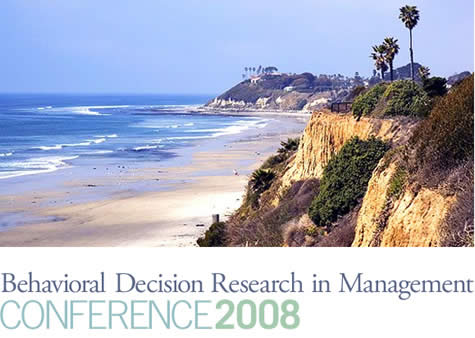
BDRM 2008. April 24-26. UC San Diego. Deadline Jan 18.

Filed in Conferences ,SJDM ,SJDM-Conferences
Subscribe to Decision Science News by Email (one email per week, easy unsubscribe)

THE 2008 BEHAVIORAL DECISION RESEARCH IN MANAGEMENT CONFERENCE

bdrm084.jpg

Decision Science News very much enjoyed the last two BDRMs. The 2008 BDRM conference promises to be very good as well, as it is sponsored by the meteorically rising UCSD Rady School of Businsess, and familiar JDM names are running the show: Dave Schkade, Craig McKenzie, Uri Gneezy, and Alan Schwartz.

Call for Papers

The Decision Research Faculty at UC San Diego’s Rady School of Management invites submissions of papers, symposia, and posters for the 11th biennial conference on Behavioral Decision Research in Management. The conference will be held April 25-26, 2008, at the Rady School of Management’s new building overlooking the Pacific Ocean in La Jolla, California.

We encourage submissions of original research in all areas of behavioral decision research, especially as it applies to management and related disciplines. This includes, but is not limited to, consumer behavior, organizational behavior, negotiation, managerial decision making, behavioral finance, experimental and behavioral economics, decision analysis, behavioral strategy, behavioral operations research, behavioral accounting, and medical and legal decision making.

Paper submissions require 400-word (max) abstracts for review and 100-word abstracts for the program. Poster submissions require 100-word abstracts. Abstracts should be submitted electronically.

The submission deadline is January 18, 2008, with final decisions by late February.

This entry was posted on Tuesday, November 6th, 2007.

Judgment and decision-making types welcome

Filed in Jobs ,SJDM
Subscribe to Decision Science News by Email (one email per week, easy unsubscribe)
JOINT APPOINTMENT IN PSYCH AND PUBLIC POLICY @ PRINCETON

pt

Princeton’s campus is easy on the eyes and Princeton’s psych department is easily among the best. You, dear reader, might be the policy-relevant psychologist they are looking for.

Princeton University’s Department of Psychology anticipates making an appointment at the associate or full professor level. The position will be a joint appointment between the Psychology Department and the Woodrow Wilson School of Public and International Affairs (WWS), as part of an expanding joint venture in psychology and public policy. The candidate will teach some psychology courses and some courses that explore the links between psychology and public policy. Social psychologists with an interest in policy-relevant topics, including health and well-being, and cognitive psychologists specializing in judgment and decision making are invited to apply.

All applicants must have an active research program and demonstrated commitment to teaching and advising at both the graduate and the undergraduate levels. They should also be interested in interacting with neighboring social science disciplines (such as economics or politics).

Applicants should submit a c.v. with a cover letter summarizing their qualifications and names of three senior researchers who would be prepared to write letters on their behalf to: Search Committee SOC/JDM/WWS, Department of Psychology, Princeton University, Green Hall, Princeton, NJ 08540-1010. Applicants should submit materials as soon as possible; the search will remain open until the position is filled. Princeton University is an Equal Opportunity/Affirmative Action Employer. For information about applying to Princeton and how to self-identify, please link to http://web.princeton.edu/sites/dof/ApplicantsInfo.htm

Photo credit: www.flickr.com/photo_zoom.gne?id=1306273779

This entry was posted on Tuesday, September 4th, 2007.

Swing weighting

Filed in Research News ,SJDM
Subscribe to Decision Science News by Email (one email per week, easy unsubscribe)

A NEW MEDICAL DECISION MAKING BLOG

swg

Alan Schwartz of the University of Illinois-Chicago College of Medicine has started a new blog in advance of his forthcoming book “Making Medical Decisions: A Physician’s Guide” by himself and George Bergus (Cambridge University Press, 2008). Visit the blog at Making Medical Decisions.

Today, we quote an example of the quality content you will find there. It’s on swing weighting (see Decision Analysis and Behavioral Research, by Detlov von Winterfeldt and Ward Edwards, for more)

“To use swing weighting with a set of goals and a set of treatment outcomes, you determine from the patient, how each treatment outcome would impact each of their goals.

For example, if a patient has three goals:

  • Live as long as possible
  • Continue working at my job
  • Keep my family financially secure

and is considering three treatments (A, B, and no treatment) with known outcomes, they might perceive the situation to look like this:


Goal 1: Live as long as possible

Goal 2: Be able to keep working

Goal 3: Keep my family financially secure

Treatment A

Best chance for long-term survival, likely live 5+ years

Will be unable to work for some months

Insurance coverage sufficient to pay for procedure, disability and life insurance coverage sufficient to provide for family

Treatment B

May result in living 3-5 years or more

Will be unable to work for some weeks

Insurance coverage sufficient to pay for procedure, disability and life insurance coverage sufficient to provide for family

No treatment

Worst chance, likely to live no more than 2 years

Can immediately resume work until condition worsens

Insurance coverage sufficient to pay for procedure, disability and life insurance coverage sufficient to provide for family

To determine the relative importance of their three goals, we ask which goal could result in the most important swing from worst possible achievement of that goal to best possible achievement. That is, if the patient were the worst possible scenario (no more than two years to live, unable to work for months, and sufficient insurance coverage), which one goal’s outcome would they want to swing to the best possible achievement? Would they prefer to improve their longevity (from “no more than 2 years” to “5+ years”), their ability to work (from “unable to work for months” to “immediately resume work”), or their financial security (from “sufficient coverage” to “sufficient coverage”)? If the patient prefers to swing Goal 1, that is considered her most important goal, and she can then proceed to choose which goal she would next choose to swing, out of those that remain”.

Photo Credit: http://www.flickr.com/photo_zoom.gne?id=1239529607

This entry was posted on Wednesday, August 29th, 2007.

SCP 2008 New Orleans: Deadline Extended

Filed in Conferences ,SJDM-Conferences
Subscribe to Decision Science News by Email (one email per week, easy unsubscribe)

A FEW DAYS LEFT: SCP 2008 NEW ORLEANS DEADLINE EXTENDED

orh

Consumer psychologists and budding consumer psychologists will be happy to know that the deadline for the Society for Consumer Psychology 2008 conference has extended its deadline until Thursday, August 9th, 2007. It’s not much time, but it’s time enough.

Previous Decision Science News post on SCP 2008.

This entry was posted on Monday, August 6th, 2007.

Have a ball in Bale (Suisse)

Filed in Jobs ,SJDM
Subscribe to Decision Science News by Email (one email per week, easy unsubscribe)

DECISION SCIENCE POSTDOC IN BASEL SWITZERLAND

bal

Decision Science News has been to visit the Center for Cognitive and Decision Sciences in Basel and can vouch for it as a center of excellence.

Applications are invited for a postdoctoral research scientist at the Center for Cognitive and Decision Sciences at the Psychology Department of the University of Basel, Switzerland.

The ideal candidate will have completed his/her graduate work in the autumn or by the end of 2007 and will have interest in one or two of the following research areas: behavioral decision making, models of bounded rationality, or risk. Experience in computer modeling is desirable. Applicants may be of any nationality, and the required teaching may be conducted in German or English. The Center for Cognitive and Decision Sciences at the University of Basel is directed by Ralph Hertwig. Please visit our website for more information: http://www.psycho.unibas.ch/cds

The position is available for two to six years at an annual starting salary of 91,664.30 Swiss Francs, with the earliest starting date of October 2007.

To apply, please send a CV, two letters of recommendation, reprints of published papers, and a cover letter describing your research interests and skills. Review of applications will start September 15 and continue until the position is filled.

Electronic applications should be submitted to: Laura Wiles at the Center for Cognitive and Decision Sciences. E-mail: Laura.Wiles at unibas.ch

If you wish to find out more about this opportunity, you may also contact Ralph Hertwig by phone at (+41 61) 267 06 11 or by e-mail at ralph.hertwig at unibas.ch

Decision Science News opts not to put circonflexes in post titles because they mess with RSS feed readers. Photo credit: http://www.flickr.com/photos/ffgoatee/296439978/

This entry was posted on Wednesday, July 25th, 2007.

Waxing on disaster

Filed in Conferences ,SJDM ,SJDM-Conferences
Subscribe to Decision Science News by Email (one email per week, easy unsubscribe)

DISASTERS: RECIPES AND REMEDIES

wh.jpg

A Social Research Conference at The New School for Social Research
November 1 and 2, 2007 www.newschool.edu/disasters

This conference is convened at a time at which we are seriously threatened by an increasing number of disasters of all kinds: those conventionally considered “natural,” like hurricanes and tsunamis, and those normally considered man-made, like pandemics and large-scale bioterrorist attacks. This increasing threat is not only due to urbanization, globalization, coastal development, inadequate infrastructure design, and international hostilities, among other things, but is also a consequence of global warming.

The need for serious reflection on how we can best think about, prepare for, respond to and prevent disasters is urgent. At this conference, leading experts will explore the commonalities of all disasters. They will examine the unequal protection and treatment of populations made vulnerable by their location and or socioeconomic status; the impact of disasters on the economy and overall human development; how hazards develop into disasters; and how design factors either mitigate or amplify their effects.

The two-day conference is organized into 5 sessions:
I. Definitions: What We Talk about When We Talk about Disasters
II. Acquiring Vulnerabilities that Potentiate Disasters
III. Keynote by Nicholas Scoppetta, NYC Fire Commissioner
IV. What “Really” Happens: Preparations and Responses
V. The Impact of Disasters on Human Development

TICKETS
Regular full conference: $50; Regular single session: $12; ACLU members: $35; New School alumni: $15; Other full-time students: $15; Full-time New School students: Free

LOCATION
John L. Tishman Auditorium, The New School, 66 West 12th Street, NYC (between 5th and 6th Ave)

CONTACT
Social Research Conferences, The New School, 65 Fifth Avenue, Room 375, New York, NY 10003, t: 212.229.5776 x3121, f: 212.229.5476, socres@newschool.edu, www.newschool.edu/disasters

Photo Credit: http://www.flickr.com/photos/37996586683@N01/42148248/

This entry was posted on Tuesday, July 17th, 2007.

Ask not what your school of government can do for you

Filed in Jobs ,SJDM
Subscribe to Decision Science News by Email (one email per week, easy unsubscribe)

PROFESSORSHIPS AT HARVARD’S KENNEDY SCHOOL

ksg

The Kennedy School of Government seeks to appoint exceptional scholars to tenure-track positions at the nexus of psychology, public policy and public leadership We especially seek individuals with research interests related to public policy and public leadership from the fields of social psychology, organizational behavior, personality psychology, behavioral decision research, sociology, and/or combinations thereof.

The Kennedy School has growing programs in judgment and decision making, broadly defined, with strength in such topics as emotional influences, negotiations, risk perception, resource allocation, trust, and group perception. For example, the Kennedy School has recently approved a field of interdisciplinary doctoral study in judgment and decision making, which draws primarily on faculty strengths in behavioral economics, organizational behavior, and psychology. The Kennedy School also has a new, state-of-the-art laboratory dedicated to supporting research in these areas. It includes, among other features, capability to collect biological measures as well as behavioral and cognitive measures.

Research and teaching excellence are the highest priorities for the position. Also important is enthusiasm for working in an environment that emphasizes the marriage of discipline-based scholarship and applied, public-policy scholarship. Applicants for the position should also be committed to teaching professionally oriented students, including middle-level and senior executives, in ways that will help them perform well in professional roles.

Interested candidates should mail their applications to Professor Jennifer S. Lerner, Faculty Search Committee, Kennedy School of Government, 79 JFK Street, Cambridge, MA 02138 no later than November 1. Review of applicants will begin as soon as they are received, and early applications are encouraged. Applications should include a current curriculum vita, representative publications, and the names of those who can provide references. Qualified women and members of minority groups are encouraged to apply. Harvard University is an Affirmative Action/Equal opportunity employer.

This entry was posted on Wednesday, July 11th, 2007.

Another open-access journal to look out for

Filed in Research News ,SJDM
Subscribe to Decision Science News by Email (one email per week, easy unsubscribe)

JOURNAL OF CHOICE MODELLING

jcm

Open-access journals all officially the rage. Here’s another newbie, possibly of interest to you, the Decision Science News reader.

We are pleased to announce the launch of the “Journal of Choice Modelling”, a new open access peer reviewed journal dedicated to the field of choice modelling.

The journal publishes theoretical and applied papers in the field of choice modelling. It is not limited to one area of study, such as transport or marketing, but invites contributions from across a range of disciplines where the analysis of choice behaviour is a subject of interest. The journal also seeks to be non-specific in terms of the topics covered, with papers dealing with methodology, data, survey and experimental design all being of equal interest. Similarly, we welcome papers discussing the use of advanced choice modelling techniques in actual real world applications.

The Journal of Choice Modelling is an open access journal. Papers published in the journal can be freely accessed by anyone with an internet connection. This greatly increases visibility, and allows access by academics, practitioners and the general public, without the need for registering or paying access fees. The Journal of Choice Modelling is a web-based journal, with no paper version. This not only greatly reduces costs, but also significantly improves turnaround times.

We are now inviting contributions for the inaugural issues of the Journal of Choice Modelling. We welcome papers discussing any topic related to the study of choice behaviour.”

For detailed information on the journal including a listing of current members of the editorial board and submission guidelines, see: http://www.jocm.org.uk

Recommended reading:

Discrete Choice Methods with Simulation
Stated Choice Methods: Analysis and Applications
Applied Choice Analysis: A Primer

This entry was posted on Wednesday, July 4th, 2007.

Jobs at UCSD

Filed in Jobs ,SJDM
Subscribe to Decision Science News by Email (one email per week, easy unsubscribe)

UNIVERSITY OF CALIFORNIA, SAN DIEGO, HIRING MARKETING PROFESSORS

oh

UCSD’s business school is small but growing fast, and is already home to decision researchers such as On Amir, David Schkade, Uri Gneezy, Craig McKenzie. The Marketing area is hiring. Since Marketing is JDM with teeth, Decision Science News readers may be interested:

The Rady School of Management (http://rady.ucsd.edu/) at the University of California, San Diego (UCSD) invites applications for assistant, associate and full professor positions in marketing. Preference will be given to experienced applicants who have distinguished scholarly records, have demonstrated teaching expertise with graduate students and executives, and are good institution builders. All applicants must have a Ph.D. or will be working towards a Ph.D. by the start date of the new academic year. Associate-level candidates must show evidence of a strong research record in their specialization, while candidates for senior rank must demonstrate a continuing publication record in leading journals. Salary and appointment level are dependent on experience and based on University of California pay scales. The positions are expected to have a start date of July 1, 2008. A detailed vita (PDF or Word document form) will be accepted only by email to radymarketing at ucsd.edu. Please indicate reference job code ACRMKTG on the subject line and state the level of position you are applying for in the cover letter. Review will begin October 1, 2007 and will continue until positions are filled. UCSD is an Affirmative Action/Equal Opportunity Employer with a strong institutional commitment to the achievement of excellence through diversity among its faculty and staff.

For information contact:
Monique M. Tanjuaquio, Academic Personnel Coordinator, radymarketing at ucsd.edu

This entry was posted on Wednesday, June 27th, 2007.