[ View menu ]

SJDM News

Get to know the Society for Medical Decision Making

Filed in Conferences ,SJDM ,SJDM-Conferences
Subscribe to Decision Science News by Email (one email per week, easy unsubscribe)

AN INTRO TO SMDM

smd

This week, Alan Schwartz and Valerie Reyna provide a bit of information to Decision Science News readers, and people familiar with the Society for Judgment and Decision Making (SJDM) about the Society for Medical Decision Making (SMDM).

As a result of strengthening ties between the Society for Judgment and Decision Making and the Society for Medical Decision Making, SJDM members with interests in decisions around health and health care are encouraged to attend (and submit presentations for) the SMDM annual meeting (for 2009, it’ll be at the Renaissance Hollywood Hotel in Hollywood, CA, USA, October 18-21). This “travel guide” highlights some of the differences between the meetings that you should expect.

About SMDM and its meeting
The Society for Medical Decision Making’s mission is to better understand medical decision making, and to improve health outcomes through the advancement of proactive systematic approaches to clinical decision making and policy-formation in health care by providing a scholarly forum that connects and educates researchers, providers, policy-makers, and the public. Its members include physicians, economists, psychologists, decision analysts, and other decision researchers. Its annual meeting is one year older than SJDM. The two societies had about 50 members in common in 2008.

Meeting format – what’s similar?
Like the SJDM meeting, SMDM features poster sessions, concurrent oral presentation sessions with question and answer time, and symposia. There is a presidential address, a keynote address, an awards presentation, and a social event.

Meeting format – what’s different?
Both SMDM and its meeting are somewhat larger than SMDM. A typical SMDM meeting sees about 560 attendees to SJDM’s 490.

SMDM oral presentations are 15 minutes long (including questions), rather than SJDM’s 20 minutes. Presentation sessions are usually chaired by a society member who is not speaking in the session, and is
responsible for timekeeping.

The SMDM symposium differs from the SJDM symposium. In SMDM, a symposium is usually held as the only session in its time slot, and is organized by the symposium chairs for the meeting. Most often, the chairs seek external funding (e.g., from one of the National Institutes of Health) to support a panel of presenters around a focused theme. In this, they resemble panel-based keynotes.

SMDM also offers (at extra cost) an extensive set of half-day and full-day short courses during the day before the meeting. These courses feature instruction by experts in a variety of methodological and content areas and vary in the level of background required; it is common for senior SMDM members to take short courses as students. Although the catalog of short courses for 2009 is already fixed, SJDM members might enjoy developing and teaching a short course at a future meeting; if that interests you, it’s wise to take a course this year to get familiar with the format.

Cultural notes
Like SJDM, SMDM is considered a very friendly meeting, and encourages presentations by students and trainees as well as more senior researchers. The keen observer of scientific cultures will, however, find several intriguing differences between SJDM and SMDM which reflect the different traditions of social science and medical meetings:

SMDM presidential addresses traditionally tackle broad themes about the Society and its role in health care scholarship, policy, and education, unlike the traditionally data-heavy research talks based on the work of the president at SJDM.

SMDM has a higher registration fee ($410 for members and $560 for non-members in 2008) meeting elements are often supported by external funding. The hotels are often more expensive, concurrent oral sessions provide microphones for the audience, and laptops are provided by the hotel for presenters.
When asking a question of a presenter at SMDM, it is customary to go to the microphone, state your name and institution, and, if possible, offer some brief encouraging words about the value of the research before asking the question. You may also hear people begin their question with “I’m confused”, in tribute to founding (and still highly active) SMDM member Steve Pauker, for whom this has become a trademark phrase. The dress code at SMDM is, on average, slightly less casual. The SMDM social event often involves renting out a museum, aquarium, or other artistic or scientifically-oriented institution, and providing a catered reception with opportunities for discussion that conclude considerably earlier than SJDM’s typical post-midnight last round. (There have been notable exceptions, however, such as the 1997 Houston meeting’s rodeo event complete with barbeque and a cow-chip throwing contest). In 2009, to avoid Los Angeles traffic, the social event will take over the upscale bowling alley next door to the hotel.

Key phrases you may hear at the SMDM meeting

Time-tradeoff and standard gamble: Two common methods for assessing the health-related utility for a person in a given state of health. In time-tradeoff, respondents identify the indifference point between living their full life expectancy in an impaired health state and living a shorter life in perfect health. In standard gamble, respondents identify the indifference point between an impaired health state for sure and a gamble with some probability of perfect health, otherwise death.

Quality-adjusted life year (QALY): A common metric for evaluating the impacts of changing health states on health-related utility over a life time. One QALY is one year of life spent in perfect health (or two years spent in a health state assessed as having utility 0.5, etc.)

Cost-effectiveness analysis: A decision analysis which seeks to minimize the ratio between the cost of a strategy (e.g., a treatment program for a disease) and its health benefit (“effectiveness”), typically measured in $/QALY or €/QALY. Conventionally, interventions with ratios lower than $50,000-$100,000/QALY are deemed “cost-effective”.

The International Patient Decision Aid Standards (IPDAS): A developing international set of criteria to determine the quality of patient decision aids, tools that attempt to improve decision quality by helping patients understand complex information and clarify their own preferences.

For more information about SMDM, including its call for papers, visit http://www.smdm.org

In 2009, there is also a special opportunity for three SJDM members to have travel supported to present their work in collaboration with SMDM members. This has a deadline of May 30, 2009; see http://decision.cybermango.org

This entry was posted on Monday, May 18th, 2009.

SPUDM, 23 – 27 August 2009, Rovereto, Italy

Filed in Conferences ,SJDM-Conferences
Subscribe to Decision Science News by Email (one email per week, easy unsubscribe)

SUBJECTIVE PROBABILITY UTILITY AND DECISION MAKING CONFERENCE 2009

rov

Decision Science News will attend the Subjective Probability Utility and Decision Making (SPUDM22) conference, which will be held in Rovereto (Italy) from Sunday, the 23rd till Thursday, the 27th of August 2009.

The deadline for the online submission of abstracts for papers/posters/symposia is April 10, 2009. Visit the conference web site at: http://discof.unitn.it/spudm22/

The organizing committee is pleased to announce that the conference will feature the following invited speakers:
  • Eric Johnson, Columbia University, New York, USA
  • Alan Sanfey, University of Arizona, Arizona, USA
  • Tilmann Betsch, Erfurt University, Germany

The conference will also include a panel discussion on “Automatic and controlled judgment and decision-making” chaired by Cornelia Betstch (Erfurt University, Erfurt, Germany) featuring the invited speakers as well as Ellen Peters (Decision Research, Eugene, USA) and Andreas Gloeckner (Max Planck Institute for Research on Collective Goods, Bonn, Germany) as invited panelists.

See you in Rovereto!

This entry was posted on Monday, March 30th, 2009.

ACR 2009 Pittsburgh Oct 22-25

Filed in Conferences ,SJDM
Subscribe to Decision Science News by Email (one email per week, easy unsubscribe)

ASSOCIATION FOR CONSUMER RESEARCH CONFERENCE, PITTSBURGH, PA, OCT 22-25 2009

Decision Science News will return to the city of its birth for this year’s Association for Consumer Research (ACR) conference. Will you?

What:The Association for Consumer Research Annual North American Conference
When: October 22 – 25, 2009
Where: Westin Convention Center Hotel, Pittsburgh, PA, USA
Submission Deadline: Monday, March 23, 2009 by 5:00 pm (EST)
Call for papers: http://acrwebsite.org/ACR_Call_09_Final_01_15.pdf
Co-chairs: Margaret C. Campbell, University of Colorado; Jeff Inman, University of Pittsburgh; Rik Pieters, Tilburg University

Conference Announcement and Call for Submissions 
(original here

The 2009 North American Conference of the Association for Consumer Research will be held at the Westin Hotel in Pittsburgh, PA from Thursday, October 22 through Sunday, October 25, 2009.

The theme of ACR 2009 is “A World of Knowledge At the Point of Confluence.” Consumer researchers from around the world will meet in the City at the Point, where the Allegheny and the Monongahela rivers flow together to form the Ohio River. International consumer researchers will gather in Pittsburgh to share the ideas and data that converge to create knowledge.

The conference format will follow that of past years. A pre-conference Doctoral Symposium will be held Thursday (co-chaired by Stacy Wood and Dave Wooten). Thursday evening will feature an opening reception for ACR 2009. The conference program on Friday and Saturday will include Competitive Paper sessions, Special sessions, Roundtable discussions, Working Paper sessions, and the Film Festival. A Gala Reception will be held Saturday evening at the Senator Heinz History Center, just two blocks from the Westin.

ACR 2009 will provide a confluence of consumer researchers for scholarly presentations, discussions, networking and collaborations.

Format and Program Structure

The conference will open with a reception on Thursday evening (after the Doctoral Symposium). Sessions will be held on Friday and Saturday.

There are five types of submission for ACR 2009.

1) Competitive Papers represent the completed original work of their authors. The ACR conference co-chairs assign papers to sessions that reflect similar scholarly interests.

2) Special Sessions provide opportunities for focused attention on emerging areas of research. Successful sessions drill deeply into a specific issue using similar theoretical or methodological bases, or they promote a confluence of paradigms, methodologies, or research orientations.

3) Films at the Film Festival sessions provide video insight into consumer topics.

4) Working Papers present preliminary findings from the early stages of a research project. Authors distribute their papers, display posters of their research, and are available to discuss and answer questions during the assigned Working Paper session.

5) Roundtables encourage intensive participant discussion of emerging consumer research topics.

Submission and Decision Deadlines

All submissions (for competitive papers, special sessions, working papers, roundtables, and films) must be received by Monday, March 23, 2009 by 5:00 pm Pittsburgh time (EST). In order to maintain accessibility, please note that each ACR participant may present only twice in Special and/or Competitive paper sessions during the conference. When uploading a submission, authors will need to specify the paper presenter.

Notification of acceptance will be made by Friday, July 24, 2009. Final acceptances will be conditional upon receipt of revised documents and copyright release.

General Submission Requirements and Procedures

All submission activity (submissions, reviews and notifications) for ACR 2009 will be electronic, through the conference website at http://www.acrweb.org/acr/.

When you first enter the conference website you will need to sign up:

– Click on the “Sign up” tab at the top right of the page.

– Provide your information (name, email address, etc.) (Note: this does NOT register you for the conference; details for conference registration will be sent out in July 2009).

– To submit the information, click on the “Log in” button and then choose “Submitting Author” as your role. You will need your email ID and the password that you created for your user profile.

– Click on the “Submit paper/proposal” button.

All submissions to the 2009 ACR Conference website require the following information:

• Submission Type: Competitive Paper, Special Session, Roundtable, Working Paper, Film Festival

• Title of Submission

• Primary Contact Information: name, affiliation, mailing address, phone number and email address for the author who is the primary contact

• Content Area Codes and Methodological Area Codes (These are critical for assigning reviewers – please pick codes that provide the best match to your work).

• Word 2003 or Rich Text Format file to upload (Don’t use Word 2007)

• Names of Other Co-authors/Participants and their affiliations, and whether they are presenting author(s)

Note: All authors need to ensure that their names appear in the same way in all submissions. This is because the database will consider J. Jeffrey Inman, John Jeffrey Inman, and Jeff Inman as three different authors.

Time limit. Please note that the website will time you out after 60 minutes. Therefore, in order to avoid losing information, it is best to copy and paste your information into submission fields rather than composing it online.

Acknowledgement of receipt. The primary contact person will automatically receive an email acknowledgement of receipt of the submission. If you do not receive an acknowledgement, please check your spam folder. If you do not receive an acknowledgement within 48 hours after submission, please send an email inquiry about the status of your submission to: ACR2009@katz.pitt.edu

This entry was posted on Monday, March 16th, 2009.

The summer neuroscience meets decision making

Filed in Research News ,SJDM ,SJDM-Conferences
Subscribe to Decision Science News by Email (one email per week, easy unsubscribe)

SUMMER WORKSHOP ON DECISION NEUROSCIENCE

cf

The University of Michigan’s Ross School of Business and INSEAD will jointly host a Summer Workshop entitled “Decision Neuroscience: How Neuroscience Can Inform Behavioral Decision Making Research – Overview, Methods & Applications”.

The workshop is co-organized by Jim Bettman, Joe Kable, Hilke Plassmann and Carolyn Yoon, and will be held in Ann Arbor, Michigan from August 21-23, 2009.

The aim of the workshop is to provide an introduction to the field of decision neuroscience/neuroeconomics for graduate students interested in neuroscience and behavioral decision making, with a particular focus on those interested in marketing and consumer behavior. The workshop will feature lectures and presentations by top researchers in fields related to decision neuroscience, and will also provide opportunities for networking and discussions among faculty and students.

Applications are due February 23, 2009.

If you’re interested in more information, please see
http://www.bus.umich.edu/Conferences/DecisionNeuroscience

Photo credit: http://flickr.com/photos/jacobkearns/318221213/sizes/m/

This entry was posted on Monday, February 2nd, 2009.

Stand for something political at Stanford

Filed in Conferences ,Programs ,SJDM
Subscribe to Decision Science News by Email (one email per week, easy unsubscribe)

THE 2009 SUMMER INSTITUTE IN POLITICAL PSYCHOLOGY, JULY 12-31, 2009

stan

Those interested in Political Psychology should read Andrew Gelman’s blog postings, and also consider attending this:

Stanford University is very pleased to announce that it will host the 2009 Summer Institute in Political Psychology, continuing an annual tradition that was started by Margaret Hermann at Ohio State University in 1991 and moved to Stanford in 2005.

The Summer Institute will offer 3 weeks of training in political psychology for up to 60 participants, including graduate students, faculty, professionals, and advanced undergraduates. The activities will include lectures by world-class faculty, discussion groups, research/interest group meetings, group projects, and an array of social activities.

Political psychology is an exciting and thriving sub-disciplinary specialty that explores the origins of political behavior and the causes of political events, with a special focus on the psychological mechanisms at work. The principal contributors to the field include political scientists, psychologists, sociologists, psychiatrists, and other researchers who cross bridges between disciplines in efforts to enrich their scholarship.

For detailed information and to apply, visit this website:

http://www.stanford.edu/group/sipp

For the best chance to be admitted, submit your application as soon as possible.

This entry was posted on Wednesday, December 10th, 2008.

Opt-out for charity?

Filed in Conferences ,Encyclopedia ,Profiles ,Research News ,SJDM-Conferences
Subscribe to Decision Science News by Email (one email per week, easy unsubscribe)

DEFAULTS IN BRUSSELS

Last week, Decision Science News spoke at a European Commission conference on “How Can Behavioural Economics Improve Policies Affecting Consumers?“, which was terrifying, as it meant addressing a large room of people with name cards and microphones and simultaneous translators behind glass walls.

The DSN editor tried to emphasize how one must consider the cause of default effects when setting policies that govern which defaults should be prohibited, as discussed in a recent HBR article (Goldstein, Daniel G., Eric J. Johnson, Andreas Herrmann, and Mark Heitmann (2008).
Nudge Your Customers Toward Better Choices. Harvard Business Review, 86(12), 99-105.).

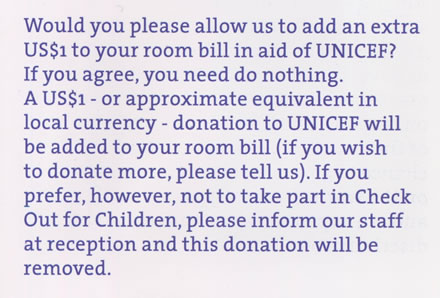
As he was checking into the Sheraton Brussels Airport Hotel, he received a brochure with his key card, stating that unless one opted out, a donation to UNICEF would be added to  the hotel bill.

Would you please allow us to add an extra US $1 to your room bill in aid of UNICEF? If you agree, you need do nothing. A US $1 – or approximate equivalent in local currency – donation to UNICEF will be added to your room bill (if you wish to donate more, please tell us). If you prefer, however, not to take part in Check Out for Children, please inform our staff at reception and this donation will be removed

Since most people would probably not choose to make a charitable donation if asked, and since it inconveniences (and probably shames) people to stop by the reception to opt out, Decision Science News wonders if this is pushing things a bit too far. On the other hand, the program has raised $20 million so far …

This entry was posted on Friday, December 5th, 2008.

JDM @ SPSP Feb 5th, 2009

Filed in Conferences ,SJDM ,SJDM-Conferences
Subscribe to Decision Science News by Email (one email per week, easy unsubscribe)

JDM PRE-CONFERENCE AT SPSP IN TAMPA

The 4th Annual Judgment and Decision Making Pre-Conference at the meeting of the Society for Personality and Social Psychology (SPSP) will be held February 5, 2009 in Tampa, FL.

*Poster deadline has been extended until Monday, December 1st.*  Poster presentation submissions are now being accepted via our website

http://www.socialthinking.org/jdm.html

Ten $200 Student Travel Awards are available to graduate students who are first authors on a poster.

The deadline to register for the conference is January 1st, 2009. For further information, please visit our website: http://www.socialthinking.org/jdm.html

The JDM preconference highlights the emerging nexus of social-personality, judgment, and decision making research. The program consists of invited addresses and a poster session.

Invited Speakers
Gretchen Chapman
Ayelet Fishbach
Chris Hsee
Arie Kruglanski
Rick Larrick
David Schkade
Leaf Van Boven
Kathleen Vohs

This year’s JDM Pre-Conference organizers are happy to field further questions.

Peter McGraw, University of Colorado, Boulder
Rebecca Ratner, University of Maryland
Neal Roese, University of Illinois
Kelly See, New York University

This entry was posted on Monday, November 17th, 2008.

SJDM and Brunswik Conferences Next Week (Nov 2008)

Filed in Conferences ,SJDM ,SJDM-Conferences
Subscribe to Decision Science News by Email (one email per week, easy unsubscribe)

SOCIETY FOR JUDGMENT AND DECISION MAKING (SJDM) AND BRUNSWIK CONFERENCES 2008

It’s not too late to hit the SJDM conference in Chicago (reception Nov 14, conference 15-17th, 2008). If you’re in town early enough (Nov 13-14th, 2008), you may be able to get into the Brunswik Society.

Where:
The Chicago Hilton, Chicago, IL
720 South Michigan Avenue
Tel: 1-312-922-4400

Map

SJDM Conference:
Info
Program

Brunswik Conference:
Info
Program

As usual, Decision Science News will be there, covering all the decision-making action. (Ok, the “talking about decision-making” action).

This entry was posted on Thursday, November 6th, 2008.

Decision Science News subscriptions exhibit upward trend

Filed in Gossip ,SJDM
Subscribe to Decision Science News by Email (one email per week, easy unsubscribe)

DECISION SCIENCE NEWS HEADING TOWARD 1000 SUBSCRIBERS

This 100 day moving average of RSS subscriptions to Decision Science News seems to suggest that readership is up, though one cannot know for sure without conducting elaborate significance tests. The site currently gets 3000 hits per day.

Decision Science News was created  in 2004 as a kind of external memory of conference dates for its editor and a handful of professors and graduate students in the once-obscure field of judgment and decision making, so this is rather unexpected.

“Hits” refers to people visiting the site directly through their browser. RSS subscribers, shown in the graph, refer to the number of people who get the sites’ content delivered by RSS feed reader or by email. If you are not subscribed, you may do so in a couple easy ways.

The first is to copy the link under the big orange icon under the word “SUBSCRIBE” in the right margin and then paste it into an RSS feed reader, such as Google Reader, Bloglines (or Bloglines beta), or Netvibes.

The second is to subscribe by email. Just type your email in the box under the words “Get new posts by email”, also in the right hand margin. Once you fill out the verification form, you’ll receive an email that will allow you to confirm your subscription. (If you don’t get it, check your junk mail folder). As the box promises, you can easily unsubscribe yourself anytime.

This entry was posted on Tuesday, September 30th, 2008.

Gerd Gigerenzer to speak in London, Sept 23rd, 2008

Filed in Conferences ,Profiles ,Research News ,SJDM
Subscribe to Decision Science News by Email (one email per week, easy unsubscribe)

GERD GIGERENZER ON IGNORING INFORMATION FOR BETTER DECISIONS

Who: Gerd Gigerenzer, Director, Max Planck Institute, Berlin
What: The Rationality of Heuristics: Ignoring Information for Better Decisions
Where: Westminster Business School, Hogg Lecture Theatre
When: 17h15-19h

The academic year in London will get off to a stimulating start as one of Psychology’s leading intellectuals, Gerd Gigerenzer, will take the stage on Tuesday September 23rd, 2008 to kick off the Economics of Behavior and Decision Making seminar in London.

Gigerenzer is Director of the Center for Adaptive Behavior and Cognition at the Max Planck Institute for Human Development in Berlin and former Professor of Psychology at the University of Chicago. He won the AAAS Prize for the best article in the behavioral sciences. His book Gut Feelings: The Intelligence of the Unconscious was one of six nominees for the 2008 Royal Society Prizes for Science Books. He is the author of Calculated Risks: How to Know When Numbers Deceive You, the German translation of which won the Scientific Book of the Year Prize in 2002. He has published several other academic books on heuristics including, Simple Heuristics That Make Us Smart (with Peter Todd & The ABC Research Group) and Bounded Rationality: The Adaptive Toolbox (with Reinhard Selten, a Nobel laureate in economics), Heuristics and the Law (Dahlem Workshop Reports) (with Christoph Engel), Rationality for Mortals: How People Cope with Uncertainty (Evolution and Cognition), and Adaptive Thinking: Rationality in the Real World (Evolution and Cognition Series).

ABOUT GIGERENZER:
Gerd Gigerenzer’s CV
Through Analysis, Gut Reaction Gains Credibility, The New York Times.
Smart Heuristics: Gerd Gigerenzer at Edge.org
Gigerenzer’s Books

NEW FACULTY OR GRAD STUDENT IN LONDON? JOIN THE EBDM SEMINAR EMAIL LIST:
To subscribe to the seminar series email list, please visit http://tinyurl.com/yvw2sr to opt in. You can easily unsubscribe anytime. Please pass this message on to those who may be interested in joining the email list.

The full schedule of talks at the Economics of Behaviour and Decision Making seminar series is maintained at http://www.decisionresearchlab.com/ebdm/

This entry was posted on Monday, September 1st, 2008.